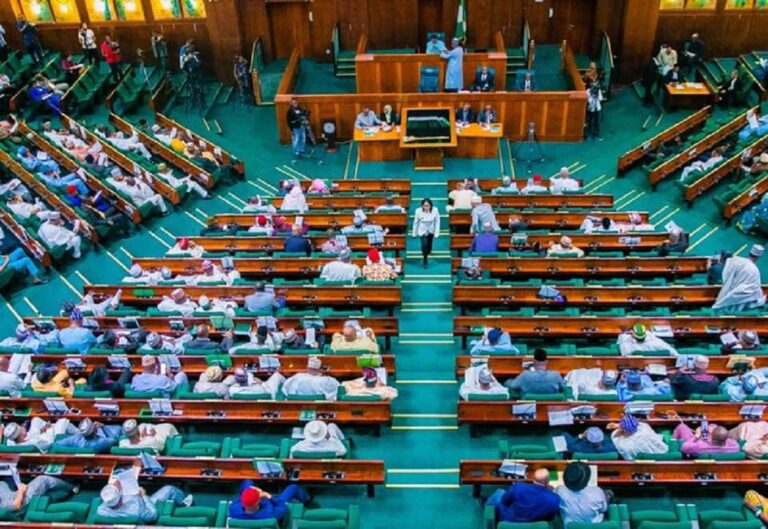

The House of Representatives has approved a major revision of campaign finance limits, raising the maximum amount presidential candidates can spend from ₦5 billion to ₦10 billion, while increasing the ceiling for governorship candidates from ₦1 billion to ₦3 billion.
The decision followed the passage of the Electoral Act (Amendment) Bill 2025 after clause-by-clause consideration of a report by the House Committee on Electoral Matters, chaired by Adebayo Balogun.
Lawmakers also approved provisions mandating the real-time electronic transmission of election results by the Independent National Electoral Commission, INEC.
Under the amended Clause 93(2), spending limits for National Assembly candidates were significantly increased.
Senators are now permitted to spend up to ₦500 million, up from ₦100 million, while candidates for the House of Representatives can spend up to ₦250 million, compared to the previous ₦70 million.
For state constituencies, the ceiling was raised from ₦30 million to ₦100 million.
Chairmanship candidates can now spend up to ₦60 million, up from ₦30 million, while councillorship candidates’ limits increased from ₦5 million to ₦10 million.
The House also approved a provision capping individual or corporate donations at ₦500 million per candidate.
Reacting to the development, political scientist Prof. Gbade Ojo said the rising cost of politics has fundamentally altered Nigeria’s democratic space, warning that it increasingly excludes ordinary citizens.
According to him, the new limits reinforce a system dominated by wealth, shutting out competent and experienced professionals who lack the financial capacity to compete.
He questioned INEC’s ability to effectively monitor campaign spending, arguing that the absence of reliable tracking mechanisms makes enforcement difficult.
Ojo also warned that widening gaps between registered voters and actual voter turnout point to growing public disengagement, adding that higher campaign spending could further entrench vote buying and undermine electoral credibility.
Similarly, Dr Edun Abdulkareem, Head of the Department of Political Science at the University of Ilorin, described the trend as dangerous, saying it promotes a culture where public office is treated as an investment to be recouped once power is attained.
He cautioned that this could deepen corruption, marginalise communities, and turn democracy into the preserve of a few.
Beyond campaign finance, the House approved amendments mandating INEC to transmit election results electronically and in real time to the IReV portal.
The new Clause 60(3) requires presiding officers to upload results after the prescribed EC8A forms are signed and stamped at polling units.
Lawmakers also strengthened the legal backing for the use of the Bimodal Voter Accreditation System, BVAS, making it the primary accreditation tool.
Where BVAS fails and no replacement is deployed, the election in the affected polling unit will be cancelled and rescheduled within 24 hours if the outcome substantially affects the final result.
The House further approved tougher sanctions for vote buying and selling, introducing a minimum of two years’ imprisonment or a ₦5 million fine, or both, alongside a 10-year ban from contesting elections.
Penalties for multiple voter registration were increased, while presiding officers who deliberately breach procedures on counting, announcement, or transmission of results now face heavier fines or jail terms.
Lawmakers also approved early release of election funds to INEC at least one year before general elections, extended deadlines for submission of candidates’ lists from 180 to 210 days, and permitted the use of electronically generated voter identification, including downloadable voter cards with QR codes.
However, the House rejected a proposal seeking to criminalise inducement of delegates during party primaries, congresses, and conventions.
Lawmakers expressed concerns that the provision could be misused and opted to delete it entirely from the bill.
Civil society groups, including the Civil Society Legislative Advocacy Centre, welcomed the amendments, particularly the mandatory electronic transmission of results.
CISLAC’s Executive Director, Auwal Musa Rafsanjani, described the move as a major step toward restoring transparency and public confidence in elections, though analysts cautioned that challenges such as poor network infrastructure could affect implementation.
The House Committee on Electoral Matters explained that proposals on early voting, inmate voting, changes to election timelines, and replacement of Permanent Voter Cards were dropped due to lack of broad consensus among lawmakers and stakeholders.
The committee said the amendments were designed to strengthen the existing Electoral Act 2022 without destabilising the legal framework.
According to the committee, the approved changes reflect a balance between reform ambitions and legislative consensus, with the aim of improving transparency, accountability, and the integrity of Nigeria’s electoral process.