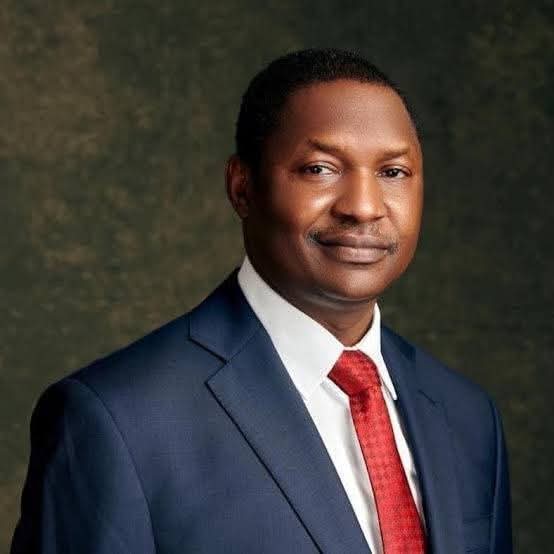

Malami,
The Chairman of the Economic and Financial Crimes Commission, Ola Olukoyede, has said the corruption investigation involving former Attorney General of the Federation, Abubakar Malami, did not originate under his leadership.
Olukoyede made the clarification during an interview on Channels Television, where he responded to allegations that the probe was politically motivated.
According to him, the investigation into Malami commenced more than two years before he assumed office as EFCC chairman and had been handled in line with due process, without personal or political bias.
He disclosed that Malami was arraigned at the Federal High Court in Abuja in December 2025 on charges bordering on alleged money laundering.
The former justice minister was charged alongside his son, Abubakar Abdulaziz Malami, and his wife, Bashir Asabe, on a 16-count charge. All three defendants pleaded not guilty to the charges.
Malami had earlier alleged that his investigation and detention were politically motivated following his defection to the African Democratic Congress.
He also called on Olukoyede to recuse himself from the case, citing claims that the EFCC chairman was indicted by the Justice Ayo Salami judicial commission of inquiry.
Dismissing the allegations, Olukoyede insisted that the probe had no political undertone, stressing that the investigation file was opened under a previous EFCC administration.
He said his responsibility was to ensure that the investigation was conducted thoroughly and professionally, adding that the anti-corruption fight must be devoid of partisanship if the country is to make progress.
“There is nothing personal in this matter,” Olukoyede said, noting that Malami had been under investigation for about two and a half years.
He explained that since assuming office, he had carefully reviewed and pursued the case to establish the alleged offences, emphasising that the process was guided strictly by law.
Responding to claims that he was indicted by the Justice Ayo Salami panel, Olukoyede challenged those making the allegation to make the report public for Nigerians to judge, reiterating that there was no persecution or personal vendetta involved in the case.