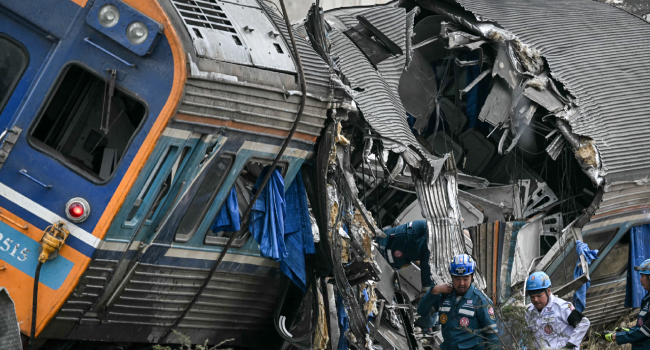

At least 32 people have been killed after a construction crane collapsed onto a moving passenger train in northeastern Thailand, causing the train to derail, authorities confirmed on Wednesday.
The incident occurred in Nakhon Ratchasima province at a construction site linked to a China-backed high-speed rail project.
Footage verified by AFP showed the massive crane’s shattered structure resting on concrete pillars above the wreckage, with smoke billowing from the derailed train below.
Rescue teams were deployed to extract passengers trapped inside the tilted carriages as emergency responders worked through the debris.
A witness, Mitr Intrpanya, said he heard a loud crashing sound followed by two explosions before rushing to the scene.
According to him, the crane struck the middle of the train’s second carriage, slicing it in half as it collapsed onto three passenger coaches.
Thailand’s health ministry reported that 32 people died in the crash, three others were missing, while 64 passengers were hospitalised, including seven in critical condition.
The train was travelling from Bangkok to Ubon Ratchathani province and had 195 passengers on board at the time of the accident, Transport Minister Phiphat Ratchakitprakarn said. Authorities are still working to identify the victims.
The crane collapse occurred at a construction site forming part of a more than five-billion-dollar high-speed rail project designed to link Bangkok with Kunming in China via Laos by 2028, under Beijing’s Belt and Road Initiative.
An engineering consultant on the project, Theerachote Rujiviphat, told AFP that Italian-Thai Development, the Thai construction firm contracted to build the affected section, was solely responsible for the crane involved in the accident.
He added that the launching crane belonged to the same company and noted that a similar incident had previously occurred under its supervision.
A spokesperson for Italian-Thai Development said the company could not immediately respond to questions regarding the collapse.
Thai Prime Minister Anutin Charnvirakul called for a full investigation into the incident, stressing that those responsible must be held accountable.
He noted that construction-related accidents were recurring and suggested tougher laws, including blacklisting firms repeatedly linked to fatal incidents.
Italian-Thai Development and its director were among those indicted in August over a separate case involving the collapse of a Bangkok high-rise during an earthquake, which killed about 90 people, most of them construction workers.
China’s foreign ministry said it was reviewing the incident and expressed condolences to the victims’ families, adding that the section under construction appeared to be handled by a Thai company.
Rescue efforts were briefly suspended due to reports of chemical leakage at the site before operations resumed, according to local police.
Thailand’s rail network spans about 5,000 kilometres, though decades of underinvestment have made rail travel less popular than road transport.
When completed, the 600-kilometre high-speed rail line will allow Chinese-built trains to travel from Bangkok to Nong Khai at speeds of up to 250 kilometres per hour.
Industrial and construction accidents remain common in Thailand, where weak enforcement of safety regulations has often resulted in deadly incidents.