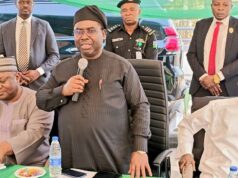

The National Publicity Secretary of the Julius Abure–led faction of the Labour Party, Obiora Ifoh, has accused the party’s former presidential candidate, Peter Obi, of acting in an undemocratic manner after the 2023 general election, following his recent defection to the African Democratic Congress.
Speaking in an interview, Ifoh dismissed claims that the Labour Party regretted presenting Obi as its presidential candidate, saying the party initially believed he met its ideological and leadership standards.
“At the time, we considered him suitable because he appeared to understand social democracy, equal opportunity and justice, which form the core of our ideology,” he said.
However, Ifoh noted that the party’s relationship with Obi deteriorated after the election, accusing him of attempting to impose undemocratic processes on the party’s leadership.
“What we later saw was not what we expected. He wanted us to take actions that were clearly undemocratic, and that was where the problem started,” he said.
He alleged that rather than rally party members after the election and court cases to build on the more than six million votes recorded in 2023, Obi sought the removal of the party’s elected executives.
“After the elections and court processes, we expected him to lead a post-election review, appreciate party leaders who campaigned across the country and bring everyone together. Instead, he demanded that our executive step down, even though we were duly elected and he supported the convention that produced us,” Ifoh said.
According to him, Obi allegedly mobilised loyal members of the National Assembly and the Abia State governor to forcefully remove the party leadership, contrary to the provisions of the party’s constitution.
Ifoh rejected allegations that the rift between Obi and the party stemmed from financial demands, insisting that Obi neither funded the party nor its campaign.
“No one ever asked Obi for money. During the campaign, he funded his own operations and did not give the party anything. He did not donate a vehicle, a bicycle or any financial support,” he said.
He explained that the Labour Party relied largely on proceeds from the sale of nomination forms and pro bono legal services to fund its campaigns and court cases.
“Thirty per cent of our forms were sold, while 70 per cent were given out. With what little we earned, we ran the party, funded campaigns and handled legal battles. Nobody has enriched himself in this process,” he said.
On the spate of lawsuits involving the party, Ifoh said Obi’s loyalists instituted multiple court cases after setting up a parallel leadership structure in Abia State in September 2024, claiming the party’s tenure had expired.
He described the move as ironic, noting that the same individuals had organised and endorsed the convention that returned Abure and his team to office.
Ifoh also accused the Independent National Electoral Commission of interfering in internal party affairs by refusing to upload Labour Party candidates for the FCT Area Council elections, despite court orders in favour of the Abure-led leadership.
On whether internal divisions influenced Obi’s decision to defect to the ADC, Ifoh said Obi had a long history of moving between political parties, contrary to his earlier public claims.
“He moved from PDP to APGA, back to PDP, then to the Labour Party, and now to ADC. Despite promising never to leave the Labour Party, he has done so,” he said.
He added that Obi preferred aligning with former governors and senators, whom the party had deliberately avoided in favour of youth-driven and reform-oriented leadership.
“These are the same people he once campaigned against. We told him our movement was not about men of yesterday who looted Nigeria,” he said.
Ifoh argued that the Labour Party’s 2023 performance was not solely dependent on Obi’s popularity, noting that the party existed and had elected officials before his emergence.
“Obi’s presence boosted our visibility, no doubt. But we handed over too much of the party’s structure to him, and that mistake has taught us important lessons,” he said.
On the Obidient movement, Ifoh described its members as loyal primarily to Obi rather than the Labour Party, claiming many of them never formally registered as party members.
“They were a support group for Obi, not for the party. Many of them caused internal crises, spread falsehoods and lacked grassroots electoral strength,” he said.
He concluded that the Labour Party was better positioned without internal conflict, stressing that Nigeria’s political future should not be tied to one individual.
“It is not about one man. One man cannot make a forest. The Labour Party has moved on, and we wish Obi well wherever he goes,” Ifoh said.