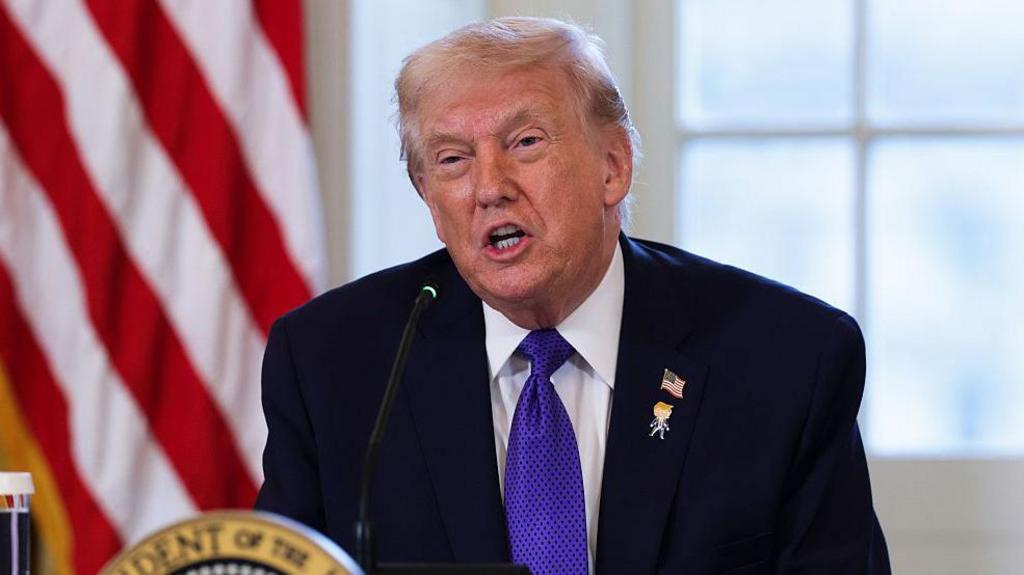

US President Donald Trump has announced plans to impose a 10% tariff on goods imported from the United Kingdom, Denmark, and other European countries starting February 1, citing Greenland as the reason.
The tariffs, announced via Truth Social, are to remain in place “until such time as a deal is reached for the complete and total purchase of Greenland.”
The announcement came as a surprise, injecting urgency into the ongoing debate over Greenland, a self-governing territory under Danish control.
The move has drawn sharp reactions from European leaders and raised concerns about international trade relations.
UK opposition leader Kemi Badenoch criticized the decision on social media, calling it a “terrible idea” and warning that it would raise costs for both UK and US consumers.
She stressed that Greenland’s sovereignty should be decided by its people.
Earlier, the Speaker of the United States House of Representatives, Mike Johnson, emphasized that the US intends to resolve the matter through diplomatic channels, noting that the appointment of a Greenland envoy shows a non-military approach.
The announcement follows widespread protests in Greenland’s capital, Nuuk, and Copenhagen, where demonstrators held placards stating “Greenland not for sale” and “Hands off Greenland.”
Analysts note that Trump’s tariffs escalate tensions over Greenland just days after US and Danish officials had agreed to form a working group, which some had hoped would ease the dispute.
Tariffs are taxes on imported goods, usually calculated as a percentage of the product’s value. For example, a 10% tariff on a $10 product adds $1, which may be passed on to consumers.
Trump defended his stance on Truth Social, claiming that the US has subsidized Denmark and the EU for years by not charging tariffs.
He said it is “time for Denmark to give back” and warned that Greenland faces a “potentially perilous situation,” citing competition from China and other foreign powers.