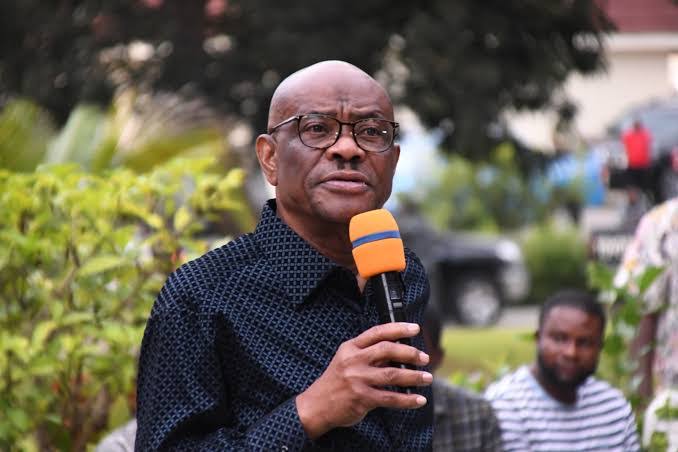

The Minister of the Federal Capital Territory, Nyesom Wike, has declared that President Bola Tinubu’s re-election in 2027 will not depend on the support of any sitting governor in Rivers State, insisting that the political machinery required for victory is already firmly in place.
Wike made the assertion on Saturday in Port Harcourt during the commissioning of the Rivers State Renewed Hope Ambassadors’ headquarters, a facility that includes Majority FM 89.5, a situation room, office spaces, and operational vehicles.
According to him, the structure backing Tinubu cuts across party lines and includes lawmakers at the national and state levels, local government chairmen, and influential political leaders from both the APC and PDP.
“We don’t need a governor to mobilise for Mr President. We have all it takes to stand on our own. Senators, National Assembly members, assembly members, council chairmen, and party leaders are already aligned,” Wike said.
Reflecting on the 2023 elections, the former Rivers State governor noted that his political camp acted independently and remained satisfied with the outcome, stressing that continued support for Tinubu in 2027 was non-negotiable.
He reiterated his long-standing stance on Rivers’ political direction, describing the state as firmly committed to the President’s second-term ambition and asserting that mobilisation structures had been established across all 23 local government areas.
Wike also commended the Coordinator of the Renewed Hope Ambassadors in Rivers State, Desmond Akawor, for what he described as effective grassroots mobilisation and organisational strength.
He urged members of the group to deepen their presence at the community level and maintain the momentum ahead of the next general election, emphasising that their commitment must be demonstrated through action rather than rhetoric.
In his remarks, Akawor praised Wike’s leadership and disclosed that coordinators had been appointed in every local government area of the state.
He described the minister’s political strategy as a distinctive model, which he termed AI politics, driven by structure, coordination, and grassroots engagement.