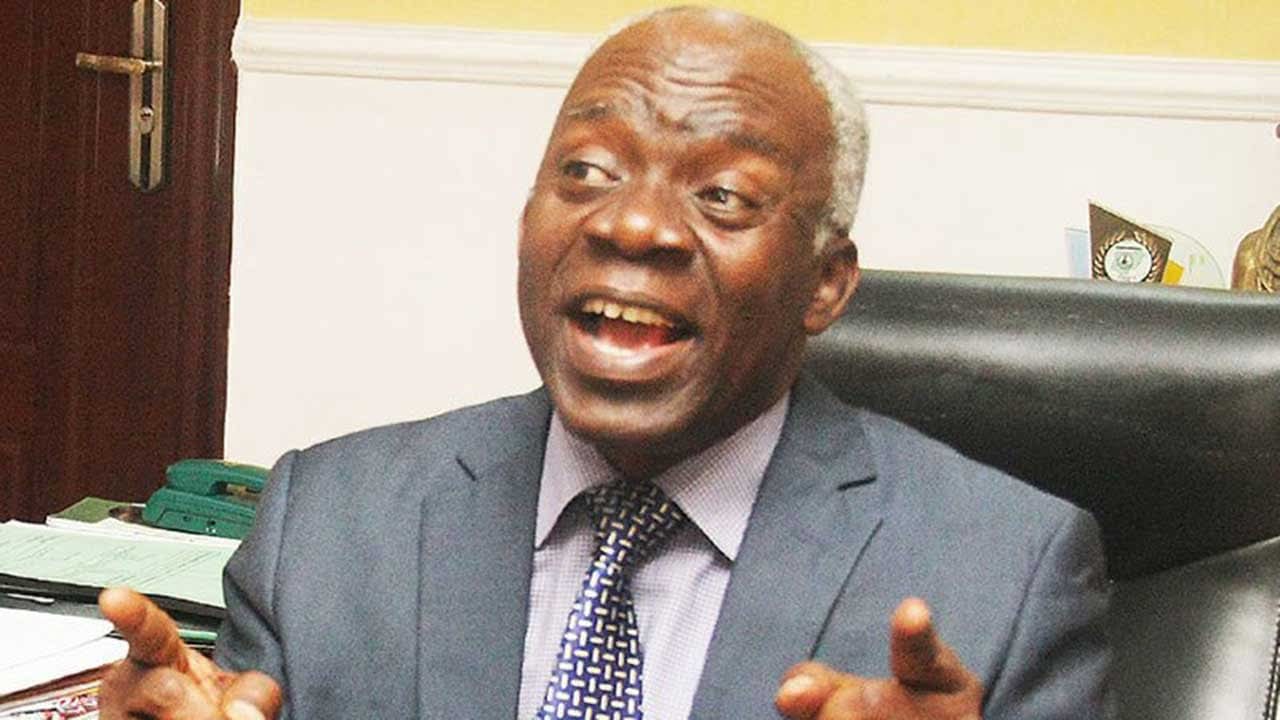

Senior Advocate of Nigeria, Femi Falana, has called on the Attorney-General of the Federation and Minister of Justice, Lateef Fagbemi, to halt the ongoing court martial proceedings against 36 military officers accused of plotting a coup, describing the charges as unconstitutional.
In a statement issued to the media, Falana urged the Attorney-General to invoke his constitutional powers under Section 174 to discontinue the case before the General Court Martial and instead arraign the accused officers before the Federal High Court.
“I am compelled to call on the Attorney-General of the Federation to terminate the illegal charge before the General Court Martial. Thereafter, the accused officers should be charged before the Federal High Court,” Falana stated.
He argued that prosecuting the officers in a military tribunal violates Section 251 of the Constitution, which vests exclusive jurisdiction over offences such as treason and treasonable felony in the Federal High Court.
Falana further faulted the disparity in the handling of related cases, noting that while some suspects are being tried in civilian courts, others are being subjected to military proceedings for the same alleged offences.
“Given the constitutional guarantee of equality before the law, trying some suspects in the Federal High Court and others before a court martial for identical offences is unjustifiable,” he said.
The legal practitioner also maintained that a General Court Martial lacks the authority to adjudicate on charges bordering on terrorism, treason, or treasonable felony under Nigeria’s current democratic framework.
Drawing from history, Falana pointed out that even during military rule, alleged coup plotters were not tried by court martials but by special tribunals established under specific decrees.
He cited instances from 1976, 1990, and 1995 to support his position.
According to him, with the abolition of such decrees following Nigeria’s return to democratic governance in 1999, only constitutionally recognized courts, particularly the Federal High Court, retain the jurisdiction to try such grave offences.
Falana’s intervention adds a significant legal dimension to the ongoing prosecution of the alleged coup plotters, raising broader questions about constitutional compliance, due process, and the appropriate forum for trying serious national security offences.