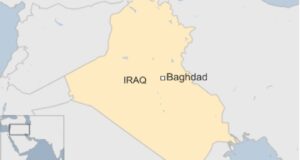

At least 20 members of Iraq’s Hashed al-Shaabi, also known as the Popular Mobilisation Forces (PMF), were killed on Wednesday after coordinated airstrikes by the United States and Saudi Arabia targeted Iran-backed armed groups in Iraq, further escalating tensions across the Middle East.
According to the PMF, the strikes also left 32 others wounded.
Two senior officials of the alliance disclosed that five Iranian military advisers were among those killed in an attack on Diyala Province in central Iraq.
Washington and Riyadh said the operation was carried out in retaliation for recent attacks on US military personnel and Saudi oil installations, which they attributed to Iran-backed militias operating from Iraqi territory.
The PMF, a powerful paramilitary alliance formed in 2014 to combat the Islamic State group before being integrated into Iraq’s armed forces, includes several brigades aligned with Iran.
Some of its factions have frequently acted independently and have been linked to attacks on US interests in the region.
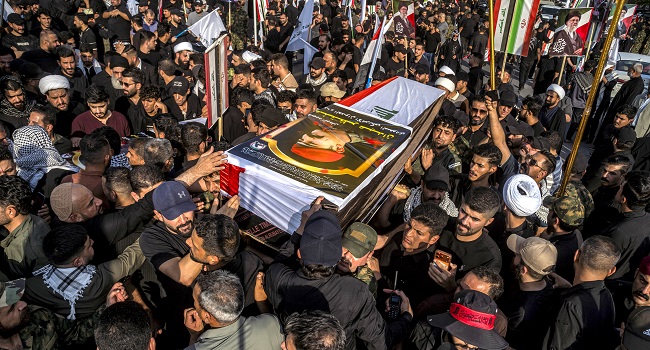
Funeral ceremonies for the victims were held in Baghdad, where mourners carried coffins draped in Iranian flags, underscoring the presence of Iranian nationals among those killed.
US President Donald Trump said the military operation was coordinated with the Iraqi government.
The strikes come amid increasing pressure from Washington on Baghdad to dismantle or disarm pro-Iran armed groups that have repeatedly targeted US facilities and demanded the withdrawal of American troops from Iraq.
Iraq’s Prime Minister, Ali al-Zaidi, who assumed office earlier this year, has pledged to bring all armed groups under state control and ensure they surrender their weapons.
However, his administration has faced stiff resistance from influential militia factions despite backing from the United States.
The latest military action followed claims by Saudi Arabia that it intercepted drones targeting critical oil infrastructure, blaming Iran-backed militias based in Iraq.
However, the armed groups have denied responsibility for the attacks.
The Islamic Resistance in Iraq, an umbrella coalition of pro-Iran factions, condemned the airstrikes and warned that retaliation against what it described as the “American enemy” was inevitable.
The group also suggested that Saudi Arabia could become a target but said any response would be delayed until after the Arbaeen pilgrimage, one of the holiest events in the Shia Muslim calendar.
The Iraqi government strongly condemned the strikes, describing them as a violation of the country’s sovereignty.
In a statement, the Ministerial Council for National Security said Baghdad rejects all acts of aggression regardless of the justification and reaffirmed its commitment to preventing Iraqi territory from being used to threaten neighboring countries.
The council also reiterated the government’s determination to ensure that only the state controls the use of arms.
Authorities have given armed groups designated as terrorist organizations by Washington until September 30 to disarm.
The latest escalation highlights Iraq’s continued struggle to balance its relationships with both the United States and Iran while preventing the country from becoming the focal point of a wider regional conflict.