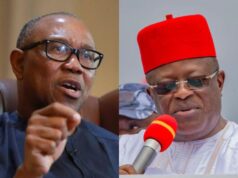

With the October 24 deadline for reporting alleged omissions from the 2027 governorship candidates’ list fast approaching, former Minister of Communications and Digital Economy, Isa Ali Pantami; former Ogun State governorship candidate, Oladipupo Adebutu; and Nigeria Democratic Congress (NDC) chieftain Aminu Gwarzo face an uncertain battle to secure their places on the ballot.
The Peoples Democratic Party (PDP) and the NDC have challenged the exclusion of their preferred candidates and threatened legal action against the Independent National Electoral Commission (INEC) if the disputes remain unresolved.
However, efforts by the affected parties to engage the electoral commission have yet to yield a definitive resolution, leaving the candidates with limited time to establish that their exclusion was unlawful.
INEC, in a clarification issued on October 13, gave political parties until October 24 to notify it of alleged omissions from the final governorship candidates’ list published on October 10.
The commission said the deadline was consistent with Section 32(2) of the Electoral Act, 2026, which provides a 14-day period for parties to report candidates they believe were wrongly excluded.
But meeting the deadline may not automatically secure the candidates’ return to the ballot.
Their chances will depend on the circumstances surrounding their exclusion, the evidence of compliance with electoral requirements and the applicable legal provisions.
Pantami’s PDP ticket faces fresh uncertainty
Pantami’s political ambition in Gombe State has been thrown into uncertainty despite his emergence as the PDP’s governorship candidate following a court-ordered rerun of the party’s primary on September 29.
His name appeared on INEC’s provisional candidates’ list published on August 29 but was missing from the final list released in October.
The development has raised questions about the status of the PDP ticket and whether the omission can be corrected within the statutory framework.
The party’s national publicity secretary, Mohammed Jungudo, was reported to have said that the PDP and Pantami’s legal team had contacted INEC over the matter.
Pantami’s lawyers also reportedly wrote to the commission seeking clarification and a resolution.
However, the party has indicated that its efforts have yet to produce a breakthrough and that it may pursue legal remedies if the dispute is not resolved.
Adebutu battles exclusion in Ogun
In Ogun State, Adebutu and his running mate, Kolapo-Sowunmi, were also missing from INEC’s final governorship candidates’ list.
Their exclusion has raised concerns about the PDP’s ability to participate in the contest with its preferred ticket.
The Ogun PDP has maintained that Adebutu complied with the party’s membership-registration requirements and accused the ruling All Progressives Congress (APC) of exerting pressure on INEC.
The commission’s stated position, however, centres on compliance with statutory requirements governing the submission of political parties’ membership registers.
The dispute therefore extends beyond the validity of the party’s primary election to whether the PDP satisfied the requirements necessary to sponsor candidates.
The NDC is confronting a similar challenge in Kano State, where Gwarzo and his running mate, Mustapha Rabiu Kwankwaso, were reportedly omitted from the final list.
The party’s Kano State chairman, Hussaini Mairiga, has maintained that the relevant candidate details were duly submitted to INEC, suggesting that an administrative mix-up may have been responsible for their absence.
The NDC’s national publicity secretary, Osa Director, also said the party had written to the commission and received acknowledgements but was yet to obtain a substantive response.
According to him, the party would pursue lawful remedies if the omission was not addressed.
The NDC’s immediate challenge is to establish that the required documents were submitted in accordance with the law and that the exclusion resulted from an error that INEC can legally correct.
At the centre of the controversy is the Supreme Court’s September 24 judgment in INEC v. Zenith Labour Party, Appeal No. SC/CV/495/2026.
The judgment restored the operation of Sections 77(5), 77(6) and 77(7) of the Electoral Act, 2026, which regulate political parties’ membership registers and their submission to the electoral commission.
Under the provisions, parties were required to submit their membership registers within the period prescribed by INEC’s timetable, which ran from April 21 to May 10, 2026.
The Supreme Court upheld the statutory requirements and the consequences of non-compliance, including a party’s ineligibility to field candidates where the relevant legal conditions are met.
INEC has said it applied the judgment in preparing the final governorship candidates’ list, citing Section 287(1) of the 1999 Constitution, as amended, which requires authorities to give effect to judicial decisions.
The commission also explained that the presidential and National Assembly candidates’ lists were published on September 12, before the Supreme Court delivered its judgment, while the final governorship list was released afterwards.
The timing has placed the governorship candidates at the centre of the controversy.
Nevertheless, the judgment’s existence does not, by itself, establish that every disputed omission was correctly handled.
The circumstances of each affected party must be examined against the court’s decision and the applicable provisions of the Electoral Act.
Winning a primary may not be enough
A critical issue in the disputes is the distinction between an individual candidate’s qualifications and the eligibility of the political party sponsoring that candidate.
A candidate may have emerged successfully from a party primary, but that achievement may not resolve a separate question about whether the sponsoring party complied with the statutory requirements governing membership registers.
Conversely, where a party can demonstrate that it fulfilled the relevant obligations and that its candidate was wrongly omitted, it may have grounds to seek a correction, subject to the applicable law and procedure.
This distinction makes the candidates’ cases more complicated than a straightforward demand for the restoration of their names.
The affected parties must do more than express dissatisfaction with INEC’s decision.
They need to provide evidence supporting their claims and demonstrate why the commission’s action should be reversed.
October 24 deadline raises the stakes
As the deadline approaches, the PDP’s prospects in Gombe and Ogun and the NDC’s position in Kano remain uncertain.
The exclusion of the candidates could have significant political implications for their respective parties, particularly as preparations for the 2027 governorship elections gather momentum.
However, political considerations alone cannot determine whether the exclusions are lawful or whether the candidates should be reinstated.
The October 24 deadline provides an opportunity for the affected parties to formally notify INEC of their complaints.
It does not guarantee that the commission will reverse its decisions or that subsequent legal challenges will succeed.
If the disputes remain unresolved, litigation could follow, with the outcome depending on the facts of each case, the legal arguments presented and compliance with relevant procedural requirements.
For Pantami, Adebutu and Gwarzo, the immediate task is to establish that their exclusion was unlawful and legally capable of correction.
Whether through administrative intervention or the courts, their political future now depends on the evidence they can present and the remedies available under electoral law.
As the deadline draws closer, the central question remains whether the affected parties can demonstrate that INEC wrongly excluded their candidates and secure a lawful path back to the ballot.