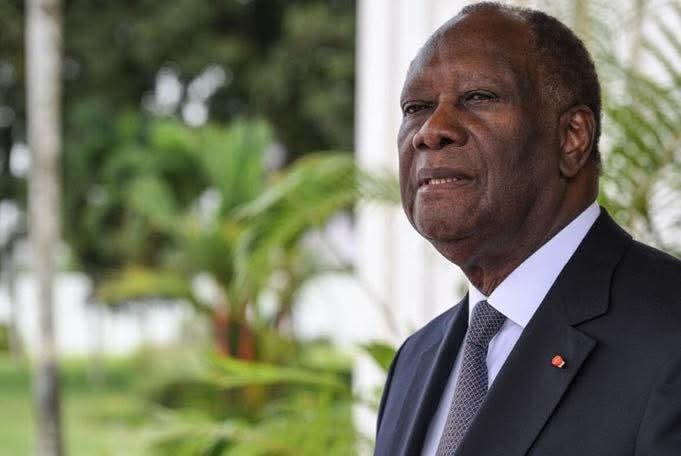

Ivory Coast’s President, Alassane Ouattara, has secured a fourth term in office, capturing a decisive 89.77 percent of the vote in an election from which his two main rivals were barred, the country’s electoral commission announced on Monday.
Nearly nine million voters were eligible to participate in Saturday’s election in the world’s leading cocoa producer, a nation that has largely remained resilient against coups and jihadist attacks affecting much of West Africa.
Tensions, however, ran high ahead of the polls, and deadly clashes were reported in the days leading up to the election.
Despite this, Ouattara was widely expected to win. Early tallies released on Sunday suggested he was leading with more than 90 percent of the votes.
Voter turnout approached 100 percent in his northern strongholds, while he also led in traditionally pro-opposition areas in the south and parts of Abidjan, the economic hub, where polling stations were largely empty.
Entrepreneur Jean-Louis Billon finished second with just 3.09 percent of the vote, according to commission president Ibrahime Kuibiert Coulibaly, who announced an overall turnout of 50.10 percent, similar to the 2020 election, when Ouattara won 94 percent amid a boycott by major opponents.
This year, Ouattara’s key rivals, former president Laurent Gbagbo and ex-Credit Suisse CEO Tidjane Thiam, were barred from running.
Gbagbo was disqualified due to a criminal conviction, while Thiam was ineligible because of his French nationality.
“Their absence, calls to boycott the election, and the tense pre-election climate foretold low participation in some regions,” said William Assanvo, a researcher at the Institute for Security Studies (ISS).
In Gagnoa, Gbagbo’s former stronghold, Ouattara claimed 92 percent of votes, but turnout was only 20 percent.
The opposition has already rejected the results, declaring Ouattara’s victory illegitimate and calling for fresh elections.
Political analyst Geoffroy Kouao observed that the turnout highlighted two realities: “Supporters of Ouattara turned out in force, while supporters of Gbagbo and Thiam largely stayed away from the polls.”
Billon also acknowledged the low turnout in certain areas but congratulated Ouattara on his victory.
Other candidates on the ballot, including former first lady Simone Ehivet Gbagbo, had little chance of advancing to a second round due to limited party support and financial resources.
Ahead of the vote, calls for protests by the opposition triggered violence, leaving at least eight people dead and nearly two dozen injured across around 200 polling stations.
Authorities imposed nighttime curfews in several areas and deployed 44,000 security personnel nationwide.
Presidential elections in Ivory Coast have historically been marked by tension and unrest.
Ouattara first assumed power following the 2010–2011 post-election crisis against Laurent Gbagbo, which resulted in over 3,000 deaths.
On Monday, normalcy returned to Abidjan, after the capital remained unusually quiet over the weekend.
Pro-Ouattara newspaper Patriote praised the vote as “a calm election,” while opposition daily Notre Voie described it as “an election reflecting a divided country.”