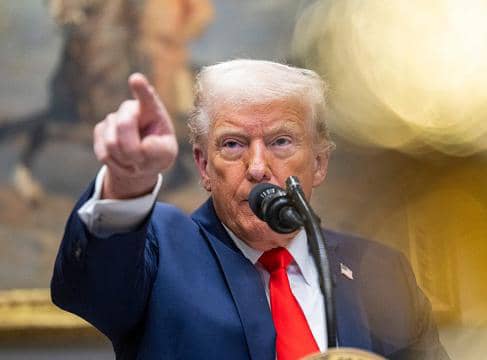

United States President Donald Trump has announced a partial travel restriction on Nigeria as part of a broader set of immigration and security measures targeting several countries.
The decision was contained in a proclamation titled Restricting and Limiting the Entry of Foreign Nationals to Protect the Security of the United States, signed by Trump and published on the White House website on Tuesday.
The measures are scheduled to take effect in January 2026.
According to the proclamation, the restriction was imposed after a review conducted by the US Secretary of State in consultation with the Attorney General, the Secretary of Homeland Security and the Director of National Intelligence.
The review assessed whether existing entry suspensions under Proclamation 10949 of June 4, 2025, should be continued, modified or expanded in the interest of US national security.
Following the review, Trump said the United States would partially restrict and limit the entry of nationals from 15 countries, including Nigeria, Angola, Antigua and Barbuda, Benin, Côte d’Ivoire, Dominica, Gabon, The Gambia, Malawi, Mauritania, Senegal, Tanzania, Tonga, Zambia and Zimbabwe.
The restrictions apply to both immigrants and non-immigrants.
The White House cited security concerns and challenges associated with screening and vetting travellers from the affected countries.
Trump specifically referenced insecurity in Nigeria, claiming that extremist groups such as Boko Haram and the Islamic State operate freely in parts of the country, making effective vetting difficult.
Under the new policy, entry into the United States by Nigerians as immigrants, as well as non-immigrants on B-1, B-2, B-1/B-2, F, M and J visas, has been suspended.
The proclamation also directs US consular officers to reduce the validity of other non-immigrant visas issued to Nigerians to the extent permitted by law.
The US president cited visa overstay data to justify the decision, stating that Nigeria recorded a B-1/B-2 overstay rate of 5.56 per cent, while the overstay rate for F, M and J visas stood at 11.90 per cent.
The announcement comes amid broader rhetoric by Trump targeting African-origin immigrants.
In recent weeks, he has used harsh language to describe immigrants from parts of Africa and the Caribbean, while expressing preference for migrants from countries such as Norway and Sweden.
Nigeria is among several African and Black-majority Caribbean nations affected by the partial restrictions, while other countries remain under a full US travel ban.
These include Afghanistan, Chad, Republic of the Congo, Equatorial Guinea, Eritrea, Haiti, Iran, Libya, Myanmar, Sudan and Yemen.
Trump also expanded the full travel ban earlier in the week to include seven additional countries, alongside Palestinian Authority passport holders, citing threats to US security and concerns about individuals who may seek to undermine American institutions and values.
The White House said the restrictions would remain under review, noting that some countries initially targeted had made progress in addressing US concerns.
Turkmenistan, for instance, was removed from the full ban list but remains subject to limits affecting immigrant visas.
The latest measures have sparked renewed debate over US immigration policy and its impact on African nations, particularly long-standing partners such as Nigeria, Senegal and Zambia.