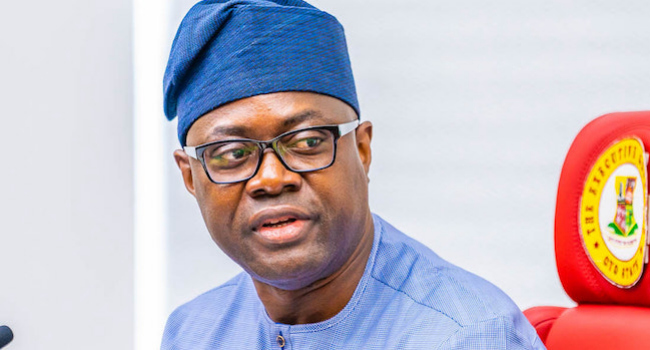

Oyo State Governor, Seyi Makinde, has warned that Nigeria’s political class may be caught off guard in the 2027 general elections, insisting that hunger, anger and deepening public frustration will play a decisive role in shaping voter behaviour.
Speaking during an extensive interaction with select media professionals in Ibadan, Makinde said political defections by governors and elites do not reflect the true mood of the electorate, stressing that ordinary Nigerians are increasingly disconnected from elite political calculations.
According to him, “People talk about governors defecting, but what about hunger? What about anger in the land? Those things have not defected. Nigerians will shock politicians and elites in 2027 in ways we cannot yet imagine.”
The governor used the session to showcase his administration’s achievements under the Omituntun agenda, outline his economic philosophy, and speak candidly on national politics, the crisis in the Peoples Democratic Party (PDP), governance under President Bola Ahmed Tinubu, and the future of Nigeria’s democracy.
On governance in Oyo State, Makinde said his government has deliberately shifted focus from dependence on federal allocations to expanding the state’s productive base through infrastructure, agribusiness, solid minerals and tourism.
He explained that the N892 billion 2026 budget, tagged “Budget of Economic Expansion,” is anchored on realistic revenue projections, improved investment inflows and disciplined budget performance.
“Our FAAC averages about N19 to N20 billion monthly, while IGR is roughly N8 billion. But beyond that, we have investments and capital receipts. We don’t just do projects that don’t make economic sense. Infrastructure must drive growth,” he said.
Makinde noted that Oyo State has maintained a budget performance of about 70 to 75 per cent over the past six years and has avoided introducing new taxes, opting instead to broaden the tax net by stimulating economic activity.
On social impact, he said regular payment of salaries by the 25th of every month injects about N33 billion into the state’s economy every four weeks, benefitting traders, artisans and small businesses.
He added that the state’s SAFER programme focuses on subsidising productivity rather than distributing handouts.
“We don’t give people money to sit at home. We subsidise transportation, support productive efforts and create opportunities for people to lift themselves out of poverty,” he said.
Addressing the controversial Ibadan circular road project, Makinde said the initiative predates his administration and is designed to support long-term industrial and commercial development.
He insisted that affected residents are being compensated, including those without formal land documents, in order to minimise hardship.
On national politics, Makinde expressed concern over what he described as Nigeria’s gradual drift toward a one-party state, warning that such a development could threaten democratic stability.
“Nigeria was negotiated on federalism and multi-party democracy. If you move this country towards a one-party state, it won’t work. When people don’t have leadership choices, they will find leaders by all means, and the consequences can be severe,” he warned.
The governor admitted regretting his role in supporting President Tinubu during the 2023 election, saying expectations of a government of national unity and competence have not been met.
“I supported the President believing Nigeria would be reset with competence and inclusiveness. That has not happened. I regret that decision,” he said.
Makinde also shed light on the deepening crisis within the PDP, blaming it on internal betrayal and attempts to weaken the opposition.
He insisted that the party’s convention held in Ibadan was valid and that internal party matters should not be manipulated to undermine democracy.
On speculation about a possible presidential ambition in 2027, Makinde said he is qualified to lead Nigeria but stressed that personal ambition is secondary to the survival of democracy.
“At this point, individual ambition is tertiary. What matters is creating a competitive political environment so democracy can survive,” he said.
He added that governance must rise above partisanship, noting that his administration has continued to work with the Federal Government where necessary, including securing approvals for infrastructure projects such as the upgrade of the Ibadan airport and repairs of federal roads.
On security, Makinde credited cooperation between federal agencies and the state-backed Amotekun corps for Oyo State’s relative stability, while urging the Federal Government to rethink its strategy beyond kinetic measures.
As he approaches the final phase of his second term, Makinde said his priority is building institutions that will outlive his administration, rather than personal legacy projects.
“We don’t want to be remembered just for roads. We want to be remembered for institutions that guarantee good governance long after we leave office,” he said.