
By Dr. Malachy Chuma Ochie,
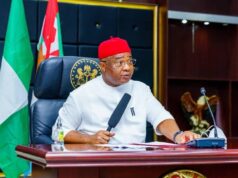
In an era when governance is often assessed by the immediacy of political gains rather than the durability of social investments, the administration of Governor Peter Ndubuisi Mbah of Enugu State stands out for its deliberate and future-oriented focus on children.
By placing child welfare and education at the very heart of governance, Governor Mbah has made a compelling statement to the effect that the true measure of leadership lies not in applause today, but in the quality of tomorrow it prepares.
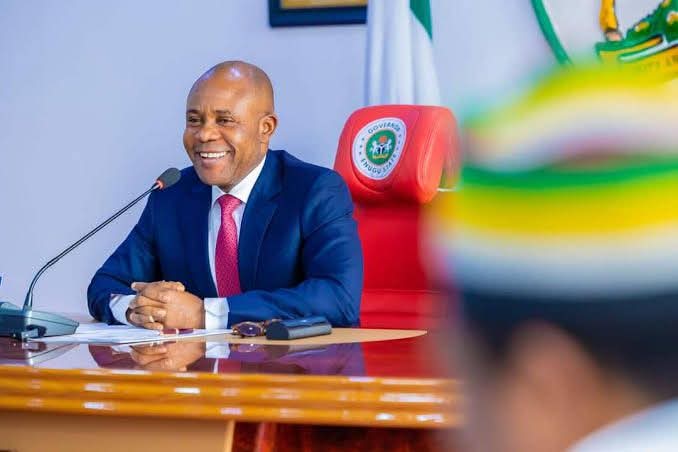
This philosophy was vividly articulated when the governor recently received members of the Enugu State Children’s Parliament at the Government House.
Addressing the children, led by their Speaker, Miss Chimamanda Amobi, Governor Mbah did not merely offer ceremonial platitudes.
Instead, he reaffirmed a governing vision anchored on the conviction that children represent the “hopes, dreams, and future” of Enugu State. His oft-repeated governance mantra, Tomorrow is Here, was given concrete meaning as he described children themselves as the living embodiment of that tomorrow that is visible, tangible, and central to every policy choice his administration makes.
Perhaps the most striking evidence of this commitment is the scale and consistency of financial investment in education.
Governor Mbah’s administration has devoted over 30 per cent of the state’s budgets in 2024, 2025, and 2026 to education.
This is an extraordinary allocation by any standard, and a bold departure from the chronic underfunding that has long plagued Nigeria’s education sector.
This sustained investment underscores his belief that any society that neglects the education and welfare of its children has already compromised its future.
At the core of this educational revolution is the construction of 260 Smart Green Schools across the State.
Conceived not merely as school buildings but as integrated centres of learning, innovation, and care, these schools reflect a holistic understanding of child development.
Beyond conventional classrooms, the Smart Green Schools are equipped with facilities for robotics, artificial intelligence, mechatronics, virtual and augmented reality, ICT hubs, and e-libraries.
The intention is clear and that is to prepare Enugu children for the demands of a rapidly evolving global economy and ensure that they can compete confidently with their peers anywhere in the world.
Yet, Governor Mbah’s vision of education transcends technological sophistication. It recognises that effective learning cannot occur in the absence of good health and proper nutrition.
Each Smart Green School includes a clinic where a child’s health and immunization status is profiled upon admission as early as age three, with mechanisms to regularize missed vaccinations.
In addition, the provision of one nutritious meal daily addresses the persistent challenge of malnutrition, ensuring that no child’s learning potential is undermined by hunger or poor health.
Equally significant is the administration’s decision to provide 12 years of completely free education, which has exceeded UNESCO’s recommended nine years.
From school uniforms and writing materials to daily meals, education in Enugu State is being treated not as a privilege or political favour, but as an inalienable right of every child.
In doing so, the Mbah administration has removed many of the economic barriers that traditionally keep children, especially from vulnerable backgrounds, out of school.
Complementing these investments in education is a firm and unequivocal stance on child protection.
Governor Mbah has repeatedly emphasised his administration’s zero tolerance for all forms of child abuse, including child marriage, sexual exploitation, trafficking, and child labour.
His revelation that the government recently halted the marriage of an underage girl, and intends to prosecute the parents, sends a strong message that Enugu State will not sacrifice the rights and dignity of children on the altar of cultural excuses or social complacency.
This approach affirms that child welfare is not negotiable and that the state will act decisively to protect its most vulnerable citizens.
Importantly, the governor has also underscored the moral dimension of child development.
While equipping children with cutting-edge skills, he urged them to imbibe values traditionally associated with Enugu people such as fairness, honesty, humility, and the fear of God.
This balance between technical competence and moral grounding reflects an understanding that sustainable development requires not just skilled hands, but upright hearts.
The appreciation expressed by the Speaker of the Children’s Parliament, Miss Chimamanda Amobi, further validates the child-centred nature of the administration.
Her commendation of initiatives such as the Smart Green Schools, free daily meals, stronger educational policies, the establishment of a Disability Commission, and the training of auxiliary social workers for child protection highlights a governance framework that is both inclusive and empathetic.
The presence of UNICEF representatives at the event also signals alignment with global best practices in child rights and development.
In prioritising child welfare and education, Governor Peter Mbah has chosen the long, demanding path of sustainable development over the short-term comforts of populism.
The full dividends of his investments may only become evident years after his tenure, but that is precisely what makes the vision profound. By building policies around children, his administration is laying the foundation for a prosperous, decent, and globally competitive Enugu State.
Ultimately, Gov. Mbah’s approach reminds us that governance is not just about managing the present, but about courageously shaping the future.
And in Enugu State, that future is being deliberately, thoughtfully, and unapologetically built around its children.