
The views expressed in this article are solely those of Dr. S. N. Chukwu and do not represent the views of the DAILY GAZETTE.
History rarely announces itself quietly. It arrives at moments when a people must decide whether progress will be built on appearance or anchored on substance.
Today, Enugu State stands at exactly such a moment.
Against the backdrop of a staggering ₦1.62 trillion state budget and ambitious projections of transforming Enugu into a $30 billion economy, citizens are beginning to confront an uncomfortable question: Is rapid development replacing responsible governance?
Across communities, concerns are mounting over the durability and transparency of flagship projects celebrated as symbols of modern governance.
Structural failures reported in some Smart School projects following routine weather conditions have ignited public debate – not merely about construction standards, but about priorities.
For many observers, the issue is no longer infrastructure. It is credibility.
Political analysts describe the current situation as a widening gap between developmental propaganda and institutional reality.
Massive spending announcements dominate headlines, yet citizens increasingly demand evidence that governance is guided by long-term planning rather than political speed.
Enugu, long regarded as Nigeria’s intellectual capital, now faces a defining dilemma: Should leadership be measured by projections – or by proven competence?
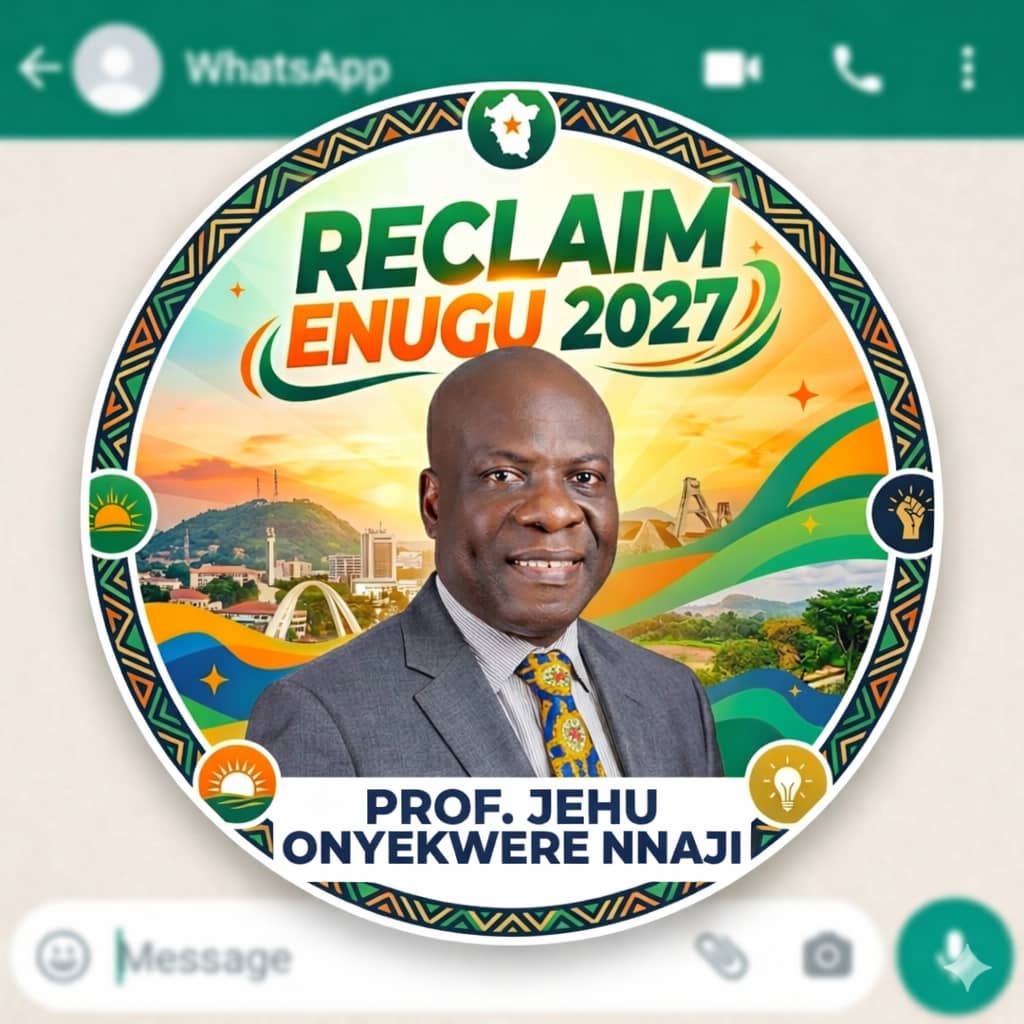
It is within this atmosphere that Prof. Jehu Onyekwere Nnaji has emerged as a compelling alternative.
Unlike the traditional political archetype, Prof. Nnaji enters the conversation not as a career politician, but as a globally respected Professor of International Law whose academic and institutional engagements span Europe and the United States.
Supporters describe him as the embodiment of disciplined governance – a leader shaped by law, systems, and accountability rather than political theatrics.
At a time when public trust appears strained, Prof. Nnaji’s message is strikingly simple: government must first work before it can impress.
His governance philosophy emphasizes restoring abandoned economic assets, strengthening institutional processes, and ensuring that public projects are built to endure not merely to attract headlines.
Perhaps the greatest infrastructure deficit confronting Enugu today is not roads or schools, but trust.
Questions surrounding transparency, procurement practices, and equitable distribution of state resources have intensified calls for leadership rooted firmly in the Rule of Law.
Observers argue that Prof. Nnaji’s international legal background uniquely positions him to rebuild governance credibility – introducing global standards into local administration while preserving community-centered development.
As political permutations toward 2027 gather momentum, the coming election is shaping into more than a contest of candidates. It is rapidly becoming a referendum on leadership philosophy.
Will Enugu continue on a path driven by grand projections and accelerated political optics?
Or will Ndi Enugu entrust their future to intellectual depth, institutional discipline, and measured development?
Increasingly, a growing chorus across professional, youth, and civic groups is echoing one message:
Enugu deserves its best. And our best must represent us.
In Prof. Jehu Onyekwere Nnaji, many believe the state has found a leader capable of matching Enugu’s historic reputation with governance worthy of its future.
The question now is no longer whether change is necessary — but whether Ndi Enugu are ready to choose excellence above mediocre, Prof. Jehu Onyekwere Nnaji is the man.
Dr. S. N Chukwu
For Enugu State Young Intellectual