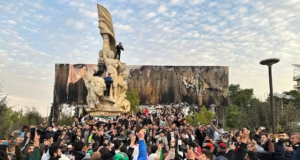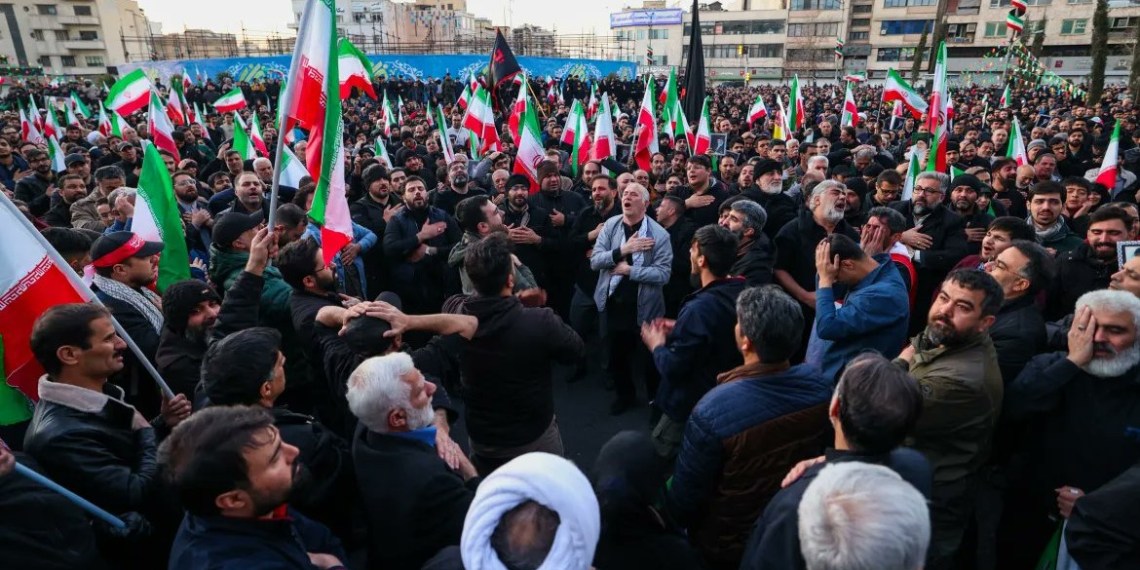

On Sunday morning, thousands of people gathered at the Enghelab (Revolution) Square, waving Iranian flags and holding photos of Mr Khameini.
Thousands of mourners assembled in Tehran on Sunday following the killing of Iran’s Supreme Leader, Ali Khamenei, in coordinated missile strikes carried out by the United States and Israel.
Iranian authorities confirmed his death in the early hours of Sunday, a day after the large-scale attacks on Tehran.
By morning, Enghelab (Revolution) Square in the Iranian capital was filled with grieving citizens. Many held Iranian flags and portraits of Mr Khamenei, while most dressed in black in a show of mourning, according to media reports.
Before Tehran formally announced his death, US President Donald Trump had declared that the 86-year-old cleric was killed in the strikes, describing him as “one of the most evil people in history.”
However, back in the United States, the president is facing growing backlash. Critics argue that Mr Trump initiated the war without Congressional approval and contrary to the wishes of many Americans.
Protests have erupted in several US cities, including Washington, D.C. and New York City. In New York, Mayor Zoran Mamdani has been reported to be leading demonstrators opposing the conflict.
Mr Trump has defended the military action, insisting that Iran posed a significant threat to US national security.
While most Republican lawmakers have backed the president’s decision, opposition voices continue to question the legality and timing of the strikes.
In response to Mr Khamenei’s death, Iran’s Revolutionary Guard Corps vowed retaliation and launched dozens of strikes targeting Israel and US interests across the Middle East.
Mr Trump has warned Tehran against further escalation.
Several nations, including Nigeria, have called for restraint and urged all parties to pursue dialogue in order to prevent the conflict from spiralling further.
Following the death of the Supreme Leader, Iranian state media announced that a three-member council will temporarily govern the country during the transition period.
The council comprises President Masoud Pezeshkian, judiciary chief Gholamhossein Mohseni Ejei, and a representative of the Guardian Council.
The body will oversee state affairs until the Assembly of Experts — an 88-member clerical institution — convenes to nominate a new Supreme Leader.