Home Blog Page 196

Nnamdi Kanu Transferred From DSS Custody To Sokoto Prison
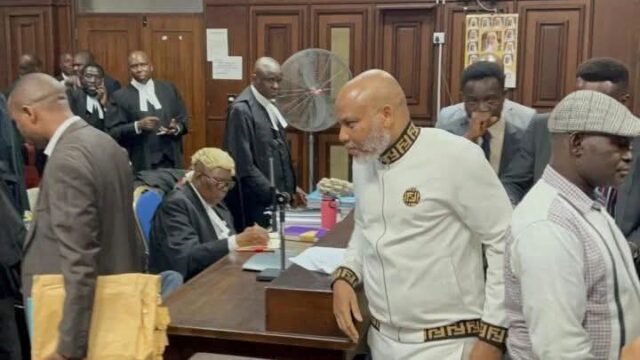
 

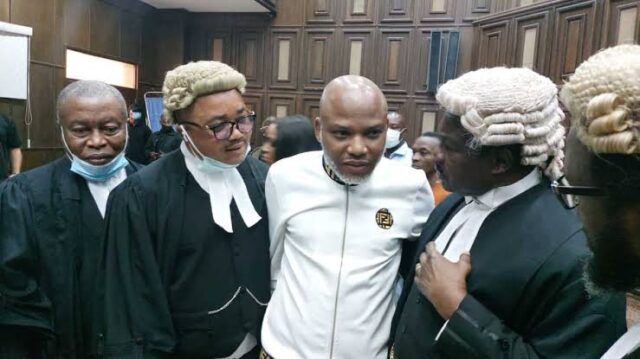
Aloy Ejimakor, legal counsel to Indigenous People of Biafra (IPOB) leader Nnamdi Kanu, has confirmed that Kanu has been moved from the Department of State Services (DSS) detention in Abuja to a correctional facility in Sokoto following his life sentence.

“MAZI NNAMDI KANU has just been transferred from DSS Abuja to a correctional facility in Sokoto, far from his lawyers, family, and well-wishers,” Ejimakor stated on X.

Kanu was sentenced by Justice James Omotosho of the Federal High Court in Abuja on Thursday after being found guilty on terrorism charges.

He received a life sentence for counts one, four, five, and six of the seven-count charge. Additionally, he was sentenced to 20 years and five years on counts three and seven, respectively.

In delivering judgment, Justice Omotosho ruled that the prosecution had proven all allegations against Kanu.

He noted that the IPOB leader provided no credible defense and “deliberately refused” to challenge the evidence presented.

Describing Kanu as “a person who cannot be allowed to remain in the company of sane minds” and labeling him an “international terrorist,” the judge explained that Kanu’s violent behavior during the trial made him unsuitable for Kuje Prison.

He emphasized that Kanu must be held in protective custody, and any use of electronic devices would require supervision by the Office of the National Security Adviser (ONSA).

Justice Omotosho further ordered the forfeiture of items retrieved from Kanu, including a smuggled transmitter, to the federal government.


Google search engine

Omotosho’s Judgment Is Illegal, Will Not Survive Appeal – Kanu’s Wife


Uchechi Okwu-Kanu, wife of Indigenous People of Biafra (IPOB) leader Nnamdi Kanu, has strongly condemned her husband’s life imprisonment sentence, calling it illegal, biased, and a miscarriage of justice.

In a statement shared on social media, Uchechi accused Justice James Omotosho of the Federal High Court in Abuja of ignoring constitutional safeguards, inventing evidence, and deliberately blocking Kanu’s right to a fair hearing.

Kanu was sentenced to life imprisonment for declaring a “sit-at-home” order in the South-East, which the court claimed was enforced through threats and violence.

The court also imposed concurrent sentences of 20 and five years on additional counts. Justice Omotosho, citing international concerns over capital punishment, opted against the death penalty.

Uchechi criticized the trial for multiple procedural breaches, stating that the charges were based on the now-repealed Terrorism Act of 2013 rather than the 2022 Act.

She said, “The judge knew the old law was dead but forced Kanu to plead under it. Charging someone under a law that no longer exists is illegal and void.”

She further accused the judge of inventing evidence, claiming allegations about Kanu plotting to bomb the British and US embassies during EndSARS were fabricated, with no witness ever testifying to such claims in court.

Uchechi also condemned the misuse of the “savings clause,” emphasizing that a repealed law cannot override the Constitution.

She highlighted the court’s failure to address international law requirements, noting there was no evidence, report, or witness from Kenya to substantiate claims of crimes allegedly committed there.

Concluding her statement, she said, “The judge didn’t follow the law, the Constitution, or due process.

“He used a dead law, invented evidence, blocked the defendant’s right to speak, and delivered a judgment that cannot stand.”

The verdict is illegal and will not survive appeal. It exposes the judge to disciplinary action.”

Google search engine

Kanu’s Life Sentence A Major Injustice Against Ndigbo – MASSOB


The Movement for the Actualisation of the Sovereign State of Biafra (MASSOB) has described the life imprisonment sentence handed down to Indigenous People of Biafra (IPOB) leader, Mazi Nnamdi Kanu, as unacceptable, arguing it amounts to a life sentence for the entire Igbo race.

MASSOB leader, Uchenna Madu, said the ruling would not weaken the Biafra struggle. He criticized the judgment, asserting it was driven by personal vendetta rather than justice.

“President Bola Ahmed Tinubu has set Nigeria on irredeemable fire,” Madu said.

“The court’s ruling was not justice but vengeance from a man fueled by pathological hatred against Ndigbo, using Nnamdi Kanu as a target.”

He added, “Nnamdi Kanu was sentenced for words spoken from abroad, after being illegally abducted from Kenya, in defiance of a United Nations ruling demanding his release, and prosecuted under a law that no longer exists. Meanwhile, Mamman Nur, responsible for over 2,000 deaths as Boko Haram’s co-founder, received only five years.”

Madu said the sentence illustrates the government’s “lawless and totalitarian nature,” noting that Kanu’s real offense was exposing the threat of radical Islamic jihad in Nigeria and the government’s complicity.

MASSOB highlighted that Kanu’s seizure in Kenya in 2021 was not an extradition but an illegal rendition.

They cited the Kenyan High Court ruling by Justice Anthony Mrima in June 2025, which condemned the abduction as a violation of Kanu’s fundamental rights.

The group also referenced the United Nations Working Group on Arbitrary Detention’s opinions in 2022 and 2025, which deemed Kanu’s detention arbitrary and called for his immediate release.

MASSOB emphasized that the United States has never listed IPOB as a terrorist organization.

They further stressed that Kanu was tried under a repealed anti-terror law with no savings clause, concluding that this injustice is not only against Kanu but against the Igbo people as a whole.

Google search engine

Kanu: Omotosho Ignored Key Constitutional Issues, Based Ruling On Repealed Law, Set A Dangerous Precedent – HURIWA


The Human Rights Writers Association of Nigeria (HURIWA) has strongly criticised the ruling delivered by Justice James Omotosho of the Federal High Court, Abuja, against the detained IPOB leader, Nnamdi Kanu, describing the judgment as a severe miscarriage of justice.

In a statement issued by its National Coordinator, Comrade Emmanuel Onwubiko, the group condemned the verdict as a “travesty of justice” and an affront to the constitutional right to fair hearing.

HURIWA argued that the judgment failed to consider major legal and constitutional concerns raised by Kanu, especially his position that he was being tried under a repealed counter-terrorism law.

According to the group, “The judgment reflects judicial haste and injustice, and the court should have suspended its decision until the Court of Appeal resolved outstanding jurisdictional and procedural disputes.”

The organisation questioned why Justice Omotosho appeared determined to speed up the ruling despite pending appeals on the legality of the charges.

It emphasised that Kanu had repeatedly informed the court that the Terrorism Prevention Act 2013, under which he was being tried, was no longer in force.

HURIWA maintained that the charge sheet did not meet constitutional requirements.

“The charge sheet does not disclose any existing written law as required under Section 36(12) of the Constitution, which vitiates the entire trial,” the group said.

It accused the court of overlooking the prosecution’s reliance on what it described as a non-existent statute, insisting that no criminal trial can proceed on the basis of an inoperative law.

“Nothing in Nigerian jurisprudence allows a criminal trial to stand when the charge is based on an inoperative statute,” the rights group added.

The organisation also faulted the court’s interpretation of Kanu’s refusal to enter a defence.

It said Kanu’s position, that the court must first determine jurisdictional objections and the legality of the charges, is consistent with established principles of criminal procedure.

They said the judge’s claim that Kanu deliberately refused to defend himself was “disingenuous and misleading.”

HURIWA further highlighted concerns over alleged violations of Section 36 of the Constitution, which protects the right to fair hearing.

The group emphasised that jurisdictional issues and constitutional objections must always be resolved before trial.

It added that urgent matters such as extraordinary rendition, and pending appeals on the competence of the charges, were ignored.

“In extraordinary circumstances like this, judicial restraint is required, not speed,” the statement noted, stressing that the judgment is fundamentally flawed because of its failure to address crucial constitutional questions.

HURIWA called on the National Judicial Council (NJC) to review the conduct of the trial and urged the Court of Appeal to overturn the ruling, describing it as a decision that “offends both the law and the conscience of the nation.”

Google search engine

FG Moves To Stop Use Of Honorary Doctorate Titles Amid Claims Of N50m Payments


The Federal Government has announced decisive measures to curb the growing misuse of honorary doctorate degrees in Nigeria, following reports that some recipients allegedly pay up to N50 million to obtain the titles.

Speaking in Abuja on Friday during the presentation of the Committee Report on the Misuse of Honorary Doctorate Degrees, the Executive Secretary of the National Universities Commission (NUC), Prof. Abdullahi Ribadu, raised alarm over the increasing number of illegal and unaccredited institutions operating as honorary degree mills.

Ribadu criticised universities that disregard the Keffi Declaration of 2012, which prohibits awarding honorary degrees to serving political office holders.

He disclosed that 32 institutions have now become “factories” for producing such degrees, many of which are not recognised by law.

He warned that any university found guilty of violating guidelines will face sanctions, adding that the NUC will work with the National Assembly to establish a stronger legal framework to prosecute offenders.

According to him, the practice of conferring honorary titles on politicians or individuals able to offer large sums of money is an abuse of the academic system.

He said:
“To the extent that there are people who even buy, give the university N20 million, N30 million, N40 million, N50 million, get honorary doctorate degree, and they go about branding themselves as doctors, comparing themselves to people who have worked tirelessly to earn a PhD.”

He added that the Keffi Declaration also cautions against recipients using the title ‘Dr’ without stating clearly that it is honorary, stressing that doing otherwise constitutes false representation and is punishable under existing fraud-related laws.

According to Ribadu, this trend “undermines the hard work of scholars and diminishes public trust” in the education sector.

The investigative report identified:

  • 10 unaccredited foreign universities
  • 4 unlicensed local universities
  • 15 professional bodies without degree-awarding powers
  • 3 other non-degree-awarding institutions

all involved in producing unearned honorary degrees. Ribadu said the list may not even be exhaustive and revealed that some institutions have gone as far as awarding fake professorships.

He emphasized that only approved and accredited universities, public or private, have the legal authority to confer honorary doctorate degrees in Nigeria.

Earlier, the committee chairman, Prof. Kabiru Bala, noted that only 27 out of over 312 universities submitted reports in response to the NUC’s inquiry.

He said the committee was set up in September following numerous petitions from citizens concerned about the widespread abuse of honorary titles.

The report recommended that the NUC enforce uniform standards for awarding honorary degrees nationwide.

The development comes just five months after Ghana banned the public use of honorary academic titles.

In June, the Ghana Tertiary Education Commission (GTEC) directed individuals to stop using honorary doctorate or professorship titles or face public exposure and possible legal action.

Google search engine

Enugu Airport Shuts Runway After Aircraft Suffers Gear Failure


Flight operations at the Akanu Ibiam International Airport, Enugu, were brought to an abrupt halt on Thursday evening after an aircraft arriving from Lagos encountered a nose-landing gear malfunction while touching down on Runway 08.

The incident occurred around 7:10 pm, leaving the aircraft, with registration number 5N-BZN, stranded on the runway and triggering an immediate emergency response.

A source at the airport, who declined to be identified because she was not authorised to speak on the matter, told DAILY GAZETTE that the runway was immediately closed and remained shut as of the time of filing this report.

In a statement, the Federal Airports Authority of Nigeria (FAAN) spokesperson, Henry Agbebire, said emergency responders were quickly mobilised to the scene to stabilise the aircraft and safeguard all passengers and crew members.

According to him, firefighters, medical teams, and other emergency units were activated in line with aviation safety protocols.

Agbebire confirmed that all passengers and crew were safely evacuated to the terminal using apron buses.

FAAN, while confirming the aircraft’s registration number, did not disclose the identity of its operator.

The agency added that the evacuation exercise concluded at 7:48 pm without any injuries reported.

“FAAN’s Aerodrome Rescue and Firefighting Services remained stationed at the site while the aircraft and the surrounding airside area were secured,” the statement noted.

Agbebire added that further details would be provided once additional verified information becomes available, stressing that “the safety of passengers, crew, and airport users remains FAAN’s immediate priority.”

Attempts to reach the spokespersons of the Nigeria Safety Investigative Bureau, Mrs Bimbo Oladeji, and the Nigeria Civil Aviation Authority, Michael Achimugu, were unsuccessful, as neither responded to phone calls nor text messages regarding the incident.

Google search engine

Kanu’s Conviction Has No Basis In Law – IPOB


The Indigenous People of Biafra (IPOB) has dismissed the ruling of the Federal High Court, Abuja, which sentenced its leader, Nnamdi Kanu, to life imprisonment on seven terrorism-related charges.

In a statement issued on Friday, IPOB’s spokesperson, Emma Powerful, insisted that Kanu “committed no offence known to Nigerian law,” arguing that his actions were rooted in the pursuit of self-determination, a right he said is protected under multiple international treaties.

He accused the trial judge, Justice James Kolawole Omotosho, of failing to apply constitutional standards required for criminal convictions.

According to Powerful, the group intends to highlight what it describes as several legal and procedural irregularities in the judgment.

He stated:
“For the avoidance of doubt, no gun, no grenade, no GPMG, no explosive, and no attack plan was ever found on Mazi Nnamdi Kanu. None. No witness, civilian or military, ever testified before any court, at any stage, that Mazi Nnamdi Kanu committed any offence known to Nigerian or international law. This is an undeniable fact.”

He added that the Federal Government has continued to “criminalise self-determination,” citing Article 20 of the African Charter on Human and Peoples’ Rights and provisions of the International Covenant on Civil and Political Rights and the International Covenant on Economic, Social and Cultural Rights.

IPOB further argued that insecurity in the Southeast escalated while Kanu was in DSS custody, insisting that incidents recorded during that period could not be attributed to him.

The group referenced earlier military operations such as Operation Python Dance, alleging unresolved human rights abuses.

The separatist group also questioned the legal foundation of the conviction, alleging that the court relied on repealed or non-existent statutory provisions.

It pointed to Section 36(12) of the Constitution, which states that no person shall be convicted of a crime unless the offence and its penalty are clearly defined in a written law.

Powerful said:
“Justice Omotosho has demonstrated, sadly, that he either cannot interpret or refuses to interpret simple English contained in Section 36(12)… Our questions to Justice Omotosho are simple: What written law did you rely on to convict Mazi Nnamdi Kanu? Is that law still in force? If it has been repealed, can a repealed law qualify as a written law under Section 36(12)? Why did you ignore binding Court of Appeal and Supreme Court decisions stating that no Nigerian can be tried or convicted under a repealed statute?”

IPOB reiterated its plan to issue a comprehensive legal response to the ruling and said it would continue engaging international human rights organisations.

The group also renewed its call for a UN-supervised referendum on self-determination.

Justice Omotosho had ruled that Kanu’s Radio Biafra broadcasts and instructions concerning sit-at-home orders constituted acts of terrorism and accepted evidence allegedly linking him to attacks carried out by members of the Eastern Security Network (ESN).

Google search engine

BREAKING: Terrorists Attack Catholic School, Kidnap Students, Staff


An unconfirmed number of students and staff have been abducted from St. Mary’s School, a Catholic institution in Papiri community, Agwara Local Government Area, Niger State, following a raid by suspected terrorists.

Details remain limited, but sources told DAILY GAZETTE that many students were taken during the attack, which occurred overnight.

A representative from one of the Catholic churches in Niger State confirmed the incident, stating:

“Yes, it is true, but I am not in a position to give details. The church will issue an official statement later in the day.”

The Niger State Police Command spokesperson, SP Wasiu Abiodun, said he would release official information later.

Meanwhile, Ahmed Abdullahi Rofia, Head of Disaster and Relief in Agwara Local Government, confirmed the raid via telephone.

He stated that the terrorists struck the school between 2:00 am and 3:00 am and that the exact number of abducted students and staff is still being assessed.

This incident follows a similar attack in Maga, Kebbi State, where 25 students were kidnapped, highlighting growing insecurity in schools across the region.

On Thursday, more than 50 schools were closed in Kwara State due to threats from bandit groups.

In response, President Bola Tinubu has cancelled his trips to South Africa and Angola to personally coordinate federal efforts to combat insecurity.

Google search engine

Those Who Openly Negotiate With Bandits Walk Freely – Southeast Boils With Anger Over Kanu’s Life Imprisonment

“Who Openly Negotiate With Bandits Walk Freely” – Anger, Outrage Across Southeast Over Kanu’s Life Imprisonment Verdict

Strong waves of anger have erupted across parts of the Southeast following the life sentence handed down to IPOB leader, Mazi Nnamdi Kanu, by Justice James Omotosho of the Federal High Court.

Many residents and commentators expressed outrage, insisting that the ruling deepened long-standing grievances about injustice, marginalisation, and selective application of the law.

A public affairs analyst, Mr. Muo, was particularly furious, describing the court’s decision as both “kangaroo” and “a gang-up.”

He rejected the basis of the conviction, saying:
“I do not know Kanu as a murderer or, in their words, a terrorist. You cannot charge one person with terrorism without bringing the so-called foot soldiers who carried out the acts to trial. Kanu is not responsible for killings in Nigeria.”

Muo accused the prosecution of failing to prove its case and said the ruling reflected systemic unfairness.

According to him, “Kanu merely spoke against injustice and marginalisation,” while others who openly promote violence “walk freely.”

He added that for many Igbo, Kanu represents resistance to structural inequality:

“There is no country Igbos don’t travel to for business, yet there is no seaport in the Southeast to ease their trade. Kanu is fighting against such injustices, but he is the one tagged a terrorist.”

In Awka, another resident, Vin, echoed the same outrage, saying the verdict was biased and influenced by a predetermined agenda.

He pointed to the earlier invasion of Kanu’s family home and the killings that followed — incidents he said were never treated with seriousness by authorities.

Google search engine

Kanu: Justice Omotosho Has Imprisoned Ndigbo For Life, Says Ex-Senate President Wabara


Former Senate President Adolphus Wabara, together with several Igbo advocacy organisations, has sharply criticised the life imprisonment imposed on IPOB leader Mazi Nnamdi Kanu by Justice James Omotosho of the Federal High Court.

Responding to the verdict, Wabara said the ruling amounted to a collective punishment of the Igbo people.

He described the judgment as unjust and discriminatory, stressing that it was “not Kanu alone, but the entire Igbo race that they have imprisoned for life.”

He expressed disbelief that, barely a day before, a Boko Haram commander had received only a five-year sentence, yet Kanu, whom he described as a non-violent campaigner, was given life imprisonment.

Wabara maintained that Kanu is not a terrorist but a freedom advocate fighting against the marginalisation of the Igbo.

He also confirmed that the legal team would challenge the ruling, expressing optimism about a favourable outcome at the appellate courts.

The Igbo Women Assembly (IWA) was equally critical of the judgment, rejecting it outright and describing it as “pre-written” and unjust.

According to IWA National President, Lolo Nneka Chimezie, the court failed to consider Kanu’s written submissions before delivering the life sentence.

She insisted that Kanu’s activism was anchored on fairness and justice for the Igbo people, arguing that “The law they apply for the Igbos is not the same as for other Nigerians,” and adding, “The real terrorists are being rehabilitated and reintegrated, while peaceful IPOB members face harsh sentencing for legitimate demands.”

Former Minister of Education and Health, Professor Ihechukwu Madubuike, expressed confidence that the ruling could be overturned, pointing out that Kanu has 90 days within which to file an appeal.

Similarly, HRH Eze Philip Ajomuiwe, former Chairman of the Umuahia North Council of Traditional Rulers, condemned the verdict as evidence of deep-rooted bias.

He questioned how Kanu could be convicted on charges for which he had previously been acquitted by the Court of Appeal, adding that Kanu’s calls for a peaceful restructuring of the country were justified and ought to be respected.

Google search engine

MOST COMMENTED

- Advertisement -
Google search engine