Home Blog Page 219

Enugu Police Arrest Power Cable Vandals, Recover Stolen Cables, Equipment


Operatives of the Enugu State Police Command, attached to the Distress Response Squad (DRS), have arrested three men for vandalizing high-voltage power cables along the Enugu/Port-Harcourt Expressway.

The suspects, aged between 25 and 28, were apprehended at around 4:48 am during a routine stop-and-search operation.

Police recovered several lengths of stolen aluminum cables concealed under cassava leaves, a large cable cutter, two pairs of rubber gloves, a black bag containing clothing, and the suspects’ operational white minibus with registration number ENU 450 XK.

A statement from the command’s Public Relations Officer, SP Daniel Ndukwe, identified the suspects as Chukwu Kelvin (25), Kenechukwu Ude (25), and Uche Nwankwo (28).

According to the statement, the trio confessed to vandalizing cables from electric poles along Ukete Road in Oduma community, Aninri LGA, intending to sell them at the New Artisan Market in Enugu.

They are expected to be arraigned in court after investigations are concluded.

The Commissioner of Police, Enugu State Command, Mamman Bitrus Giwa, commended his officers for the arrest and reiterated the command’s commitment to tackling vandals and criminals undermining essential social amenities.

“We call on citizens to continue supporting the police in our quest to ensure that essential public services are protected,” the commissioner said.

Google search engine

Pupils Stranded As Cross River Govt Shuts 69 Private Schools


Hundreds of pupils across Cross River State have been left in limbo following the government’s closure of 69 private primary and secondary schools for alleged violations of operational standards.

The schools were sealed between October 20 and 21 during an enforcement exercise led by the Commissioner for Education, Senator Stephen Odey, as part of the state’s recently launched Education Reform Policy.

According to government officials, the move was aimed at sanitising the education sector and ensuring that only properly accredited institutions continue to operate.

“We cannot compromise the quality of education in Cross River State,” a senior official in the ministry said.

“Every school must meet the minimum standards set by law before they can teach our children.”

However, the crackdown has sparked outrage among parents and proprietors, who described the timing as abrupt and unfair.

Mrs. Maria Umoh, a mother of four, said the sudden closure has disrupted her children’s learning.

“My four kids have been sent home with no idea when they’ll return to school,” she lamented. “It’s heartbreaking to see them idle while others continue with their lessons.”

Some school owners told DAILY GAZETTE that they were already working to comply with the new regulations when task force officials sealed their premises without prior notice.

They appealed to the government for more time to meet the requirements.

The Education Reform Policy, introduced earlier this month, aims to bring uniformity and structure to the state’s education system.

Among its key provisions are: A harmonised academic calendar for all schools; the exclusive use of ministry-approved textbooks; a ban on merging workbooks with textbooks; regulation of graduation ceremonies to only terminal classes; and strict closing times—1:00 p.m. for primary schools and 2:00 p.m. for secondary schools.

To enforce compliance, two dedicated task forces have been established, one to identify and close illegal schools and another to monitor adherence to the new standards across all local government areas.

Despite the government’s justification, education stakeholders warn that the policy, if not carefully implemented, could worsen educational inequality and leave many pupils without immediate alternatives.

On local radio programmes in Calabar, callers criticised the government’s “sledgehammer approach,” urging authorities to reconsider and adopt a phased compliance strategy that safeguards both quality and access to education.

“Reforms are necessary, but they must be humane,” one commentator said.

“You cannot claim to be protecting education while sending children back to the streets.”

Google search engine

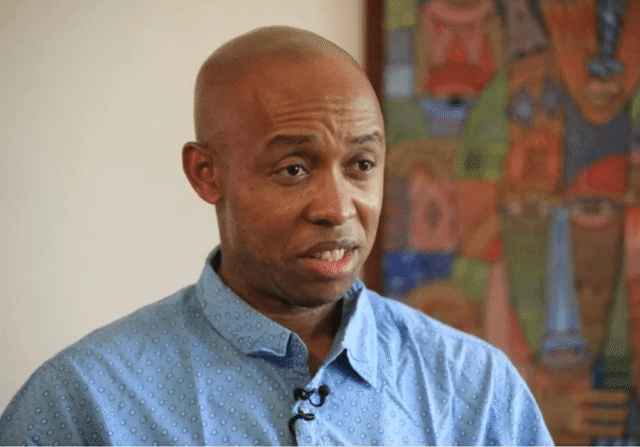
‘Multiple Principalities’ Inside INEC, Its Power Brokers Could Test Amupitan’s Integrity – Odinkalu Warns


A former chairman of the National Human Rights Commission (NHRC), Professor Chidi Odinkalu, has described the newly appointed Chairman of the Independent National Electoral Commission (INEC), Professor Joash Amupitan, as a man of integrity and principle, but warned that the complex internal politics within INEC could challenge those values.

Speaking on Politics Today on Channels Television, Odinkalu said that though he had known Amupitan since their days in law school, leading INEC is an entirely different challenge.

“Joash is a decent man, a man of basic integrity. I’ve known him for nearly four decades. I don’t see him presiding over an election that ends up with four conflicting results like what we saw in Edo,” Odinkalu said.

He, however, cautioned that Amupitan’s integrity alone might not be enough to withstand the “multiple principalities”, a term he used to describe the entrenched interests within the electoral body.

“INEC is not an ordinary institution. It is filled with competing power centres. Every major politician, from the presidency down to governors, has loyalists planted inside the commission,” Odinkalu noted.

“That’s the danger, the integrity of one person can be strained by the vested interests surrounding him.”

Odinkalu urged the new INEC chairman to set clear priorities and focus on measurable progress, especially with the Anambra governorship election just around the corner.

“He can’t fix everything in one day, but he must decide what his immediate goals are. The Anambra election on November 8 is his first real test. People will judge him by how he handles that,” he said.

The human rights advocate added that the Anambra, Ekiti, and Osun governorship elections would serve as “testing grounds” for Amupitan’s leadership style ahead of the 2027 general elections.

“These polls are like laboratories. How INEC performs there will give Nigerians an idea of what to expect in 2027,” he explained.

President Bola Tinubu officially swore in Professor Joash Amupitan as INEC Chairman on Thursday, following his Senate confirmation on October 16.

During the ceremony, the President tasked him with protecting the credibility of Nigeria’s electoral process and strengthening INEC’s institutional independence.

Upon assumption of office, Amupitan pledged to uphold Nigeria’s electoral laws and defend the Constitution, emphasizing that he would run the commission with transparency and accountability.

“I reaffirm that I will defend the Constitution and the laws of the Federal Republic of Nigeria, especially as they concern the electoral process,” he told journalists shortly after taking his oath.

Despite his cautionary tone, Odinkalu expressed confidence in Amupitan’s character.

“My hope is that when his tenure ends, he will leave INEC the same Joash I’ve known for nearly 40 years, decent, fair and untainted,” he said.

Google search engine

My Appointment Is Divine, Election Integrity Non-Negotiable – INEC Chair Amupitan


The newly inaugurated Chairman of the Independent National Electoral Commission (INEC), Prof. Joash Amupitan, has described his appointment as a divine call to national service, vowing to protect the integrity of Nigeria’s electoral process at all costs.

Speaking on Thursday at the Commission’s headquarters in Abuja, shortly after officially taking over from Mrs. May Agbamuche-Mbu, who served as Acting Chairman following the exit of Prof. Mahmood Yakubu, Amupitan pledged to uphold transparency, discipline, and accountability in election administration.

Amupitan, who was sworn in earlier in the day by President Bola Ahmed Tinubu at the State House, said his mission at INEC was guided by faith and a deep sense of duty to the Nigerian people.

“I am here for a purpose. Perhaps if I had a choice, I might have declined, but it’s clear that God is moving this country in a new direction and my coming here is divine,” he said.

“With God’s mandate, who am I to say no? I believe I have a role to play in ensuring that a new Nigeria is born.”

Accompanied by his family, the Vice-Chancellor of the University of Jos, Prof. Tanko Ishaya, and other dignitaries from the institution where he previously served, Amupitan assured INEC staff that his administration would prioritise staff welfare and professional development.

He emphasised that teamwork, synergy, and institutional cohesion were critical to INEC’s success, stressing that public confidence in elections must be restored through credibility and transparency.

“Our mandate is clear, to deliver free, fair, and credible elections that reflect the will of the people. The integrity of our elections is not up for negotiation. Every voter must believe that their vote counts,” Amupitan declared.

The new INEC boss also promised improved working conditions and better resourcing for the Commission’s staff, noting that effective performance could only come from a motivated workforce.

“We expect a lot from our staff, and because of that, you deserve to be well equipped and adequately supported to deliver. We will make your welfare a top priority,” he assured.

Looking ahead to the forthcoming Anambra governorship election, Amupitan said the poll would be a critical test of INEC’s commitment to credible elections.

“The task ahead is enormous, but together we can meet it. The eyes of the nation are upon us. We must rise to the occasion and prove that we can deliver elections that meet Nigerians’ expectations,” he said.

Amupitan also commended Agbamuche-Mbu for her leadership during the transition period and lauded INEC staff for their dedication and resilience.

He urged all departments to work collaboratively, break bureaucratic barriers, and stay united in pursuit of democratic excellence.

“Let us uphold the values of democracy and work with one mind to strengthen the credibility of our elections. The journey may be demanding, but if we stand together, there is nothing we cannot achieve,” he concluded.

Google search engine

SDP Expels National Chairman Gabam, Top Officials Over Misconduct Allegations


The Social Democratic Party (SDP) has expelled its former National Chairman, Shehu Gabam, along with several senior officials, over allegations of misconduct, financial impropriety, and abuse of office.

The decision followed the adoption of a White Paper by the party’s National Working Committee (NWC) on Thursday in Abuja, which reviewed and upheld the findings of an independent Disciplinary Committee set up earlier in the year.

Addressing journalists at the party’s national secretariat, National Publicity Secretary Rufus Aiyenigba said the expulsions were the result of months of investigation and due process aimed at sanitising the party’s leadership structure.

“The NWC considered and adopted the report of the Disciplinary Committee and the accompanying White Paper, which reviewed the findings and recommendations regarding the allegations brought against the affected officers,” Aiyenigba explained.

He recalled that the NWC had earlier suspended Gabam, National Youth Leader Mr. Ogbonna Chukwuma Uchechukwu, and National Auditor Mr. Clarkson Nnadi on June 24, 2025, after a prima facie case of financial misappropriation and gross misconduct was established.

To ensure transparency, the party set up an independent Disciplinary Committee on July 4, 2025, which conducted a two-week probe before submitting its report on July 18, 2025.

The NWC subsequently reviewed the findings and adopted the White Paper on August 15, 2025, culminating in Thursday’s decision.

Those expelled include: Alhaji Shehu Musa Gabam, former National Chairman, Mr. Ogbonna Chukwuma Uchechukwu, former National Youth Leader, Adamu Abubakar Modibbo, Abubakar Dogara, Nuraddeen Bisalla, Solsuema Osaro and Ambo Ekpeyong.

Others are; Eluwa Ifeanyi Henry, Humphrey Unwukaeze and Judith Israel Shuaibu.

The National Auditor, Mr. Clarkson Nnadi, was also removed from office following his voluntary resignation.

According to Aiyenigba, the affected members were accused of disloyalty and unlawful entry into the SDP national secretariat on July 28, 2025, where they allegedly carted away sensitive documents and party property.

He added that the individuals were later apprehended by security operatives and are now facing criminal prosecution.

“These disciplinary measures are necessary to restore integrity, discipline, and internal order within our great party,” Aiyenigba said, stressing that other administrative recommendations from the White Paper would also be implemented to strengthen accountability mechanisms.

He noted that the sanctions took immediate effect from Thursday, October 23, 2025, and were unanimously approved by members of the National Working Committee.

Reaffirming the party’s commitment to transparency and constitutional order, Aiyenigba maintained that the SDP remains resolute in upholding ethical leadership and institutional discipline.

It will be recalled that on June 24, 2025, the SDP leadership suspended Gabam and several others over alleged embezzlement and diversion of party funds, a move that set the stage for the disciplinary process leading to their eventual expulsion.

Google search engine

Reps Push To Amend EFCC Act, Strengthen Commission’s Autonomy


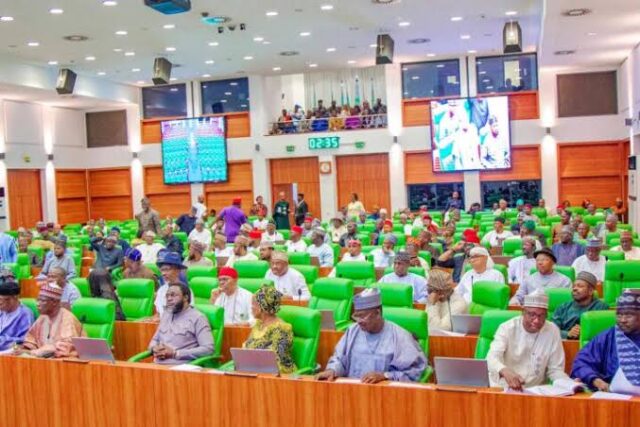
The House of Representatives has taken a significant step toward reforming Nigeria’s anti-corruption framework with the second reading of a bill seeking to amend the Economic and Financial Crimes Commission (Establishment) Act, 2004.

The bill, sponsored by Hon. Yusuf Adamu Gagdi (APC–Plateau), aims to enhance the institutional independence, operational efficiency, and accountability of the EFCC, ensuring the agency functions free from undue political influence.

Presiding over Thursday’s plenary session, Deputy Speaker Benjamin Kalu oversaw the debate on the proposed legislation titled:

“A Bill for an Act to Amend the Economic and Financial Crimes Commission (Establishment) Act, 2004, and for Related Matters (HB. 2493).”

Gagdi, while leading debate on the bill, argued that the EFCC Act, crafted over two decades ago, has failed to keep pace with the evolving landscape of financial crimes.

“When the EFCC was established in 2004, it gave Nigeria a pioneering legal framework to tackle corruption and financial malfeasance,” Gagdi noted.

“However, the world has changed dramatically since then, with the rise of cybercrime, cryptocurrency-related fraud, illicit financial flows, terrorism financing, and real estate-based money laundering. The Commission currently operates under outdated provisions that no longer address these modern realities.”

He further pointed out that the current Act grants the President broad powers to remove the EFCC chairman, a provision that, in his view, compromises the Commission’s autonomy.

Under Section 3(2) of the existing EFCC Act, the President may remove any member of the Commission at his discretion, including for “inability to discharge the functions of his office or misconduct.”

However, the new amendment proposes that removal of the EFCC chairman must be subject to the approval of two-thirds of both chambers of the National Assembly.

According to Gagdi, this reform will help insulate the EFCC from political manipulation and foster transparency, professionalism, and public trust.

“This amendment represents a decisive move toward strengthening Nigeria’s anti-corruption architecture,” he said.

“By ensuring the EFCC’s operational independence, we promote good governance, economic stability, and greater public confidence in our justice system.”

Supporting the motion, the Chairman of the House Committee on Financial Crimes, Hon. Ginger Obinna Onwusibe, described the move as “long overdue,” adding that many modern financial crimes were unimaginable when the original law was enacted in 2004.

“Our legal instruments must evolve to meet emerging threats,” Onwusibe said.

“This amendment will give the EFCC the institutional backbone it needs to operate effectively in today’s complex financial environment.”

Google search engine

Man Arraigned In Enugu Court for Allegedly Killing His Wife With An Axe


A 46-year-old man, Livinus Aniegbunam Okoh, has been arraigned before the Magistrate Court 3, Enugu East Magisterial District, for allegedly killing his wife, Mrs. Onyinyechi Okoh, in Amuri, Nkanu West Local Government Area of Enugu State.

The suspect was brought before Magistrate Uche Jideofor in the case titled Commissioner of Police vs. Livinus Aniegbunam Okoh (Charge No. CME/821C/2025).

The prosecution was led by C.O. Ugwu, Esq. and A.C. Amalu, Esq.

According to the charge sheet, the incident occurred on October 8, 2025, around 4:00 a.m., when the defendant allegedly attacked his wife with an axe, striking her on the lower jaw, which resulted in her death.

The charge reads:

“That you, Livinus Aniegbunam Okoh ‘m’, on the 8th day of October, 2025, at about 0400 hours, at Umuedum Amuri in Nkanu West Local Government Area of Enugu State, within the jurisdiction of this honourable court, did unlawfully kill one Onyinye Okoh ‘f’, aged 46 years, by hitting her with an axe on her lower jaw, which led to her death, thereby committing an offence punishable under Section 274 (1) of the Criminal Code, Cap 30, Vol. II, Revised Laws of Enugu State of Nigeria.”

The defendant did not take a plea, as the Magistrate ruled that the court lacked jurisdiction to entertain the case.

He was subsequently remanded at the Enugu Correctional Centre, pending legal advice from the Department of Public Prosecution (DPP).

Magistrate Jideofor ordered that the case file be transferred to the Enugu State Ministry of Justice for further review and adjourned the matter to December 17, 2025.

Reacting to the incident, the Enugu State Commissioner for Children, Gender Affairs, and Social Development, Mrs. Ngozi Enih, condemned the killing, describing it as “a grievous act that must not go unpunished.”

She said: “The murder of Mrs. Okoh is both tragic and unacceptable. The Ministry is monitoring the case closely to ensure justice is served in accordance with the law.”

Mrs. Enih reaffirmed the state government’s zero-tolerance policy on domestic violence and urged residents to report all forms of abuse to relevant authorities.

“We must all speak up against gender-based violence. Silence only empowers the perpetrators,” she added.

Google search engine

Nnamdi Kanu’s Trial: Details Of What Happened In Court Today


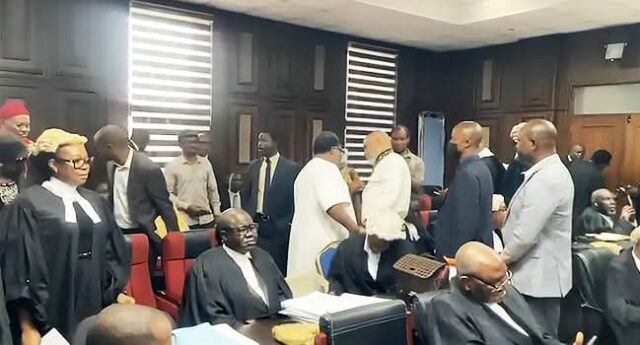
The Federal High Court in Abuja has adjourned the trial of the detained leader of the Indigenous People of Biafra (IPOB), Nnamdi Kanu, till Friday, October 24, following the withdrawal of his entire legal team.

Justice James Omotosho fixed the new date after Kanu’s lead counsel, former Attorney-General of the Federation Kanu Agabi (SAN), informed the court that the defence team would be stepping down at the request of their client.

Agabi said, “We are withdrawing because the defendant has decided to take the case back from us and we respect his wishes.”

All other Senior Advocates of Nigeria (SANs) on Kanu’s team, including Onyechi Ikpeazu, Paul Erokoro, and Emeka Etiaba, also announced their withdrawal.

Kanu confirmed the development in court, stating that he would represent himself for now, though he did not rule out engaging new lawyers later.

When Justice Omotosho offered to assign him a lawyer, Kanu declined, insisting on self-representation.

The judge then directed junior members of the defence team still present in court to leave and asked Kanu to begin his defence.

However, when the IPOB leader orally argued that the court lacked jurisdiction to try him, the judge disagreed and ordered the continuation of proceedings.

Counsel to Kanu, Ikpeazu, requested additional time to allow the defendant to prepare, noting that the withdrawal took effect that same morning.

With no objection from the prosecution, Justice Omotosho adjourned the case till Friday for Kanu to open his defence.

Kanu is facing a seven-count charge bordering on terrorism, incitement, and unlawful activities under the Terrorism (Prevention and Prohibition) Act, 2022, and other related laws.

He was first arrested in 2015 and charged with treasonable felony.

After being granted bail in 2017, he fled Nigeria following a military operation in Abia State. He was later re-arrested in Kenya in June 2021 and extradited to Nigeria.

Initially facing 15 counts, the Federal High Court struck out eight in April 2022 for being repetitive or vague.

The Court of Appeal subsequently dismissed the remaining counts and discharged him, citing his illegal rendition.

However, the Supreme Court, in December 2023, overturned that decision, ruling that while the rendition was unlawful, it did not invalidate the charges.

The Federal Government then reactivated the seven-count charge (FHC/ABJ/CR/383/2015), which accuses Kanu of using Radio Biafra broadcasts between 2018 and 2021 to incite violence, promote secession, and direct the activities of a proscribed organisation.

Kanu has also filed a fresh motion indicating his intention to call 23 witnesses, including several top political figures and retired military chiefs such as Nyesom Wike, Babajide Sanwo-Olu, Gen. Tukur Buratai (rtd.), Gen. Theophilus Danjuma (rtd.), and Abubakar Malami (SAN), among others.

He said he plans to testify personally and provide sworn statements to clarify his actions and statements, insisting that “justice must not only be done but be seen to have been done.”

Google search engine

BREAKING: Tinubu Swears In Joash Amupitan As INEC Chairman


President Bola Ahmed Tinubu has officially sworn in Professor Joash Amupitan as the new Chairman of the Independent National Electoral Commission (INEC).

The swearing-in ceremony took place on Thursday, October 23, 2025, at the State House, Abuja.

Amupitan’s inauguration comes one week after the Senate confirmed his appointment following a rigorous screening exercise held on October 16.

During the ceremony, President Tinubu charged the new INEC Chairman to uphold the integrity of Nigeria’s electoral process, safeguard the commission’s independence and strengthen its institutional capacity ahead of future elections.

Professor Amupitan succeeds Professor Mahmood Yakubu, whose tenure ended earlier this year.

Google search engine

Police Arrest Sowore Inside Abuja Court Premises


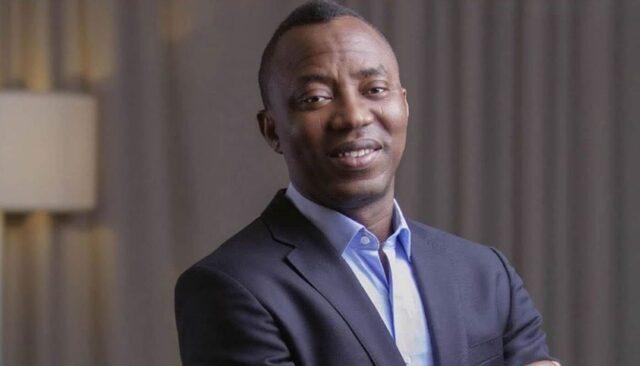
The Federal Capital Territory (FCT) Police Command has arrested human rights activist and African Action Congress (AAC) presidential candidate in the 2023 election, Omoyele Sowore, within the premises of the Federal High Court in Abuja.

Eyewitnesses said Sowore was apprehended on Thursday by armed policemen shortly after attending the court session of detained Indigenous People of Biafra (IPOB) leader, Nnamdi Kanu, where he had come to show solidarity.

Confirming the arrest to Channels Television, the Force Public Relations Officer, Benjamin Hundeyin, stated that Sowore is currently in police custody and will be charged to court today.

Hundeyin explained that the activist was arrested for violating a subsisting court order that prohibits protests calling for the release of Nnamdi Kanu.

Sowore, a journalist and convener of the #RevolutionNow movement, has previously faced multiple arrests over his involvement in pro-democracy campaigns and public demonstrations.

Detail shortly…

Google search engine

MOST COMMENTED

- Advertisement -
Google search engine