Home Blog Page 278

Controversial Election Divides Ivory Coast As 83-Year-Old Ouattara Wins Fourth Term
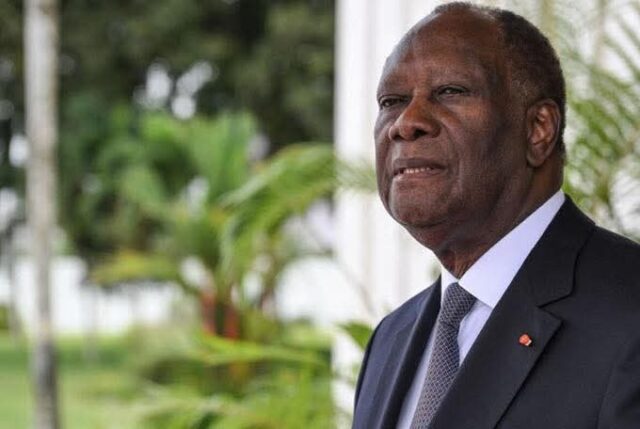
 

Ivory Coast’s President, Alassane Ouattara, has secured a fourth term in office, capturing a decisive 89.77 percent of the vote in an election from which his two main rivals were barred, the country’s electoral commission announced on Monday.

Nearly nine million voters were eligible to participate in Saturday’s election in the world’s leading cocoa producer, a nation that has largely remained resilient against coups and jihadist attacks affecting much of West Africa.

Tensions, however, ran high ahead of the polls, and deadly clashes were reported in the days leading up to the election.

Despite this, Ouattara was widely expected to win. Early tallies released on Sunday suggested he was leading with more than 90 percent of the votes.

Voter turnout approached 100 percent in his northern strongholds, while he also led in traditionally pro-opposition areas in the south and parts of Abidjan, the economic hub, where polling stations were largely empty.

Entrepreneur Jean-Louis Billon finished second with just 3.09 percent of the vote, according to commission president Ibrahime Kuibiert Coulibaly, who announced an overall turnout of 50.10 percent, similar to the 2020 election, when Ouattara won 94 percent amid a boycott by major opponents.

This year, Ouattara’s key rivals, former president Laurent Gbagbo and ex-Credit Suisse CEO Tidjane Thiam, were barred from running.

Gbagbo was disqualified due to a criminal conviction, while Thiam was ineligible because of his French nationality.

“Their absence, calls to boycott the election, and the tense pre-election climate foretold low participation in some regions,” said William Assanvo, a researcher at the Institute for Security Studies (ISS).

In Gagnoa, Gbagbo’s former stronghold, Ouattara claimed 92 percent of votes, but turnout was only 20 percent.

The opposition has already rejected the results, declaring Ouattara’s victory illegitimate and calling for fresh elections.

Political analyst Geoffroy Kouao observed that the turnout highlighted two realities: “Supporters of Ouattara turned out in force, while supporters of Gbagbo and Thiam largely stayed away from the polls.”

Billon also acknowledged the low turnout in certain areas but congratulated Ouattara on his victory.

Other candidates on the ballot, including former first lady Simone Ehivet Gbagbo, had little chance of advancing to a second round due to limited party support and financial resources.

Ahead of the vote, calls for protests by the opposition triggered violence, leaving at least eight people dead and nearly two dozen injured across around 200 polling stations.

Authorities imposed nighttime curfews in several areas and deployed 44,000 security personnel nationwide.

Presidential elections in Ivory Coast have historically been marked by tension and unrest.

Ouattara first assumed power following the 2010–2011 post-election crisis against Laurent Gbagbo, which resulted in over 3,000 deaths.

On Monday, normalcy returned to Abidjan, after the capital remained unusually quiet over the weekend.

Pro-Ouattara newspaper Patriote praised the vote as “a calm election,” while opposition daily Notre Voie described it as “an election reflecting a divided country.”

Google search engine

Direct Military, Paramilitary To Wear Locally Made Uniforms, Oshiomhole Tells Tinubu


Senator Adams Oshiomhole has urged President Bola Tinubu to issue a directive compelling the military and other paramilitary organisations to patronise locally made uniforms, saying such a move would boost job creation and revive Nigeria’s dying textile industry.

Speaking on Monday in Kaduna at the 37th Annual National Education Conference of the National Union of Textile, Garment and Tailoring Workers of Nigeria (NUTGTWN), Oshiomhole lamented the continued importation of foreign fabrics by government institutions despite the nation’s capacity to produce them locally.

“If we wear what we produce and produce what we wear, we can employ 20 million Nigerians,” he said. “That is the real meaning of putting Nigeria first.”

The conference, themed “Industry, Labour and National Development,” drew labour leaders, policymakers, and industry stakeholders from across the country.

During the event, the union renamed its five-storey headquarters in Kaduna, formerly known as the Textile Labour House, as the Adams Oshiomhole Textile Labour House in honour of the former Edo State governor, who served as the union’s Secretary-General over four decades ago.

Oshiomhole called on the president to match rhetoric with concrete action by strengthening local industries through deliberate government patronage.

“As Commander-in-Chief, the President should direct that the Nigerian Army, Navy and Air Force wear only uniforms produced and sewn in Nigeria,” he declared to loud applause from thousands of textile workers.

He recalled the golden era of Kaduna’s textile industry, when over 27,000 workers were employed across multiple shifts, blaming its collapse on “reckless government policies” and “unguarded trade liberalisation.”

“Those factories didn’t die of old age; they were murdered by bad policies,” he said.

“When we joined the World Trade Organization, we surrendered our right to protect our industries and jobs.”

The former Nigeria Labour Congress (NLC) president praised the late Premier of Northern Nigeria, Sir Ahmadu Bello, for his foresight in establishing the Kaduna Textile Mills in the 1950s, a move that, according to him, gave dignity to labour and reduced dependence on imported goods.

“Our leaders then knew it made no sense to export cotton and import clothes. That vision created jobs and built communities,” Oshiomhole added.

He linked the collapse of industries to rising insecurity, unemployment, and social unrest.
“When people had jobs, nobody cared about religion. Today, with factories shut and millions idle, we have produced anger, not cotton,” he lamented.

Commending President Tinubu’s foreign exchange reforms, Oshiomhole said they had curtailed the excesses of “emergency billionaires” who profited from currency arbitrage.

“Before Tinubu, people made money without effort, just with a phone call. Now, those distortions are being corrected,” he said.

He urged workers to remain committed to the fight for decent wages and fair treatment, describing the struggle as an act of patriotism.

“Don’t ever apologise for fighting for dignity. The primary purpose of government is the welfare of citizens, not the profit of business,” he stated.

Reaffirming his loyalty to the labour movement, Oshiomhole concluded, “I remain a labour man for life. From age 18, I’ve known no other calling. I will keep fighting until Nigeria returns to the path of production, not importation.”

Google search engine

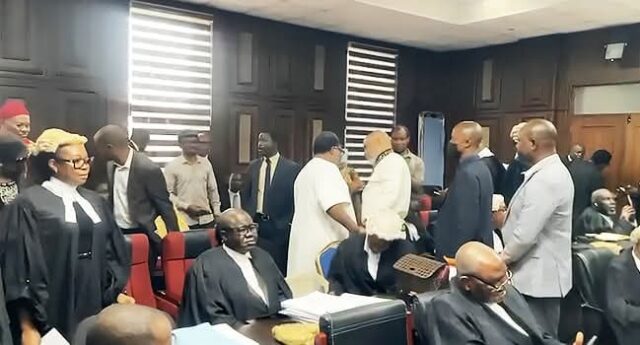
N4.49bn Fraud Case: Ganduje, Wife’s Trial Stalled Again


The ongoing corruption trial involving the immediate past National Chairman of the All Progressives Congress (APC), Dr. Abdullahi Umar Ganduje, his wife Dr. Hafsat Umar Ganduje, and six others, suffered another setback on Monday at the Kano State High Court.

The Kano State Public Complaints and Anti-Corruption Commission (PCACC) had filed an 11-count charge against the defendants over alleged bribery, conspiracy, and diversion of public funds amounting to several billions of naira.

Those standing trial alongside the former Kano State governor and his wife include Abubakar Bawuro, Umar Abdullahi Umar, Jibrilla Muhammad, Lamash Properties Limited, Safari Textiles Limited, and Lasage General Enterprises Limited.

The case, which was scheduled for the prosecution to open with witness testimony, was stalled after the defendants’ counsel declared their unpreparedness to proceed.

Earlier, Adeola Adedipe (SAN), lead counsel to the state government, informed Justice Amina Adamu Aliyu that the prosecution was ready to present its witnesses, who were already seated in court.

However, defence counsel Lydia Oluwakemi-Oyewo, representing Ganduje, his wife, and son, objected to the commencement of the hearing, claiming that her clients were not properly served with the notice of hearing.

She subsequently filed a motion on notice urging the court to stay proceedings, arguing that the matter was already before the Court of Appeal.

Similarly, other defence lawyers, Chief M. N. Duru (SAN) for the 3rd defendant, Sunusi Musa (SAN) for the 5th, Abubakar Ahmad for the 6th, and Abdulrazaq A. Ahmed for the 8th, informed the court of their pending applications for stay of proceedings and preliminary objections.

They all maintained that the trial could not proceed until those motions were heard.

In response, prosecution counsel Adedipe urged the court to dismiss the applications, accusing the defence of deliberate delay tactics meant to frustrate the trial.

He appealed to the court to allow the case to proceed concurrently with the pending motions, suggesting that rulings on the motions could be deferred until the substantive matter concluded.

Justice Aliyu, however, disagreed, ruling that all preliminary objections must be resolved before the substantive trial could commence.

She also dismissed the defence’s request for a stay of execution, stating that the court lacked grounds to halt proceedings in the absence of a direct order of reference.

The judge subsequently adjourned the case to November 26, 2025, for the hearing of all pending applications.

Google search engine

2027: Get The Law Right And Even Losers Will Congratulate Winners – INEC Boss Pledges To Reduce Pre-election Court Cases


The Chairman of the Independent National Electoral Commission (INEC), Prof. Joash Amupitan, SAN, has pledged to prioritise the reduction of pre-election litigations as Nigeria prepares for the 2027 general elections.

Amupitan, who recently assumed office as INEC’s sixth substantive chairman following his swearing-in by President Bola Tinubu, said cutting down the volume of electoral disputes would be one of his administration’s major goals.

Speaking on Monday at the 56th Annual National Conference of the Nigerian Association of Law Teachers (NALT), held at the University of Abuja, Amupitan disclosed that over 1,000 pre-election cases were filed before the 2023 elections, a situation he described as unhealthy for the political and judicial systems.

He emphasised that stronger internal party democracy, adherence to electoral laws, and early dispute resolution mechanisms were key to preventing such litigations.

“If political parties follow their constitutions, comply with the Electoral Act, and uphold the Nigerian Constitution, pre-election litigations will drastically reduce,” Amupitan stated.

“My desire is that if we get the law right, even losers will congratulate winners. The law should be used as a tool for change, not conflict.”

The INEC boss urged the National Assembly to strengthen the country’s electoral legal framework to promote fairness and transparency in future polls.

He noted that while fewer pre-election cases might not please some legal practitioners, the reform would enhance the credibility of elections and reinforce public trust in the democratic process.

Amupitan described his tenure’s legal reform agenda as a step toward ensuring that elections reflect “the genuine will of the people.”

The conference, themed “Law, National Development and Economic Sustainability in a Globalised World,” brought together law teachers, jurists, policymakers, and students from across the country.

Amupitan, who attended the event with his wife, Prof. Yemisi Amupitan, commended the association for its role in promoting legal scholarship and mentoring young academics.

“This is a gathering of brilliant minds. I urge young law lecturers to uphold integrity and professionalism because the future of justice, democracy, and the rule of law depends on them,” he said.

Also speaking, Prof. John Akintayo, President of NALT and Dean, Faculty of Law, University of Ibadan, stressed that effective legal frameworks were essential for inclusive growth and national stability.

He noted that in a globalised world, aligning domestic laws with international best practices while protecting national interests was vital for sustainable development.

“The law must not merely react to change but anticipate and shape it, ensuring development anchored on justice, equity, and the rule of law,” Akintayo said.

Conference Chairman and Dean, Faculty of Law, University of Abuja, Prof. Uwakwe Abugu, revealed that plenary sessions at the event would explore topics such as agriculture and food security, artificial intelligence, biotechnology, and legal reforms.

Google search engine

Marginalisation Rekindled Biafra Movement – Dele Momodu Backs Calls For Kanu’s Release


Media entrepreneur and publisher of Ovation International, Dele Momodu, has joined growing calls for the release of detained Indigenous People of Biafra (IPOB) leader, Nnamdi Kanu.

In a post shared on his verified X (formerly Twitter) account on Tuesday, the former presidential aspirant urged the Federal Government to address the root causes of separatist agitations in Nigeria’s South-East.

Momodu accompanied his post with a clip from one of Kanu’s previous broadcasts, recorded shortly before his controversial repatriation from Kenya by Nigerian security operatives.

He argued that the Biafra movement stemmed from what he described as “decades of marginalisation and deprivation” experienced by the Igbo people.

“Shortly before his abduction from Kenya by the Nigerian government, Mazi Nnamdi Kanu made this thought-provoking broadcast in which he philosophised about the reasons he and his supporters became radicalised,” Momodu wrote.

The veteran journalist criticised those who condemn Kanu and his supporters without, in his view, understanding the historical and political factors driving the agitation.

“I have taken time to listen to his critics and discovered that most of them jumped to conclusions without proper analysis of why the agitation for Biafra became reignited and attractive after the pogroms that claimed millions of lives and destroyed properties in the 1960s and ’70s,” he said.

Momodu also quoted Kanu as saying that the “continuing marginalisation of the Igbo and deprivation accorded some of the most energetic and vibrant brains in Africa and globally rekindled the Biafra sentiment.”

He warned that any attempt to silence or eliminate Kanu would not end the separatist movement, stressing that the crisis required political rather than legal or military intervention.

“Attempts by enemies of Kanu, including his own kinsmen, to exterminate him will never solve the problem. The Igbo struggle goes beyond legalese, it requires serious political reconfiguration, and urgently too,” he stated.

While clarifying that he does not condone violence, Momodu advised the government to meaningfully engage the South-East through inclusion and opportunity.

“I will never support violence. But any sensible government will keep the geniuses of the South-East very busy with productive engagements, instead of this rabid hatred,” he added.

Google search engine

Commissioners Without Tinubu’s Signature Cap Will Be Suspended, Says Edo Govt


The Chairman of the All Progressives Congress (APC) in Edo State, Jarrett Tenebe, has declared that any commissioner barred from the State Executive Council (SEC) meeting for refusing to wear President Bola Tinubu’s signature cap will face immediate suspension from the party.

Speaking during a television interview monitored by The Guardian, Tenebe described the refusal to comply with Governor Monday Okpebholo’s directive as “an act of indiscipline and insubordination.”

He warned that any behavior capable of hindering the party’s goal of securing 3.5 million votes for President Tinubu in the 2027 general election would not be tolerated.

“If you refuse to wear the cap as the governor has directed, we will suspend you. That is indiscipline and insubordination,” Tenebe stated.

The Edo APC chairman emphasised that loyalty to the President and the party’s leadership must be demonstrated through full compliance with internal directives, including the symbolic wearing of Tinubu’s signature cap.

“We are doing it because we have made a promise that 3.5 million votes are guaranteed. Everybody has keyed into achieving that target,” he said.

“If, as a member of the APC, you got an appointment, you are expected to be loyal to the President. We are showing that loyalty by wearing the cap. Those complaining are not members of the APC. In Edo, we’ve made it clear, no Asiwaju cap, no Exco.”

Tenebe’s comments come amid mixed reactions over the governor’s directive requiring commissioners to don the trademark cap associated with President Tinubu during official functions and meetings.

Google search engine

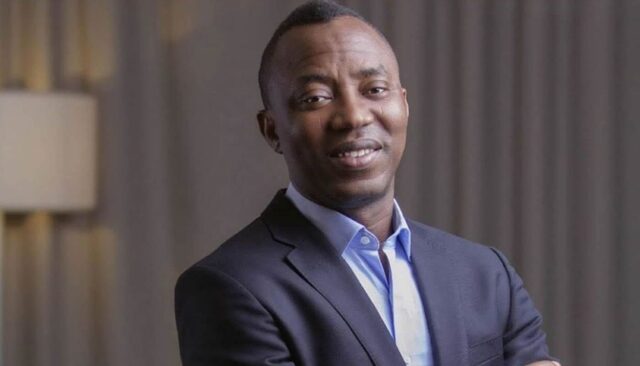
Sowore Released From Kuje Prison After Four Days In Detention


Human rights activist and former presidential candidate, Omoyele Sowore, has regained his freedom after spending four days in Kuje Prison, Abuja.

His release followed the fulfilment of bail conditions imposed by a Magistrate Court in Kuje.

Sowore announced his release on Monday via his verified X (formerly Twitter) handle, writing:

“HAPPENING NOW: Leaving Kuje Prison in Abuja after being detained there illegally for four days. #FreeNnamdiKanuNow.”

The activist was detained alongside Aloy Ejimakor, Special Counsel to the Indigenous People of Biafra (IPOB) leader Nnamdi Kanu, as well as Emmanuel Kanu, Nnamdi Kanu’s younger brother, and eleven other demonstrators.

They were arrested last week by operatives of the Nigeria Police Force during a #FreeNnamdiKanuNow protest in Abuja.

Last Friday, they were arraigned before Magistrate Abubakar Sai’id of the Kuje Magistrate Court on charges of unlawful assembly and disturbance of public peace.

Each of the 14 defendants was granted bail in the sum of ₦500,000, with conditions that included Submission of a verified National Identification Number (NIN), Presentation of a three-year tax clearance certificate, and Deposit of their international passports.

After meeting these requirements, Sowore and the other detainees were released on Monday.

Following his release, Sowore criticized the Nigeria Police Force, describing it as an “irresponsible organisation” that habitually acts beyond its constitutional powers.

He argued that the police overstepped their legal boundaries by enforcing a court order in which they had a vested interest.

“If a court issues an order and it’s violated, you return to that court to lodge a complaint. It is not the duty of the police to enforce a court order that affects them directly,” Sowore said.

He further maintained that neither he nor the other defendants were ever served with any restraining order before their arrest.

“I can guarantee you that those court orders were never served on us. Even if they were, our courts understand there are limits you cannot cross when it concerns fundamental human rights,” he added.

Google search engine

Understanding Governor Mbah’s Tax Reforms

By Dr. Justice Chidi

A lot of public conversations within Enugu have centred on the phrase “tax increase.” This often provokes negative feelings and resentment amongst the people.

To many, tax payment feels like penalty rather than contribution. And when disposable income is low, taxes, no matter how friendly, feel like a burden.

But what if the core issue is less about increament and more about how taxes are collected. Governor Mbah’s administration has not hiked tax rates but has essentially streamlined the tax system by widening the net and plugging leakages.

The focus has been on compliance, not increament.

Governor Mbah has consistently emphasised that his administration did not increase the tax rate. He has, on many occasions, clarrified: “We have not increased tax in Enugu State.

What we have essentially done is the expansion of the tax net. We have also made sure that monies that were collected in cash before now are now adequately captured and paid into the state coffers.”

Mbah’s government saw to the passage of the Enugu State Internal Revenue Service Law, 2025, which created a single-point revenue aggregation agency to end multiple taxation and redundant channels of collection.

It also introduced e-payments and electronic tax filing, which replaced or reduced entirely manual and cash-based collections, which, in turn, reduced the chances of leakages.

This does not necessarily amount to increament. It is only a conscious strategy that brought into the tax net previously non-compliant individuals. Those who had not been paying or were outside formal systems have been made to start paying, and, as expected, it feels strange.

However, given the economic situation in the country, the reality is that there was no tax increament in Enugu, but only plugging of leakages, which still does not sit well with some people.

In response, as would a listening government, Governor Mbah’s administration has formed a multi-stakeholder committee to review the tax system and address taxpayer concerns.

A take-home from the present administration is that the enhanced revenue is not being trapped in consumption or recurrent expenditure. It is visibly channelled into large-scale public investment across infrastructure, education, health, and security.

When I see international conference centre, the world- class conference centre hotel, smart green schools rising in the 260 electoral wards, the dualisation of Abakpa-Ugwogo, Opi-Agu road, the type-2 primary healthcare centres across the 260 wards, what I see is the taxpayer’s money being utilised for public good.

The deployment of revenue into visible infrastructure is at the heart of social contract.

Jean-Jacques Rousseau, whose idea provided the philosophical foundation for modern taxation, asserts “social contract implies that citizens contribute to the state through taxes, and the state, in return, guarantees their welfare and justice.”

This implies that it is the duty of the citizens to pay taxes and to also hold the government accountable for how such monies are utilised.

Google search engine

Accelerating Development In Enugu: Gov Mba’s Multiple Approach By Dr. Jeff Ejiofor

The opinions expressed in this article are solely those of the author and do not represent the views or position of DAILY GAZETTE or its editorial team.

Alan Kay, a famous American computer scientist, said that the best way to predict the future is to create it, validating the slogan of Dr Peter Mbah’s administration, “Tomorrow is Here,” which describes the governor’s unquenchable innovative intuition and creative administrative acumen.

Gov Mbah’s efforts to pull Enugu State out of economic doldrums and development deficit through a multi dimensional approach is a perfect reflection of good governance which is no doubt an antidote to poverty and under development as rightly stated by the former United Nations Secretary General, Mr Kofi Annan when linking governance with development.

Governor Mbah’s administration actually embarked on a multifaceted development strategy to accelerate growth and progress in Enugu State.

This approach encompasses various sectors, including infrastructure, education, healthcare, agriculture, and economic empowerment.

It is implicitly clear that by adopting a holistic development framework, Gov Mbah aims to create a more prosperous, equitable, and sustainable future for the people of Enugu State.

Apparently, one of the critical areas of focus for Gov Mbah’s administration is infrastructure development.

The government has invested heavily in road construction, rehabilitation, and maintenance, improving connectivity and facilitating economic activity.

This includes the construction of new roads such as the Enugu- Owo to Oboollo dual carriage way, rehabilitation of existing ones like being witnessed across the state, and upgrading of key infrastructure such as bridges and drainage systems etc.

It is also a well-known fact that better infrastructure reduces travel times, increases access to markets, and enhances the overall business environment.

Furthermore, Gov Mbah’s administration recognizes the importance of education in driving development.

Hence, the government has implemented various initiatives to improve the quality of education, including training for teachers, provision of educational materials, and infrastructure upgrades like the smart initiative.

Additionally, the administration has introduced scholarship programmes and other forms of support to encourage students to pursue higher education.

These efforts aim to equip the youth of Enugu with the skills and knowledge necessary to compete in the 21st century global economy.

Equally, Peter Mbah’s administration has prioritized healthcare, investing in the construction and renovation of healthcare facilities across the state, provision of medical equipment, and training of healthcare professionals.

These efforts have improved access to quality healthcare services, reduced mortality rates, and enhanced the overall well-being of the people of Enugu State.

The regime’s focus on preventive care and health education has also helped to promote healthy lifestyles and reduce the burden on the healthcare system.

The construction of Type 2 health centres in all the 260 political wards of Enugu State will no doubt reduce mortality rate among the rural dwellers and the most vulnerable in the society.

The International Hospital, under construction in Independence Layout, is another landmark health facility by the Mbah administration, which will halt medical tourism abroad by Ndi Enugu and save hard currency for the people of the state and other Nigerians.

Also, agriculture is another significant sector in Enugu’s economy that Gov Mba’s administration has prioritized through implementing various initiatives to support farmers and promote their development.

These include the provision of farm inputs, mechanization, and policy to establish farm estates and access to markets.

The government has also established programmes to promote entrepreneurship and value addition in the agricultural sector, creating opportunities for economic growth and job creation.

Above all, to stimulate economic growth and create jobs, Gov Mba’s administration has launched various initiatives, including entrepreneurship training, access to finance, and business incubation programmes. These efforts aim to empower young entrepreneurs and small business owners, promoting innovation and job creation.

The government has also established partnerships with the private sector to attract investments and stimulate economic activity.

In conclusion, Gov Peter Mba’s multiple development approach is accelerating development in Enugu and transforming the lives of its citizens.

By adopting a holistic development framework, the government has created opportunities for economic growth, improved access to basic services, and enhanced the overall quality of life for the people of Enugu.

As the state continues to grow and develop, it is essential to sustain this momentum and build on the progress made so far by supporting and encouraging the governor rather than distracting him through sponsored campaigns of calumny.

Indeed, Tomorrow is Here.

Google search engine

Osun 2026: Alleged Forgery Sparks Rift Among APC Youth Leaders Ahead Of Primary


A dispute has broken out among youth leaders of the All Progressives Congress (APC) in Osun West Senatorial District over claims that signatures were forged on a communiqué advocating the zoning of the party’s 2026 governorship ticket to the district.

At least 40 youth leaders from five local government areas; Ola-Oluwa, Isokan, Ede North, Ede South, and Ayedire accuse some party members of falsifying their signatures on the document.

Speaking to journalists, Alimi Bakare, one of the aggrieved leaders, said the communiqué misrepresented the position of many youth leaders.

“We never signed any document supporting the zoning of the governorship ticket to Osun West. Not all youth leaders attended the meeting, and many signatures were forged,” he said.

Bakare added that in Ede North, a single person signed on behalf of all ten youth leaders and appealed to the party hierarchy to prioritise competence over zoning.

Other youth leaders, including Amos Amindiya (Ola-Oluwa), Raji Rafiu (Isokan), and Idris Aderibigbe, alleged that some leaders were pressured into endorsing the zoning move instead of supporting the most qualified aspirant.

However, the Osun West APC leader, Imran Mojeed, rejected the forgery claims, insisting all youth leaders present at the meeting signed voluntarily.

“We all agreed to seek the zoning of the governorship ticket to Osun West, and there is video evidence to confirm this,” he said.

Mojeed accused dissenting youth leaders of attempting to create confusion for personal reasons.

“Those opposing us are only two LCDA youth leaders, not representatives of the main councils. Some even tried to bribe our members to change their stance, but our members refused,” he alleged.

He clarified that the communiqué simply reinforced an earlier appeal by the Osun West Senatorial Chairman of the APC, Gbenga Omolaoye, asking the party leadership to consider the district for zoning.

“We did not push for any particular candidate from Osun West,” Mojeed said.

“We only highlighted that capable hands exist in our district.”

Google search engine

- Advertisement -
Google search engine

MOST COMMENTED