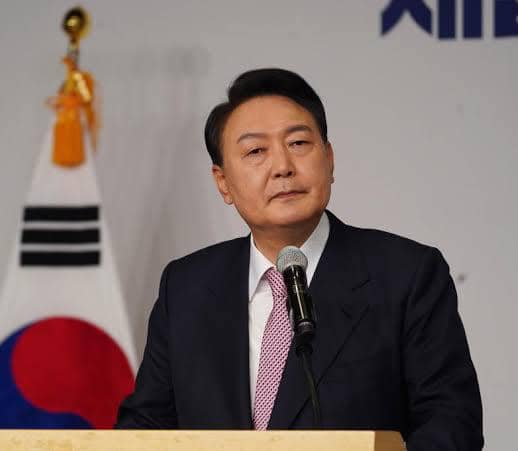

South Korea’s top court on Friday ruled unanimously to remove impeached president Yoon Suk Yeol from office, following his controversial martial law declaration, which caused political turmoil and prompted the deployment of armed soldiers to parliament.
This decision paves the way for new elections after months of political instability.
Yoon, 64, was suspended by lawmakers after his attempt to subvert civilian rule on December 3, which saw soldiers deployed in an effort to prevent lawmakers from voting on his decree.
He was also arrested on charges of insurrection related to the same event.
Millions of South Koreans watched the Constitutional Court’s ruling live on television, with the country’s main messaging app, KakaoTalk, reporting delays due to a surge in traffic.
“Given the serious negative impact and far-reaching consequences of the respondent’s constitutional violations… (We) dismiss respondent President Yoon Suk Yeol,” acting court president Moon Hyung-bae said while announcing the decision.
The ruling, effective immediately, requires the government to hold a new presidential election within 60 days.
Authorities will soon announce the date of the election.
Outside the court, AFP reporters overheard Yoon’s supporters threatening the judges with violence, demanding retribution for their decision, prompting authorities to increase security for the judges.
The court’s ruling emphasized that Yoon’s actions “violate the core principles of the rule of law and democratic governance.”
The judges specifically condemned Yoon’s deployment of armed soldiers to parliament to block the vote, noting it violated “the political neutrality of the armed forces.”
The ruling further stated, “In the end, the respondent’s unconstitutional and illegal acts are a betrayal of the people’s trust and constitute a serious violation of the law that cannot be tolerated.”
Opposition party lawmakers clapped in approval as the verdict was announced, calling the decision “historic.”
Members of Yoon’s party, on the other hand, quickly left the courtroom.
In response to the ruling, Yoon issued a brief statement apologizing for failing to meet the people’s expectations.
Yoon is the second South Korean leader to be impeached by the court after Park Geun-hye in 2017.
The case had led to weeks of hearings, followed by over a month of deliberations by the judges. Meanwhile, public unrest grew, and police raised the security alert to the highest level.
Officers surrounded the courthouse with a perimeter of vehicles, and special operations teams were stationed nearby.
Anti-Yoon protesters gathered outdoors, cheering and holding hands as they watched the live broadcast of the verdict.
When the court dismissed Yoon, they erupted in loud cheers, with some breaking into tears.
“When the dismissal was finally declared, the cheers were so loud it felt like the rally was being swept away,” said Kim Min-ji, a 25-year-old anti-Yoon protester.
“We cried tears and shouted that we, the citizens, had won!”
Despite the court’s ruling, Yoon still has support from some extreme followers. Outside his residence, his supporters shouted and swore in anger, with some also breaking into tears.
At least two Yoon supporters have self-immolated in protest of the impeachment.
The decision highlighted the resilience of South Korea’s democracy, as noted by Byunghwan Son, a professor at George Mason University.
“The very fact that the system did not collapse suggests that the Korean democracy can survive even the worst challenge against it — a coup attempt.”
Following the ruling, portraits of Yoon were ordered to be removed from military offices, as mandated by defense ministry regulations.
The South Korean won strengthened against the US dollar immediately after the verdict, while Seoul’s benchmark KOSPI index rose by 0.35%.
The country has been without an effective head of state since Yoon’s martial law declaration, which was followed by his impeachment.
In the meantime, the opposition also impeached Yoon’s temporary replacement, only for him to be reinstated by the courts.
This period of leadership uncertainty came amid several national crises, including an aviation disaster and the deadliest wildfires in South Korea’s history.
On the international front, South Korea recently faced a 25% tariff on exports to the United States after former President Donald Trump introduced global reciprocal tariffs.
In response to the court’s ruling, National Assembly Speaker Woo Won-shik said, “We have reaffirmed that no one in the Republic of Korea can be above the law,” adding, “We have made clear the principle that any power that commits unconstitutional or illegal acts must be held accountable.”
Yoon is still facing a separate criminal trial for insurrection related to the martial law declaration.
Acting President, Han Duck-soo will continue to lead the country until the new elections are held.