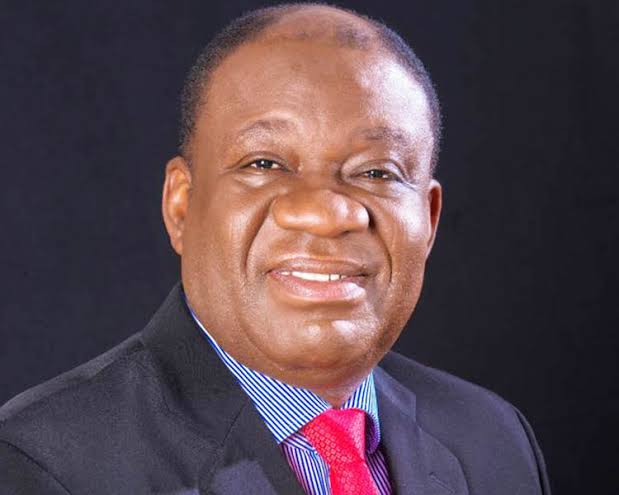

Prof. Chinedu Nebo, Nigeria’s Former Power Minister
Chinedu Nebo, the former Minister of Power and Vice Chancellor of the University on the Niger, shared his thoughts on Nigeria’s political future and the upcoming 2027 general elections.
In an interview, Nebo discussed the current state of the country, political defections, and his concerns regarding the Electoral Commission’s ability to conduct a fair election.
When asked if he joined the People’s Democratic Party (PDP) to secure a position in Goodluck Jonathan’s administration, Nebo explained, “I served as a technocrat. I have never been a politician. It was just that I was invited to serve my country, but at that time, if I had a political preference for a political party, it was obviously PDP. But I never really became an active member of a political party.”
Nebo further clarified his limited involvement with the party, stating, “It was just after I was made Minister of Power that somebody suggested I should join the party at least at the ward level. They brought me one small card and filled in my name, and I became a member. But that was it. I was never involved in any of the meetings and what have you.”
Despite the challenges faced by the PDP, Nebo expressed a preference for the party over the All Progressives Congress (APC), saying, “The PDP is falling apart. But I would choose PDP over APC any day.” He criticized the APC for what he perceived as institutionalized corruption, asserting, “APC has glorified corruption. Corruption has become part of our civil service and political system.”
He went on to highlight the extent of corruption, noting, “In the PDP government, there was a lot of corruption, but it was nothing to be compared with the APC. As a political party, quite often, they go for the worst and not the best.”
On the issue of political defections, Nebo lamented, “Defections occur because people are not there to serve the electorate. They are there to protect their interests, steal as much as possible and retain power.”
He criticized the lack of principles in Nigerian politics, comparing politicians to “socio-political prostitutes” who shift allegiances based on personal gain.
He further remarked, “Politicians in Nigeria are mostly socio-political prostitutes. They jump from one place to another. If our politicians see that they will grab more somewhere, they will leave their party and join that one.”
Addressing the pervasive corruption in the country, Nebo emphasized the severity of the issue: “Nigeria has never been this corrupt since I was a child.”
“It is oozing from every fabric of Nigeria and it would destroy this country because the resources are not being utilized for the development of the country.”
He also criticized the judiciary, citing a recent report that highlighted it as the most corrupt arm of government.
“It is a shame that a national parastatal came up recently to say that in the index of corruption, the judiciary is seen by Nigerians as the most corrupt arm of government, followed by the Police Force.”
Nebo was particularly critical of the Independent National Electoral Commission (INEC), arguing that its current structure could not deliver a credible election in 2027.
“No amount of opposition will stop Tinubu in 2027 if the corrupt Independent National Electoral Commission (INEC) we have now continues,” Nebo warned.
He further explained, “If you have an umpire who is corrupt, who doesn’t care what the electorate says, no amount of voting will change the result of 2027 elections.”
He also raised concerns about glitches in the 2023 election results transmission, noting, “How can you trust an electoral body that did not experience glitches during transmission of the results of the senatorial and House of Representatives elections but suffered glitches in that of the presidential election?”
Discussing the Tinubu administration, Nebo acknowledged some of its positive impacts but expressed concerns over what he described as its “nepotistic attitude.”
“Virtually every appointment that comes out goes to the Southwest. We complained about Buhari, but Tinubu is much worse in that regard,” he said.
He advised the opposition to focus on grassroots mobilization, saying, “If the opposition is strong enough, they should go to the grassroots and convince the electorate not to allow anybody to steal their votes.”
Nebo also addressed the issue of insecurity in the Southeast, criticizing the lack of cooperation among the region’s governors. “It is so unfortunate that in the Southeast, the governors have refused to work together,” he stated.
He emphasized the importance of collective efforts, explaining, “A situation where you do your things individually will have an effect, but the cumulative effect of working together would have strengthened their efforts even much more than what they are doing individually.”
Nebo voiced his support for the establishment of more universities in Nigeria, countering arguments against it by stating, “I don’t think there are too many universities in Nigeria.”
“A situation where more than 60 percent of all those who are qualified yearly or those who take the Unified Tertiary Matriculation Examination never find placement in the universities is an indication that the universities are not too many.”
He also criticized the federal government’s competition with private institutions, saying, “the federal and state governments are killing education by competing with the private universities unduly.”
Nebo shared his experiences working in both public and private institutions, highlighting the challenges faced by private institutions.
“If you are in a federal institution, the resources are often much more abundant than private institutions. Federal universities have undue advantage over the private ones,” he said.