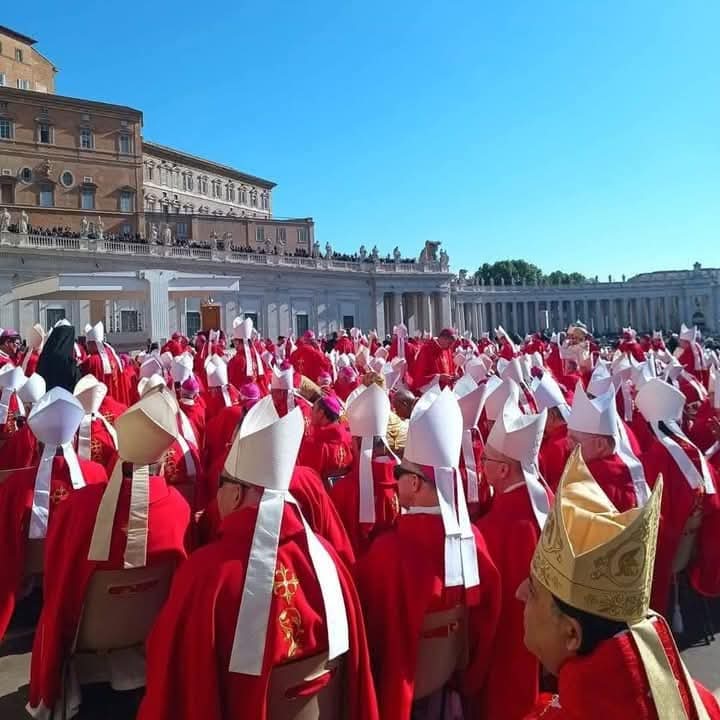

As preparations intensify for the election of a new pope following the death of Pope Francis on April 21, 133 cardinal electors will begin moving into Vatican accommodations on Tuesday, a day before the secretive conclave begins.
Traditionally, the cardinals stay in the Vatican’s Santa Marta guesthouse, known for its en-suite bathrooms and hotel-style amenities.
However, due to the unprecedented size of this conclave, the largest and most international in Church history, with participants from 70 countries across five continents, not all cardinals can be accommodated there.
Some will instead be housed in the nearby Santa Marta Vecchia, a facility typically reserved for Vatican officials.
Each cardinal will be assigned their room by drawing lots and will be able to settle in between Tuesday and Wednesday morning, just ahead of the Mass that officially begins the conclave.
Although recent conclaves have produced popes within two days, including those of Francis and Benedict XVI, history reminds the Church of a more drawn-out possibility: the longest papal election ever took 1,006 days, from 1268 to 1271.
Earlier Tuesday, the cardinal electors under 80, alongside their senior counterparts, concluded a final round of nearly daily preparatory meetings.
Topics included the Vatican’s financial status, responses to the clergy abuse scandal, the Church’s unity, and the expected profile of the next pope.
Franco-Algerian Cardinal Jean-Paul Vesco described the sessions as essential in fostering connections among the diverse group of electors.
“We’ve come from so many countries, many of us had never met before. Finally we have got to know each other,” he told Corriere della Sera.
Cardinal Vesco noted that several names have emerged as possible frontrunners.
“There were the so-called ‘natural’ candidates, those already known for their role and personality. And there are those who speak and make you think ‘that is strong’,” he said.
Still, he acknowledged that no clear favorite has emerged.
“But there is no-one who ‘trounces’ the others, who you think ‘he’s the one’. Yet it will happen,” he added.
Pope Francis, who led the Catholic Church for 12 years, was known for his energetic reforms and inclusive approach.
While admired for opening up the Church, critics argue that he failed to adequately defend traditional Catholic teachings.
Now, observers are watching closely to see if his successor will continue his progressive trajectory or return to a more conservative direction.
Though Francis appointed roughly 80 percent of the current cardinal electors, analysts warn against assuming the next pope will be a mirror of his papacy. Surprises, they say, are possible.
As dictated by conclave protocol, all cardinals are sworn to strict secrecy, under penalty of excommunication, and are prohibited from any outside communication once the election begins.
To enforce this, the Vatican announced that mobile phone signals within Vatican City will be disabled starting at 3:00 p.m. (1300 GMT) on Wednesday, until a new pope is elected.
This blackout will not affect St. Peter’s Square.
Once inside the Sistine Chapel, the cardinals must surrender their mobile phones.
Communication with the outside world will take place only through the traditional smoke signals: black to indicate no decision has been reached, and white when a new pope has been chosen.
All personnel assisting the cardinals during the conclave, including healthcare workers, canteen staff, cleaners, and elevator operators, have also taken oaths of secrecy, sworn on Monday, in keeping with the solemnity of the proceedings.