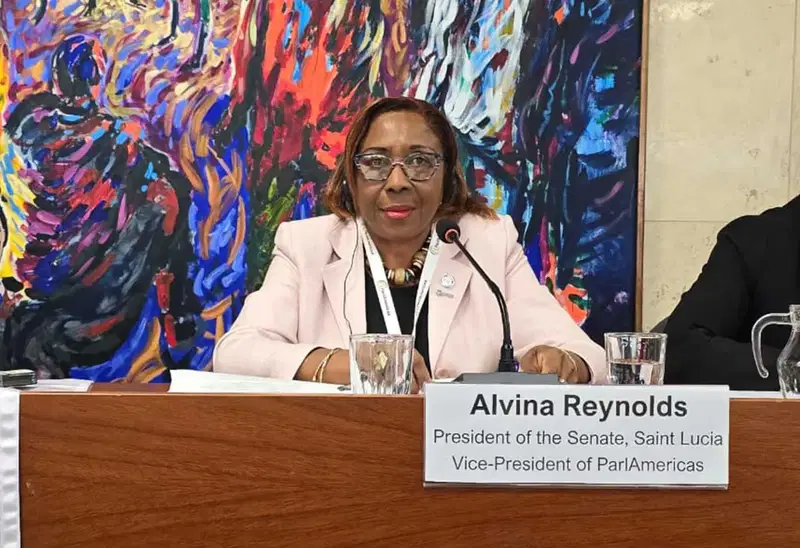

During President Bola Tinubu’s recent visit to Saint Lucia, the President of the country’s Senate, Alvina Reynolds, reaffirmed the deep ancestral connection between the Caribbean island and Nigeria.
Speaking at a joint session of the bicameral parliament, Reynolds referenced historical records to emphasize the African roots of many Saint Lucians.
According to her, a British census from 1815 confirmed that a significant portion of the enslaved population on the island originated from Nigeria.
“Of the 16,282 enslaved people in Saint Lucia that year, 3,488 were born in Africa,” she said.
“Of these, 34 per cent were from Nigeria, 11 per cent from Nigeria-Cameroon, and 22 per cent from the Congo.”
“The remaining 12,794 were born in Saint Lucia, with most of their forefathers coming from Sene-Gambia and Nigeria.”
Reynolds described Tinubu’s visit as a landmark occasion for the Saint Lucian Parliament and its people.
She linked the enduring cultural ties to the painful legacy of the transatlantic slave trade, which, she said, spanned over 350 years and forged long-lasting bonds between Africa and the Caribbean.
Calling the occasion symbolic, she said,
“A mission to reunite us with our homeland and for our people to work together.”
Reynolds also paid tribute to Sir Darnley Alexander, a Saint Lucian who once served as Chief Justice of Nigeria (1975–1979), underscoring the historical connections between the two nations.
“This mission, Your Excellency, continues with Catholic priests from Nigeria who have answered the call and come to Saint Lucia to serve, one of whom is our special guest this morning—Father Festus,” she added.
She highlighted the significance of Tinubu’s address, noting its alignment with World Parliament Day.
“Your address to this Parliament today could not have occurred at a more auspicious time, for today is World Parliament Day—an occasion to reflect on the essential role of Parliament and the service we provide as representatives to our people.”
In his response, Prime Minister Philip Pierre called the visit a time of unity and celebration. He emphasized Saint Lucia’s deep spiritual and cultural ties to West Africa, describing the island as “a small fragment of Africa.”
“Our people have been separated, but nothing has ever been able to separate us spiritually and culturally from West Africa, where some of our ancestors came from and for whom our hearts continually yearn,” Pierre said.
“We are African people who have made permanent homes for ourselves on this side of the Atlantic, on the hills and valleys of the plantations on which we were enslaved.”
“But, we have built these homes, Mr President, not for ourselves but in the service of all humanity, especially Africa, in whose direction we continually watch, wait, hope and pray for our future redemption.”
Pierre humorously remarked that Saint Lucia’s population is smaller than Eti-Osa Local Government in Lagos, yet reaffirmed the island’s global standing.
“We are a sovereign nation deeply connected to the world, Nigeria, and West Africa,” he said.
He also acknowledged the significant role played by Nigerians residing in Saint Lucia in several sectors:
“We warmly welcome every Nigerian hand of support and embrace with gratitude their contributions to Saint Lucia’s cultural, social, and economic development.”
“We are the richer for it.”
On strengthening Africa-Caribbean relations, Pierre applauded progress made since the Africa-CARICOM Summit in 2021, expressing optimism for the next summit in Addis Ababa.
He outlined areas ripe for collaboration, such as tourism, fintech, air travel, renewable energy, creative arts, sports, and medical services.
Noting the tourism potential, he pointed out the challenges of limited connectivity with Nigeria.
“While Saint Lucia receives over one million tourists annually, few come from Nigeria due to limited air connectivity.”
He proposed new partnerships in sports, especially football and cricket, and invited Nigerian professionals in healthcare and fintech to explore opportunities in Saint Lucia’s growing economy.
The event was attended by diplomats, top officials, and leaders from across the Organisation of Eastern Caribbean States (OECS), marking a significant moment in the deepening relationship between Nigeria and the Caribbean.