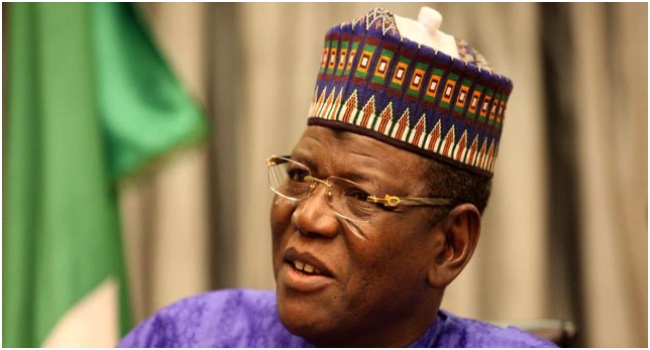

Former Jigawa State Governor and Peoples Democratic Party (PDP) stalwart, Sule Lamido, has expressed willingness to support Peter Obi in the 2027 presidential election provided the Labour Party leader emerges as the flag bearer of a broader coalition.
Lamido, in a statement, said his loyalty to PDP remains intact but emphasized the need to prioritize Nigeria’s future over ethnic or regional considerations.
“If the coalition produces Peter Obi or anyone else committed to rescuing Nigeria, I will support them. But I remain PDP. We should have outgrown tribal and regional sentiments. Leadership should be about competence and vision, not geography.”
“What has the North gained from producing the most presidents if the region remains underdeveloped? I’m open to any arrangement that can confront the APC and rescue Nigeria. I’ll support those who share that goal.”
He further argued that the PDP’s zoning arrangement was originally created as a temporary mechanism to heal national wounds after the annulment of the June 12 election.
“It was meant to be a healing mechanism, a temporary measure to restore trust. But now, it has become an albatross.”
Middle Belt Forum: Obi May Be the Only Trustworthy Option
The Middle Belt Forum (MBF), through its National President Dr. Bitrus Pogu, suggested that Obi might be the North’s most viable option in 2027, citing his consistency and public trust.
> “I want to say that a drowning person wouldn’t mind even holding onto a straw thinking that it will save him. So, in the situation which the North finds itself in, I do not think that their choices are many.”
He added that while the North might still consider other figures like Atiku Abubakar or even former President Goodluck Jonathan, they are unlikely to succeed:
“Getting a Northerner to contest is a problem… they may still go for somebody in the South, either somebody who will promise them like Peter Obi or somebody like former President Jonathan if it is allowed, knowing that he cannot go beyond one term.”
But Pogu cautioned:
“In spite of his pronouncement, in spite of the fact that they may extract a written agreement from him, will they faithfully carry out their support promises…? Those are the options they have, because when people lack options, of course any option is a good option.”
Former Information Minister, Ibrahim Nakande dismissed Obi’s single-term proposal as political posturing:
“For someone to say he will do only one term is political. Will the people from his zone agree with that?”
However, he acknowledged Obi’s growing support base:
“He has support everywhere, even in the North if you look at the record in the last election. There is no way he won’t have support, it depends on his proposed policies and programmes, and it is up to the greater Nigerian people to decide.”
Elder statesman Alhaji Tanko Yakasai argued that President Bola Tinubu, if re-elected, is constitutionally limited to one more term and therefore more likely to hand over power in 2031:
“President Bola Ahmed Tinubu is therefore in the best position to honour an agreement to hand over four years after 2027 because even the constitution is there to compel him to do so.”
President of the Arewa Defence League, Alhaji Murtala Abubakar, strongly opposed the one-term proposal, calling it a threat to democracy:
“The idea that power must ‘rotate’ artificially restricts democratic choice and is no longer tenable in a modern Nigeria.”
He argued that performance, not regional origin, should determine leadership:
“Imposing an arbitrary one-term limit on a Southern president in 2027 undermines the will of the people… Nigeria’s challenges require the best leaders, not those selected merely to fulfill a zoning formula.”
Alhaji Muhammad Salihu Danlami, Speaker of the Arewa Youth Assembly, rejected the notion of a one-term presidency, citing past disappointments:
“The North succumbed to power of incumbency in 2011 and allowed President Goodluck Jonathan who promised Nigerians he would be a one-term president… only to seek re-election in 2015.”
He stated flatly: “The North will not accept any presidential candidates who will try to sell the idea of one term… The North will not support Peter Obi because of his type of politics of religion and ethnicity.”
From the Coalition of Northern Groups, Alhaji Jamilu Charanchi warned against blind trust in campaign pledges:
“Anyone who still believes in such promises without critical scrutiny is simply deceiving himself… Only time will reveal where the true allegiance of the North lies, not sweet words, but actions.”
Anthony Sani, former Secretary-General of the Arewa Consultative Forum, viewed Obi’s promise as a sign of desperation:
“When aspirants pledge to do only one tenure, it makes me feel they are unduly desperate for power and not for service.”
He suggested the North may still favor President Tinubu over Obi:
“Unless President Bola Tinubu does so badly in his first term… I expect the North to prefer President Bola Tinubu… as against Peter Obi who can change his mind reminiscent of how President Jonathan changed his mind and contested in 2015.”
Bitrus Kaze, a former House of Representatives member and Obi supporter in 2023, called the one-term pledge “pacifying” but doubted its effectiveness:
“The north… may not be convinced… The law didn’t say a President can’t contest for the second term.”
Alhaji Tanko Yunusa, Global Coordinator of the Obidient Movement, expressed optimism about Obi’s growing northern appeal:
“Peter Obi’s offer to serve a single term… will undoubtedly assuage the concerns in some quarters… There is no doubt that Obi’s proposal is being well received in the North.”
He added “Only recently, the Pantami Emirate in Gombe State honoured him with a traditional title… Obi’s acceptance in the North… is far better in 2025 than what we saw during the 2023 elections”