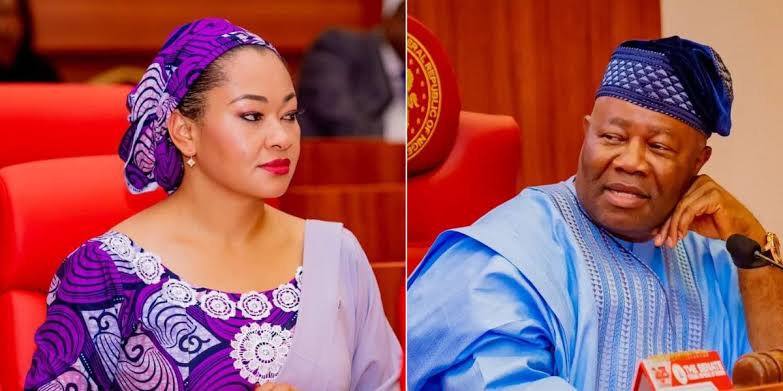

The Nigerian Senate has stated it will not immediately recall suspended Senator Natasha Akpoti-Uduaghan until she complies with a Federal High Court directive mandating her to issue a formal apology.
Senator Adeyemi Adaramodu, Chairman of the Senate Committee on Media and Public Affairs, clarified the Senate’s position in reaction to the recent court ruling.
He emphasized that while the court acknowledged the Senate’s authority to discipline its members, reinstatement would be subject to Akpoti-Uduaghan fulfilling the court’s orders.
“The court has not ousted the Senate’s statutory right to punish any erring senator,” Adaramodu said.
“It was established that the senator in question erred. The court has already told her to go and do some things, like restitution, so after the restitution, the Senate will now sit again and consider the content of that restitution, and that will inform our next line of action.”
Senator Akpoti-Uduaghan, representing Kogi Central under the Peoples Democratic Party (PDP), was suspended in March for six months over alleged gross misconduct.
The suspension followed her clash with Senate President Godswill Akpabio, reportedly over sitting arrangements.
The conflict escalated when Akpoti-Uduaghan, in a national TV interview, accused Akpabio of retaliating after she rejected alleged sexual advances—an accusation the Senate President strongly denied.
Akpoti-Uduaghan subsequently filed a lawsuit (FHC/ABJ/CS/384/2025), challenging her suspension.
In her ruling, Justice Nyako declared parts of the Senate’s Standing Rules and the Legislative Houses (Powers and Privileges) Act as overreaching, especially since they lacked a time limit for disciplinary suspensions.
The judge ruled that: “The court is not saying that the Senate lacks the power to sanction a member. However, such sanctions must not negate the constitutional right of constituents to be represented in parliament.”
Justice Nyako emphasized that the Senate’s suspension of the senator for 180 days, nearly the entire 181-day legislative year, effectively denied the people of Kogi Central proper representation in national affairs.
However, the court also found Akpoti-Uduaghan guilty of civil contempt for a satirical apology she posted on Facebook on April 27, which was deemed to have mocked the legal proceedings. Justice Nyako ruled:
“After reviewing the post and the application before her instituted by the third respondent, she was satisfied that it was linked to the suspension matter before the court and therefore found the plaintiff guilty of contempt.”
As part of her judgment, the judge ordered the senator to issue a genuine apology in two national newspapers and on her Facebook page within seven days, and to pay a ₦5 million fine.
When asked if the Senate would appeal the ruling, Adaramodu replied:
“Which judgment are we appealing when they (court) said the Senate has the right to discipline its erring members?”
He added that the Senate would only reconvene to deliberate after Akpoti-Uduaghan complies with the court’s instructions.
“The onus is no more on us now; it is already on her doorstep to go and apologise. Once she does that, then the Senate will sit and look at the content of her reaction as prescribed by the court.”
Legal counsel to the Senate, Paul Dauda, SAN, described the ruling as a partial victory for the upper chamber, particularly regarding the contempt issue.
“The first application filed by the Senate, that no social media posts should have been made, was decided in our favour.”
“The court directed that the satirical apology be taken down and that a proper apology be published in two national dailies. Additionally, damages of ₦5 million were awarded to be paid to the court.”
Dauda also noted that the court did not explicitly order Akpoti-Uduaghan’s reinstatement but suggested that the Senate could reconsider the issue after her compliance.
“There was no relief asking for the suspension to be lifted. The judge only made what we call an obiter dictum, a non-binding remark, that the suspension may have been excessive. We will consult with our colleagues, read the full judgment, and respond accordingly.”