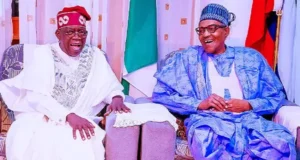
Former President Goodluck Jonathan has alleged that his successor, Muhammadu Buhari, targeted key members of his administration with harassment in connection to the controversial OPL-245 oil block transaction, popularly referred to as the Malabu scandal.
The former president made the accusation during the public unveiling of a memoir titled “OPL 245: Inside Story of the $1.3bn Nigerian Oil Block,” written by former Attorney-General of the Federation and Minister of Justice, Mohammed Bello Adoke.
Jonathan, represented at the event by former Senate President Pius Anyim, recounted how officials who served under him faced intense scrutiny and persecution after his administration ended in 2015.
“Shortly after my tenure ended in 2015, the succeeding government launched what many saw as a manhunt against key officers of my administration,” Jonathan said.
“The author of this memoir, Mr. Bello Adoke, was the Attorney-General of the Federation at that time. He was hunted across the globe over the OPL-245 matter.”
“But today, he is alive, he is healthy, and he is here to tell his story. Let me, therefore, use this occasion to congratulate Mr. Bello Adoke, my friend and brother, for his doggedness, and to say that I am pleased to join you in celebrating this victory. I urge all of us to remain conscious of the fact that power belongs to God.”
Jonathan also used the platform to stress the significance of justice and integrity in governance, asserting that any nation or institution that ignores these values cannot expect peace or progress.
“I must state, as always, that it is widely acknowledged among all civilisations that any society or organisation that does not promote justice and fairness will neither have peace nor make progress,” he added.
He called on public officeholders to commit themselves to upholding truth, justice, and equity in the execution of their duties.
The Malabu oil deal, which dates back to 1998 under the Sani Abacha administration, involved the allocation of OPL-245 to Malabu Oil and Gas. In 2011, the block was sold to multinational oil firms Shell and Eni for $1.3 billion.
However, investigations later revealed that $1.1 billion of the payment was funneled through intermediaries and allegedly used to pay bribes to Nigerian politicians and government officials.
The scandal led to multiple international probes, prosecutions, and court cases involving high-ranking Nigerian officials, including Bello Adoke, whose new book offers an insider account of the controversial deal.