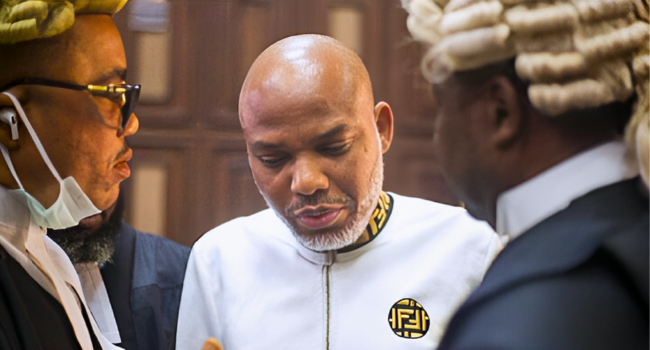

The Federal High Court in Abuja has set October 10 as the date to rule on the no-case submission filed by the detained leader of the Indigenous People of Biafra (IPOB), Nnamdi Kanu.
Justice James Omotosho fixed the date after hearing arguments from both the prosecution and defence during Friday’s proceedings.
Leading the prosecution, Adegboyega Awomolo (SAN) urged the court to dismiss the no-case submission and compel Kanu to open his defence in the terrorism charges filed against him.
Awomolo argued that the prosecution had presented sufficient evidence to warrant a defence.
“The prosecution has supplied sufficient evidence in proof of all elements of the offences charged to warrant the court to call on the defendant to enter a defence,” he said.
According to Awomolo, the prosecution had called five witnesses and tendered numerous exhibits, including audio and video recordings in which Kanu admitted to leading IPOB, a proscribed group, and calling for violence.
“In both the video and audio evidence tendered by the prosecution, Kanu admitted being the leader of the IPOB, which he knew was a proscribed group,” he said.
He criticized the defence counsel’s argument that Kanu’s broadcasts were merely “boasting” and not grounds for criminal prosecution.
“Why would somebody say a terrorist, who boasted that security men and other people should be killed, should be allowed to go free?” Awomolo asked.
“Boasting is not the answer. If the defendant believes that he was merely joking and was a content creator, he should be made to answer to why he was boasting and creating fear in the mind of the people.”
“When a person is boasting and threatening death and violence, that cannot be said to be mere boasting.”
Awomolo stated that at least 170 security officials were killed as a result of the defendant’s inciting broadcasts.
“The aim of the defendant was to create a separate state of Biafra, and in the process not less than 170 security men were killed because of his boasting,” he said.
He further dismissed claims made by Kanu’s lawyer, Kanu Agabi (SAN), that the IPOB leader had been in solitary confinement for 10 years.
“Kanu was first arrested in 2015, granted bail in 2017, and enjoyed the bail until 2022 when it was revoked for jumping bail. The current detention is based on a valid court order,” Awomolo said.
He accused the defence team of delaying the trial for three years.
“For three years, his counsel were responsible for the delay of trial. The delay had been the shenanigans of the defence team, not that of the prosecution,” he argued.
On the legality of IPOB’s proscription, Awomolo noted that the matter was pending before the Supreme Court and should not be deliberated by the trial court.
Defence Response: ‘It Was Just Boasting’
Responding, Kanu Agabi argued that the prosecution failed to prove any of the charges against his client. He dismissed the evidence as attempts to paint Kanu as a villain without substance.
“This man (Kanu) can boast. He was just boasting. He said I can bring the world to a standstill. I don’t see anything wrong with that. You don’t prosecute a man for mere boasting,” Agabi said.
He maintained that the prosecution presented no witnesses who testified to being incited by Kanu’s statements.
“No single element of the offences charged was proved by the prosecution,” he said.
Agabi also criticized the DSS’s role and the reliability of its witnesses:
“All the witnesses came from the DSS. That is why they kept saying I can’t remember; I am not aware because they did nothing,” he claimed.
He noted that during cross-examination, DSS witnesses used phrases such as “I don’t remember,” “I am not aware,” or “I do not know” over 80 times, failing to provide credible evidence.
“Memories have been lost, which is why most of the prosecution witnesses were saying they can’t remember, they don’t know, when they were asked questions,” he said.
He challenged the authenticity of the #EndSARS report and the death certificates tendered by the prosecution, noting that no doctors were brought for cross-examination.
Agabi further argued that Kanu had spent over six years in solitary confinement, violating international human rights standards:
“He is no longer normal on account of his solitary confinement. The case has been pending for 10 years,” he said.
He criticized the prosecution’s failure to respond to 10 out of 40 issues raised by the defence.
“If they (prosecution) failed to respond to one or two issues, it is enough for the court to acquit the defendant. But, in this case, the prosecution failed to respond to 10 issues raised by the defence.”
Agabi also insisted that the amendments to the charge sheet—now up to seven times—did not name any individuals allegedly incited by Kanu.
“The participation of the witnesses was not more than obtaining statements. The statements obtained from the defendant were not investigated,” he said.
On the issue of IPOB’s proscription, Agabi stated:
“Proscription does not lie without the President’s approval. We are saying there is no proscription, because there is no presidential approval; if they have it, they should bring it.”
He also argued that the court lacks jurisdiction over charges related to the allegedly imported transmitter, citing an earlier ruling by the Court of Appeal.
Justice Omotosho reserved ruling on the no-case submission until October 10, when he will determine whether Kanu must open his defence.