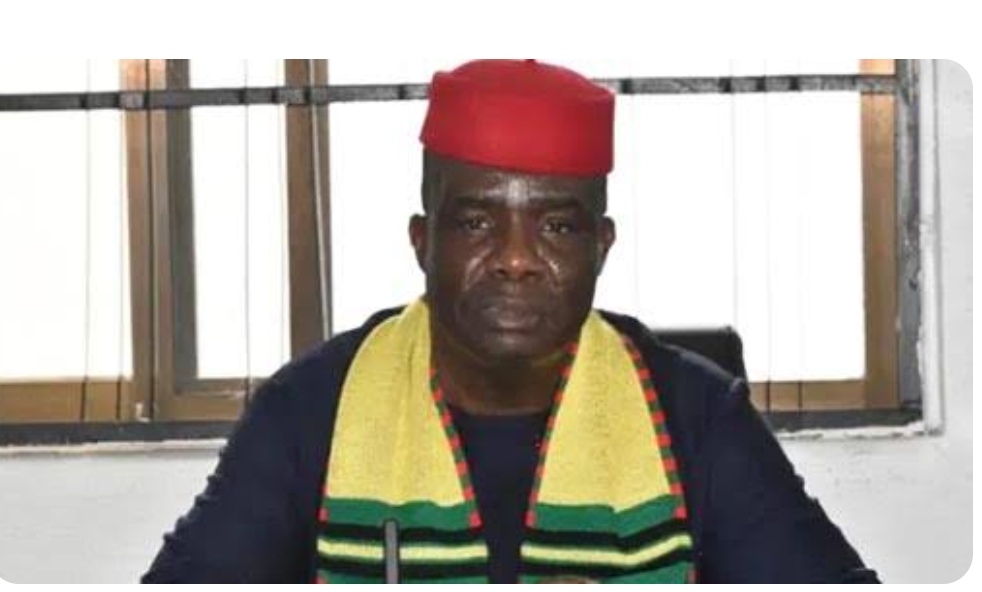

Retired Major General Ijioma Nwokoro Ijioma has decried the continued marginalisation of the Igbo people in Nigeria, stating that despite their unwavering loyalty to the idea of a united country, they remain politically and economically excluded.
Speaking at a virtual town hall meeting organised by Ikengaonline on Thursday, Gen. Ijioma argued that over 50 years after the civil war ended, the Southeast has yet to be fully reintegrated or accepted.
“Our people at the end of the war wholeheartedly wanted to be reintegrated into Nigeria and have done everything possible to convince Nigerians that we are Nigerians,” he said.
“But I want to observe that despite these efforts, it seems that there is an agreement by Nigerians that the war hasn’t ended.”
Gen. Ijioma, who served in the Nigerian Army for more than three decades and attained the rank of Major General, said his experiences in the military made it clear that the Igbo are still viewed as outsiders.
“Nigeria is still at war against Ndigbo,” he said. “My experience in service convinced me that the rest of Nigeria have not accepted that the war ended in 1970.”
He compared the national dynamic to a scenario where “six dwarfs ganged up against their giant sibling,” describing Nigeria as a country where smaller ethnic groups collectively suppress a larger one.
The retired general also highlighted the persistent denial of the presidency to the Igbo, pointing out that while other ethnic groups have occupied the highest political office, the Southeast has been systematically excluded.
“If President Tinubu runs his second course in 2027, that will be eight years. Then add it to eight years of former President Obasanjo, making it 16 years for the Yoruba nation,” he said.
“Add it to the six years of Jonathan, and eight years of Buhari, that is 30 years of political exclusion. By 2031, the presidency goes back to the North. That would be 38 years of continued exclusion of Igbo from the Nigerian presidency.”
Despite this marginalisation, Gen. Ijioma stressed the contributions of the Igbo to national development and unity.
“We fought because we had a just cause. I don’t know why Nigeria is so afraid of Ndigbo. It’s because of the fact that Ndigbo are true Nigerians.”
“I don’t just claim Ndigbo are the true Nigerians, but in theory and in practice we are the true Nigerians. The development Nigeria has made is as a result of the effort of Ndigbo. I will dare you and I will challenge you to show me an Hausa man in Igbo land developing it as we do outside Igbo land.”
“In Igbo land, you won’t see any Hausa man’s house, or any Yoruba man’s house, but look at Lagos and other parts of the country, we have landed property in them. Twenty five per cent of houses in Lagos belong to Ndigbo. The same thing in other cities. This is because we believe in One Nigeria.”
He questioned the logic behind excluding a people so committed to the country’s unity:
“Why is it that the people that are so committed to Nigeria are the people that are so excluded from Nigeria?”
Gen. Ijioma also criticised Southeast political leaders, particularly the governors, for their failure to present a unified front and protect the region’s interests. He blamed internal divisions for the region’s diminished political clout.
“When we were in PDP, were we not much stronger and was our voice not louder? Were we not respected?” he asked. “Now that you have APC crawling in and taking two states, you have Labour, you have PDP struggling in Enugu, and APGA in Anambra. Is there any doubt to anybody why our status has gone miserable? It’s because of division.”
Reflecting on the political timeline, he described 2015 to 2025 as the most challenging decade for the Igbo since independence.
“This is an era when Ndigbo people were excluded from the leadership of certain parties, excluded from the leadership of the legislative arm of government, and excluded from governance in Nigeria.”
Still, Gen. Ijioma expressed optimism, calling for introspection and unity among the Igbo to reclaim their place in national politics.
“But there is hope,” he said. “The hope is that Ndigbo will do a self-searching, self-re-evaluation to be able to do the whole of the united front.”
He warned against blind loyalty to leaders lacking credibility, noting that the erosion of values within the region was partly to blame for its current predicament.
“You see people following people who ordinarily do not have the integrity to be called leaders,” he said. “Is it not high time they held their political representatives to account?”
Concluding, the retired general affirmed that the Igbo still possess the numbers and capacity to claim the presidency, if they organise strategically and build alliances.
“With about 65 million people that make up the 200 million in Nigeria, the Igbo, with marginal support from other regions, can put one of their own kind in the presidency come 2027.”