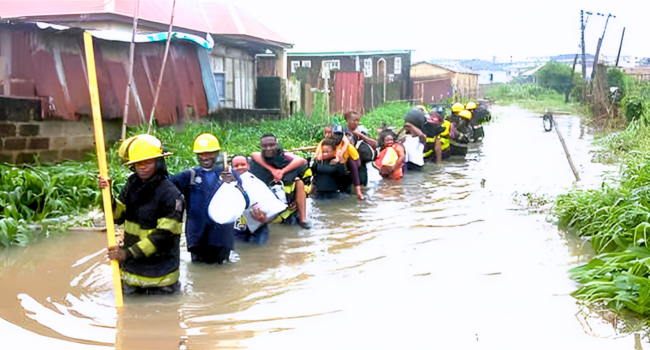

The Lagos State Government has issued a strong advisory urging residents in flood-prone areas such as Lekki, Ikorodu, and Ajegunle to immediately relocate from lowlands to higher ground as the state braces for more intense rainfall and flash flooding in 2025.
The warning was delivered by Tokunbo Wahab, the state Commissioner for Environment and Water Resources, during an interview on Politics Today, a programme aired on Channels Television on Tuesday, August 5.
“Those around the Ajilete axis of Lagos, that’s Ajegunle, they have to move. Those around the coastline of Ikorodu; Majidu, have to move. Some areas around the Lekki corridor, too, not all,” Wahab said.
He further emphasized that while certain areas are at risk, others remain relatively safe.
“Epe had always been safe, Mushin will be safe, Ikeja will be safe,” he added, also alerting residents in Isheri (OPIC area) to be cautious.
Wahab explained that Lagos, as a coastal city, is highly vulnerable to the effects of climate change, particularly flash floods resulting from heavy and prolonged rainfall.
“We won’t tell Lagosians lies. Lagos will be exposed to the vagaries of climate change, and that means Lagos will have flash flooding, but as a state, we have to provide resilient infrastructure, and we have to tell our people to be responsible,” he stated.
Referring to recent predictions by the Nigerian Meteorological Agency (NiMet), the commissioner noted that this year’s rainfall is expected to exceed that of 2024, increasing the risk of flooding in low-lying parts of the state.
“For those who stay in the lowland of Lagos, they have to move to the upland pending when the rain recedes,” he advised.
His comments come in the wake of widespread flooding across Lagos earlier this week, after marathon rainfall that began on Sunday night and lasted until Monday evening, leaving streets submerged and disrupting economic activity.
Viral videos from affected communities showed homes and vehicles underwater, with residents wading through flooded streets caused by overflowing drainage systems and clogged canals.
Despite the challenges, Wahab assured the public that the state government is actively working to address the situation.
“If nature takes its course, what we can do is to mitigate its impact,” he said, noting that efforts are ongoing to clear drainage channels and expand flood pathways as part of long-term mitigation measures.