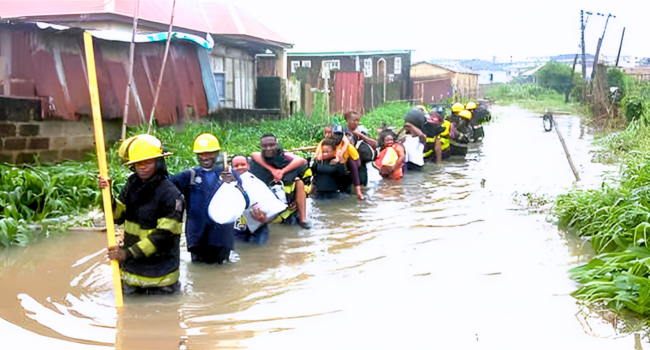

Two suicide attempts were averted in Ogbaru Local Government Area of Anambra State after massive flooding submerged farmlands, pushing some farmers to the brink of despair.
It took the timely intervention of local villagers to prevent the two individuals from taking their own lives.
The flooding, predicted earlier by the Nigerian Meteorological Agency (NiMet), has begun to impact not only coastal states but also parts of the North, South-East, and South-South regions.
In recent weeks, persistent torrential rainfall in the South-East has caused the River Niger to overflow, submerging large expanses of farmland in Ogbaru and leaving devastation in its wake.
According to local reports, many of the affected farmers had taken out loans for the current planting season.
The destruction of their crops has left them anxious and hopeless, with no clear means of repaying their debts, a situation that reportedly drove two of them to attempt suicide.
Ogbaru, a riverine area located along the banks of the River Niger and bordering Delta and Rivers States, is once again grappling with the harsh reality of its flood-prone geography.
Communities including Ossomala, Obeagwe, Akili Ogidi, Ogwuikpele, Ogwuaniocha, and several farm camps have been hit hard, with residents describing the flood as overwhelming.
Homes, farmlands, and infrastructure have been consumed by rising waters.
Many locals have voiced frustration over the lack of government support in the face of the disaster.
Residents say no meaningful efforts have been made to relocate them or provide relief materials and medical aid.
Mr. Adimali Nwachukwu, a yam and cassava farmer in Ogwuikpele, expressed his deep distress:
“The flood has destroyed me. It has ruined my hopes and wasted my labour. I don’t know where to start from. I borrowed money at a high interest rate to invest in large-scale farming this year.”
A widow, Nwakaego Nwafili, who cultivates cassava and maize, shared her heartbreaking experience:
“This year’s flood is suffocating me. Since the heavy rains started in July, I’ve been having panic attacks, knowing what was to come. I haven’t been sleeping at night, my mind is constantly preoccupied with my farm. I’m heartbroken as I speak to you now.
“All my crops are submerged underwater. I don’t have the funds to hire labourers to help with the harvest. I’m doing the premature harvesting by myself. I’m ruined.”
Another resident, Mrs. Oluchi Nzekwe, revealed that the flooding has taken a toll on her family’s health and well-being.
She disclosed that her husband’s blood pressure has risen sharply since the floods began, adding that their sole source of livelihood, farming, has been severely affected.
In June, the National Emergency Management Agency (NEMA), in collaboration with the Anambra State Emergency Management Agency (SEMA), visited Ogbaru for a flood simulation and awareness campaign.
The operation was designed to test Nigeria’s preparedness for forecasted flooding, strengthen inter-agency collaboration, and educate vulnerable communities.
Speaking during the exercise, NEMA Director-General, Mrs. Zubaida Umar, emphasized the agency’s commitment to proactive disaster management, particularly in flood-prone states highlighted in the 2025 Seasonal Climate Prediction by NiMet.
“The simulation was a demonstration of the agency’s proactive approach to disaster management, particularly in high-risk flood-prone states like Abia, Anambra, and Imo, as identified in the 2025 Seasonal Climate Prediction by the Nigerian Meteorological Agency (NiMet) and the Annual Flood Outlook,” she said.