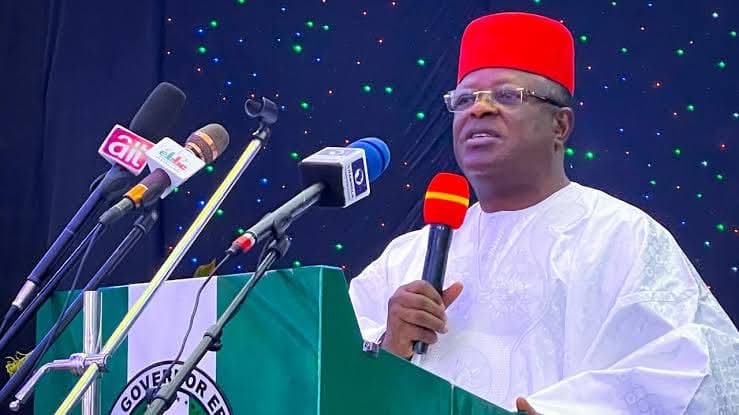

The Minister of Works, David Umahi, has disclosed that the structural rehabilitation of the Third Mainland Bridge in Lagos State will cost more than ₦3 trillion.
Speaking after the Federal Executive Council (FEC) meeting in Abuja, Umahi explained that underwater and structural assessments revealed significant damage to the bridge’s piles and piers caused by illegal sand mining, erosion, and corrosion.
“The rehabilitation is estimated at ₦3.8 trillion, while a complete rebuild would cost about ₦3.6 trillion,” the minister said.
“We have approval for at least seven specialist contractors to carry out detailed investigations, designs and bids for both rehabilitation and new construction under an EPC+F [Engineering, Procurement, Construction and Financing] arrangement.”
Umahi added that similar findings were reported from earlier studies on the Carter Bridge in Lagos, which was deemed beyond repair.
Contractor Julius Berger recommended a full replacement, with costs estimated at ₦359 billion.
Following FEC’s approval, the government will invite public-private partnership bids for the projects and is exploring funding options with international lenders such as Deutsche Bank.
The Third Mainland Bridge, Nigeria’s longest bridge, was inaugurated in 1990 and serves as a vital transport artery for Lagos’ estimated 20 million residents.
Although periodic maintenance has been carried out over the years, recent inspections showed more severe damage than previously known.
“The underwater problems are compounded by decades of neglect and human activities that have undermined the bridge’s substructure,” Umahi explained.
He emphasised the urgency of the project, saying, “We cannot delay. If we decide on rehabilitation, it will require huge resources and specialised engineering. If we opt for a new build, it is slightly less costly but still a massive undertaking.”
In addition to the Lagos bridges, Umahi said the FEC approved interventions for several other damaged bridges across Nigeria, including the Jalingo Bridge in Taraba State, the Ido Bridge damaged by fire, Keffi Flyover in Nasarawa State, Mokwa Bridge in Niger State, a bridge on the Abuja–Kogi route, bridges on the Lagos–Ibadan corridor hit by vehicles, the Jebba Bridge in Kwara State, and the Itokin–Ikorodu Bridge in Lagos.
“These emergency works will be documented and forwarded to the President for approval through the Ministry of Finance,” he added.
Umahi also announced that the FEC had allocated ₦493 billion for two major infrastructure projects: upgrading the Kano–Katsina Road and constructing a new Carter Bridge.
The 152-kilometre Kano–Katsina Road, initially awarded in two contracts, has undergone significant cost revisions due to current economic realities.
Section One’s cost rose from ₦14 billion in 2013 to ₦68 billion, while Section Two’s price moved from ₦29 billion in 2019 to ₦66.115 billion.
He noted, “₦6 billion and ₦34 billion had been allocated in the 2024 and 2025 budgets, respectively, for Section One, while Section Two will receive ₦80 billion over the same period.”
The minister underscored the importance of bridge and road infrastructure to economic growth and national connectivity.
“We are pursuing partnerships that will bring in private capital while ensuring that the government retains oversight and quality control,” Umahi said, stressing the use of the EPC+F model and PPP arrangements to ease the funding burden on the federal budget.
The Third Mainland and Carter bridges are key components of Lagos’ main road network, carrying hundreds of thousands of vehicles daily.
Umahi revealed that detailed studies and procurement processes for the Lagos bridge projects would begin immediately, with timelines dependent on financing agreements.