
The United States has granted approval for a potential Foreign Military Sale to Nigeria, involving advanced munitions and support systems valued at an estimated $346 million.
According to a statement from the Defense Security Cooperation Agency (DSCA) dated August 13 and received via email on Thursday, the U.S State Department authorized the transaction, which includes a wide range of precision bombs, rockets, and related equipment.
“The State Department has made a determination approving a possible Foreign Military Sale to the Government of Nigeria of Munitions, Precision Bombs, and Precision Rockets and related equipment for an estimated cost of $346m. The Defence Security Cooperation Agency delivered the required certification notifying Congress of this possible sale today,” the DSCA said.
The Nigerian government is requesting to acquire several categories of military hardware under the proposed deal. These include:
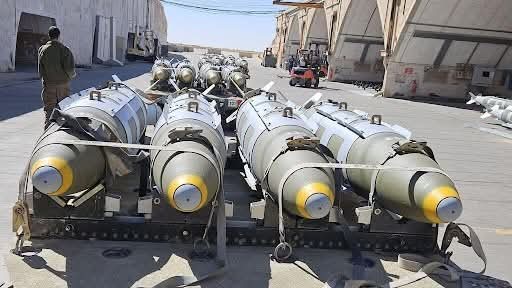
– 1,002 MK-82 general purpose 500-pound bombs
– 1,002 MXU-650 Air Foil Groups (AFGs) for Paveway II GBU-12
– 515 MXU-1006 AFGs for 250 lb Paveway II GBU-58
– 1,517 MAU-169 or MAU-209 computer control groups for Paveway II GBU-12/GBU-58
– 1,002 FMU-152 joint programmable fuzes
– 5,000 Advanced Precision Kill Weapon System II (APKWS II) all-up-rounds (AURs)
“The Government of Nigeria has requested to buy one thousand two (1,002) MK-82 general purpose 500 lb bombs; one thousand two (1,002) MXU-650 Air Foil Groups (AFGs) for 500 lb Paveway II GBU-12; five hundred fifteen (515) MXU-1006 AFGs for 250 lb Paveway II GBU-58; one thousand five hundred seventeen (1,517) MAU-169 or MAU-209 computer control group (CCG) for Paveway II GBU-12/GBU-58; one thousand two (1,002) FMU-152 joint programmable fuzes; and five thousand (5,000) Advanced Precision Kill Weapon System II (APKWS II) all-up-rounds (AURs) (consisting of one each WGU-59/B guidance section (GS); high-explosive warhead; and MK66-4 rocket motor),” the statement outlined.
In addition to the main weapons systems, the package includes supporting items such as FMU-139 joint programmable fuzes, bomb components, impulse cartridges, and both high-explosive and practice rockets. It also features test equipment, integration support, and logistical services.
“The following non-MDE items will also be included: FMU-139 joint programmable fuzes; bomb components, impulse cartridges, and high-explosive and practice rockets; integration support and test equipment; U.S. Government and contractor technical, engineering, and logistics personnel services; and other related elements of logistical and program support. The total estimated programme cost is $346m,” the agency noted.
The DSCA emphasized that the deal supports U.S. foreign policy objectives and aims to enhance the defense capabilities of a key African ally.
“This proposed sale will support the foreign policy goals and national security objectives of the United States by improving the security of a strategic partner in Sub-Saharan Africa.”
“The proposed sale will improve Nigeria’s capability to meet current and future threats through operations against terrorist organisations and to counter illicit trafficking in Nigeria and the Gulf of Guinea. Nigeria will have no difficulty absorbing these munitions into its armed forces.”
The agency further clarified that the transfer would not disrupt the regional military balance nor impact U.S. defense preparedness.
“The proposed sale of this equipment will not alter the basic military balance in the region,” the statement affirmed. “There will be no adverse impact on U.S. defense readiness as a result of this proposed sale.”
Key contractors expected to be involved in the deal include RTX Missiles and Defense, Lockheed Martin Corporation, and BAE Systems.
“At this time, the U.S. Government is not aware of any offset agreement proposed in connection with this potential sale. Any offset agreement will be defined in negotiations between the purchaser and the contractor. Implementation of this proposed sale will not require the assignment of any additional U.S. Government or contractor representatives to Nigeria.”
The statement also noted that the actual cost of the deal may vary based on future negotiations and final requirements.
“The description and dollar value are for the highest estimated quantity and dollar value based on initial requirements. Actual dollar value will be lower depending on final requirements, budget authority, and signed sales agreement(s), if and when concluded,” the DSCA concluded.