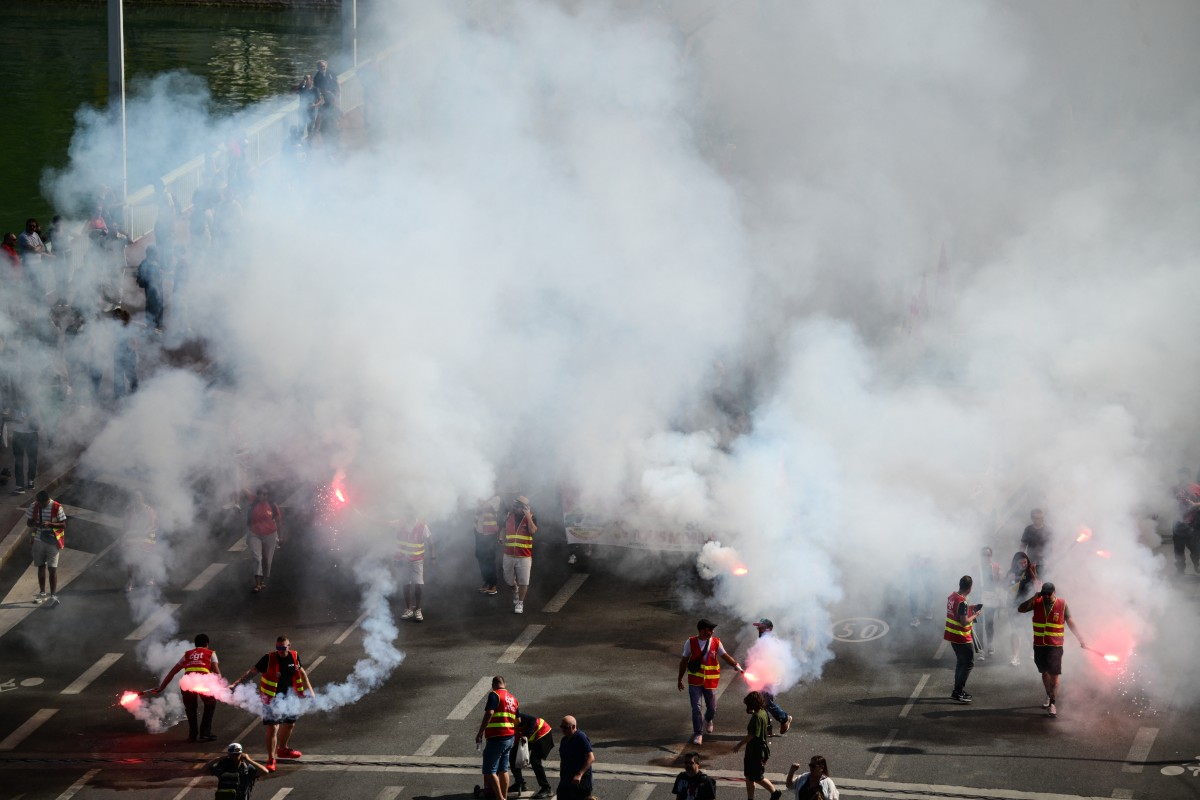

Thousands of protesters across France took to the streets on Thursday in a massive show of resistance against President Emmanuel Macron’s austerity measures, triggering nationwide strikes and disrupting transport, schools, and essential services.
Public transport was brought to a standstill in many areas, schools were shuttered, and tens of thousands demonstrated in major cities including Paris, Lyon and Marseille.
Sporadic clashes broke out between protesters and police, with tear gas deployed in several cities to disperse crowds.
This wave of unrest follows public outrage over the government’s proposed €44 billion cost-cutting budget, introduced by former Prime Minister François Bayrou.
Although the new Prime Minister, Sébastien Lecornu, Macron’s seventh in office, has promised a new direction, his appointment has done little to ease tensions.
“We’re tired of watching the rich get richer while we struggle to survive,” said Bruno Cavalier, 64, protesting in Lyon with a sign reading “Smile, you are being taxed.”
The demonstrations were sparked by budget proposals that include eliminating two public holidays and curbing perks for former prime ministers.
Despite promises to abandon some of these plans, discontent remains high.
More than 80,000 security personnel, including police and gendarmes, were deployed across the country.
Armoured vehicles, drones, and water cannons were also on standby.
The Interior Ministry estimated that between 600,000 and 900,000 people would join the protests nationwide.
By midday Thursday, over 76,000 people had already taken part.
The strikes saw major turnout from various sectors. Around one in six teachers walked off the job, and nine out of ten pharmacies closed their doors.
Paris commuters faced major disruptions, with only three automated metro lines running as usual.
Unions hailed the turnout as a success. “We’ve recorded 260 demonstrations nationwide and thousands of strikes across sectors,” said Sophie Binet, head of the CGT union.
Violent incidents were reported in cities like Lyon and Marseille.
A journalist and a police officer were injured during clashes in Lyon, while in Marseille, video footage showed a police officer kicking a protester on the ground.
Protesters also blocked bus depots in Lille and several secondary schools in Paris. About 300 students gathered at Maurice Ravel Secondary School in the capital’s east, waving signs that read, “Block your school against austerity.”
The protests come at a time when President Macron’s popularity is at an all-time low, with just 18 months left in his term. Critics blame him for fuelling unrest.
“The president is the source of this chaos,” said left-wing leader Jean-Luc Mélenchon at a rally in Marseille.
Authorities fear further violence. Paris police chief Laurent Nuñez warned that radical groups might infiltrate peaceful protests and advised central Paris shops to stay closed during the demonstrations.
While a smaller day of protest held earlier this month had limited impact, Thursday’s action marks the largest mobilisation since last year’s uproar over Macron’s controversial pension reforms, which were passed without a parliamentary vote.