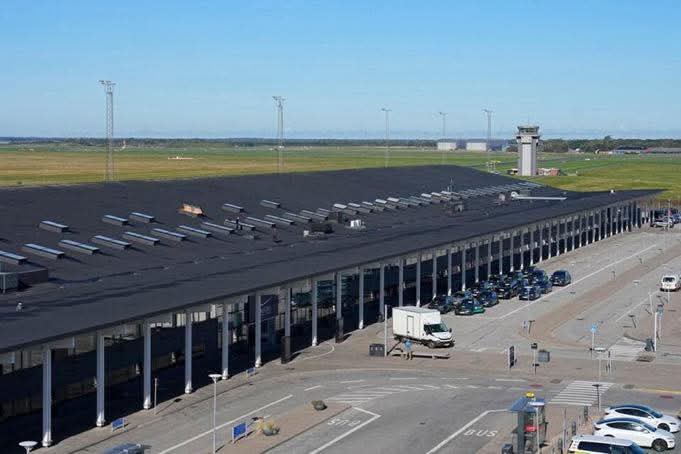

Danish airports were forced to close twice within hours on Friday due to suspected drone sightings, in what the country’s leadership describes as part of ongoing “hybrid attacks” possibly linked to Russia.
Since Wednesday, drones have been spotted flying over multiple Danish airports, prompting prolonged closures including Copenhagen and Aalborg airports.
This activity follows similar incidents in Norway, Poland, Romania and a breach of Estonian airspace by Russian fighter jets, heightening tensions amid Russia’s invasion of Ukraine.
“Denmark has been targeted by hybrid attacks over recent days,” Prime Minister Mette Frederiksen said in a social media video on Thursday, warning that such drone operations “could increase.”
While investigators have yet to identify the perpetrators, Frederiksen singled out Russia as “the main threat to Europe’s security.”
Moscow denied involvement, labeling the claims a “staged provocation.”
Justice Minister Peter Hummelgaard stated the drone flights aim “to spread fear, create division, and intimidate us.”
He announced plans to enhance Denmark’s capabilities to detect and neutralize drones.
On Friday, Denmark will join other EU nations, especially those bordering Russia, in discussions on proposals to build a defensive “anti-drone wall” in response to rising tensions.
Drones were reported over Aalborg, Esbjerg, Sonderborg airports, and Skrydstrup air base between Wednesday and early Thursday.
Aalborg Airport was closed for several hours on Wednesday and again for about an hour early Friday after new drone sightings.
North Jutland police chief Jesper Bojgaard Madsen said, “It was not possible to take down the drones, which flew over a large area for hours.”
Denmark’s military intelligence head Thomas Ahrenkiel told a press conference the source of the drones remains unknown.
However, intelligence chief Finn Borch warned that the risk of Russian sabotage in Denmark “is high.”
Defense Minister Troels Lund Poulsen described the operation as “systematic” and “professional,” noting it occurred simultaneously in many locations.
He reassured the public that there was “no direct military threat” to Denmark.
Prime Minister Frederiksen has discussed the incidents with NATO Secretary-General Mark Rutte.
The government is considering invoking NATO’s Article 4, which allows urgent consultations when a member’s security or sovereignty is threatened.
French President Emmanuel Macron pledged support, saying France stands ready “to contribute to the security of Danish airspace.”
Investigations continue with cooperation from Danish intelligence and the armed forces.
The drone activity has unsettled some Danes. 85-year-old Birgit Larsen said, “I feel rather insecure. I live in a country that has been peaceful since 1945. I’m not used to thinking about war.”
Others took a more pragmatic view. 48-year-old Torsten Froling commented, “It’s probably Russia testing Europe’s borders, trying to provoke but not directly threaten.”
This surge in drone activity comes as Denmark announced plans to acquire long-range precision weapons for the first time, anticipating Russia will remain a significant security challenge for years ahead.