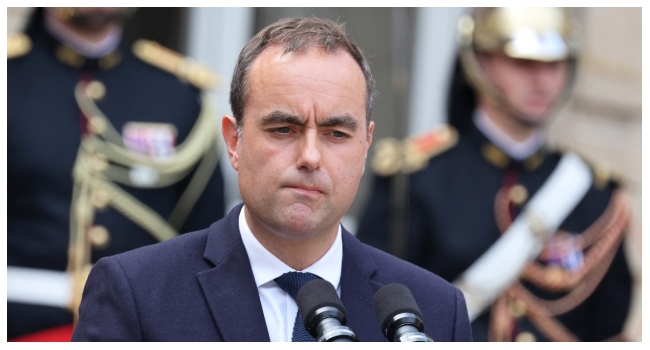

France’s President Emmanuel Macron has accepted the resignation of Prime Minister Sébastien Lecornu, just hours after the new cabinet was announced, a move that deepens the country’s political gridlock.
Lecornu, a former defence minister, had been appointed only last month.
However, the largely unchanged cabinet he unveiled on Sunday drew sharp criticism from across the political spectrum, increasing the pressure on his administration.
The outgoing prime minister faced the daunting challenge of securing legislative approval in a fragmented parliament for France’s proposed austerity budget, a task many of his predecessors failed to achieve.
Indeed, his two immediate predecessors, François Bayrou and Michel Barnier, were dismissed during budget standoffs in the legislature.
France currently carries record-high public debt, with its debt‑to‑GDP ratio ranking third highest in the European Union, trailing only Greece and Italy and nearing twice the 60 % ceiling set by EU rules.
Lecornu had pledged to break from recent precedent by allowing a full debate and vote on the budget rather than using constitutional shortcuts to push it through.
Yet, his sudden exit casts more uncertainty over the nation’s political future.
Macron’s gamble on snap parliamentary elections in mid‑2024 backfired, leaving his bloc without a majority and intensifying the nation’s deadlock.
Lecornu now becomes the latest casualty in this turbulent era of French politics.