
The Human Rights Writers Association of Nigeria (HURIWA) has praised the Independent National Electoral Commission (INEC) for its recent efforts to enhance electoral fairness, notably the delineation of the Warri Federal Constituency in Delta State.
However, political tensions continue to mount over the President’s authority to appoint INEC officials.
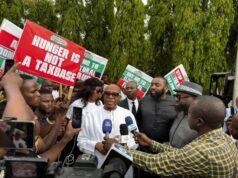
Leaders of Nigeria’s registered political parties convened yesterday to urge the National Assembly to remove the President’s power to appoint the INEC chairman and other top officials.
This demand coincides with increasing calls from civil society groups and youth organizations supporting a bill currently being debated in the National Assembly aimed at comprehensive electoral reform.
Rauf Aregbesola, former Osun State governor and National Secretary of the African Democratic Congress (ADC), stressed the urgency of reforming Nigeria’s electoral system to restore public confidence and ensure credible elections.
Similarly, Peter Obi, the Labour Party’s presidential candidate in 2023, challenged INEC and security agencies to uphold integrity by conducting thorough screening of candidates ahead of the 2027 elections.
Political party leaders highlighted the crucial role of parties in democracy and insisted they must have input in selecting election officials.
Yusuf Dantalle, Chairman of the Inter-Party Advisory Council (IPAC), speaking through Deputy Chairman Dipo Olayokun, argued that free and fair elections are impossible when INEC is subordinate to the executive.
IPAC called for the establishment of an Independent Appointment Committee (IAC) comprising representatives from registered political parties, civil society, the National Judicial Council (NJC), and the National Assembly to oversee INEC appointments, ensuring impartiality.
Further, IPAC recommended abolishing State Independent Electoral Commissions (SIECs), transferring local council election responsibilities to INEC, and adopting a system where vacancies due to decamping or death are filled by the original winning party instead of costly by-elections.
Senate President Godswill Akpabio, represented by Senator Tahir Monguno, urged political actors to view the Constitution as a dynamic document that should evolve alongside Nigeria’s realities.
He called for a strengthened INEC and an independent judiciary, referencing reforms in India and South Africa as examples.
Akpabio highlighted judicial reform, women’s inclusion, and local council autonomy as vital for the nation’s democratic stability.
Deputy Speaker of the House of Representatives, Benjamin Kalu, echoed the call for institutional reforms to ensure credible elections, empowered local governments, and inclusive governance that rise above partisan politics.
The electoral reform bill, submitted by former Anambra South Senator Ikechukwu Obiorah, aims to remove the President and governors’ power to appoint officials of both INEC and SIECs.
Instead, it proposes forming a new, internationally-modeled electoral body to restore credibility and impartiality in Nigeria’s elections.
Abdulrahman Aliyu, President of the National Muslim Youth Association (NMYA), stressed that free and fair elections remain unattainable as long as those contesting elections appoint the officials managing them.
He applauded technological innovations like the Bimodal Voter Accreditation System (BVAS) and INEC Result Viewing Portal (IReV) but warned that without institutional independence, these tools can be undermined.
Aliyu urged the National Assembly to swiftly pass the constitutional amendment bill and called on the Presidency and state assemblies to collaborate to make it law.
The bill outlines that professional bodies such as the Nigerian Bar Association (NBA), Nigerian Medical Association (NMA), Nigerian Union of Journalists (NUJ), Academic Staff Union of Polytechnics (ASUP), Academic Staff Union of Universities (ASUU), and the Institute of Chartered Accountants of Nigeria (ICAN) would each elect one commissioner from different geopolitical zones, promoting transparency and reducing political interference.
At the launch of the Athena Election Observatory (AEO), former Osun State Governor Aregbesola rejected the current system where the chief beneficiary of electoral manipulation appoints INEC officials.
He advocated for a new framework where political parties with a minimum of five members in the National Assembly nominate INEC leaders on an equal footing.
Peter Obi warned that Nigeria’s leadership crisis will worsen if candidates with forged credentials continue to gain office unchecked.
He condemned the trivialization of forgery, a crime punishable by disqualification and prosecution worldwide, describing its dismissal in Nigeria as a dangerous double standard undermining leadership integrity.