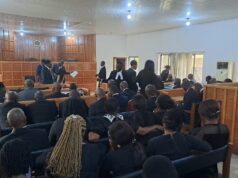

Court Rules In Favour Of Air Force Officer Seeking Voluntary Retirement, Declares NAF’s Refusal Illegal
In a significant ruling that reinforces the constitutional right of Nigerians to resign from public service, the National Industrial Court of Nigeria (NICN), Abuja Division, has delivered judgment in the case of NICN/ABJ/453/2024 – Smart A. Amough v. Nigerian Air Force & Chief of Air Staff, siding with Squadron Leader Smart A. Amough, a serving officer in the Nigerian Air Force (NAF), who challenged the refusal of the military authority to accept his voluntary retirement.
Justice O.Y Anuwe held that Amough had met all statutory and constitutional requirements for resignation and declared the Nigerian Air Force’s refusal to accept his retirement “null, void and of no effect.”
Squadron Leader Amough, who joined the NAF on August 23, 2013, through the Direct Short Service Commission, had served for 11 years before applying for voluntary retirement on September 4, 2024.
According to the Harmonised Terms and Conditions of Service for Officers of the Armed Forces of Nigeria (HTACOS) 2017 (Revised), officers with a Direct Regular Commission who have served for at least 10 years are eligible to retire voluntarily, a condition Amough clearly met.
Despite this, the Chief of Air Staff, via a letter dated October 31, 2024, rejected his retirement request, citing Paragraph 03.12 of HTACOS.
According to the military, Amough had recently completed a training course in the United States in November 2023 and officers who attend courses of nine months or more are barred from resigning within three years unless approved by the Service Chief and Council.
The NAF argued that Amough could only reapply after November 2026.
Amough, represented by his counsel, Chimezie Ogenna Nwodo Esq, disagreed and filed an originating summons, asking the court to determine whether his rights under HTACOS and the Constitution had been violated.
In a well-reasoned judgment, the court analyzed the provisions of HTACOS, particularly Paragraphs 03.12 and 05.04(a).
It found that the cumulative duration of the trainings attended by Amough, which took place in Ghana, France and the United States, amounted to just over five months, well below the nine-month threshold that would trigger the three-year restriction clause in HTACOS.
Justice O.Y Anuwe held that:
“The course attended by the claimant did not last up to nine months as required under Paragraph 03.12. Therefore, the three-year debarment from voluntary retirement does not apply to him.”
Even more crucially, the court invoked Section 306(1) and (2) of the 1999 Constitution, which grants every public officer the right to resign, effective upon delivery of the resignation letter to the appropriate authority.
“The Constitution provides that resignation takes effect upon receipt. Whether or not the employer accepts the resignation, the employment ends once the letter is received or on the effective date specified by the employee,” the judge ruled.
Quoting binding authorities, including Ibrahim v. Abdallah and WAEC v. Oshioneho, the court reaffirmed that no employer, not even the Nigerian Air Force, can block an employee from resigning where constitutional rights are in play.
The court granted five of the six reliefs sought by Amough, including:
- A declaration that he was eligible for voluntary retirement under HTACOS;
- A declaration that the NAF could not lawfully reject his application;
- An order setting aside the October 31, 2024, rejection letter from the Chief of Air Staff;
- A declaration that Amough is deemed to have retired effectively from 30th September 2024, the date he had indicated in his letter;
- A perpetual injunction restraining the Nigerian Air Force and its agents from interfering with his liberty or attempting to enforce service obligations against him.