The Nigerian Presidency has strongly pushed back against a recent World Bank report estimating that 139 million Nigerians currently live in poverty.
The government called the figure “unrealistic” and said it misrepresents local economic conditions.
In a statement posted to social media, Sunday Dare, Special Adviser to President Bola Tinubu, argued that the World Bank’s poverty model is based on outdated metrics and doesn’t capture the complexities of Nigeria’s informal and subsistence economies.
“The figure is based on a global poverty benchmark of $2.15/day, set in 2017 under Purchasing Power Parity (PPP) terms. When converted to today’s nominal value, it equates to roughly ₦100,000 per month, which is above Nigeria’s new minimum wage of ₦70,000,” Dare said.
He added that the World Bank’s numbers are theoretical projections, not actual real-time headcounts of Nigerians living in poverty.
The Presidency stated that Nigeria is currently on a path of recovery and reform, emphasizing that economic hardship is being tackled through structural policy changes rather than temporary relief.
Key government initiatives highlighted include Conditional Cash Transfers to over 15 million households, with ₦297 billion disbursed since 2023, Renewed Hope Ward Development Programme, targeting micro-projects across 8,809 wards, Expanded N-Power, TraderMoni, FarmerMoni, and School Feeding Programmes, Subsidised food distribution and fertiliser access to ease inflation, Renewed Hope Infrastructure Fund, supporting housing, roads, and energy as well as National Credit Guarantee Company, enabling access to small business loans.
The Tinubu administration said it’s focused on building a resilient and inclusive economy, correcting decades of neglect and systemic problems.
Structural reforms like fuel subsidy removal and exchange rate unification, while painful, are necessary to stabilize the economy, officials said.
“Even the World Bank acknowledges signs of macroeconomic improvement, rising revenue, stabilizing FX, and easing inflation,” the statement added.
Despite acknowledging Nigeria’s reform efforts, the World Bank expressed concern that poverty continues to rise.
During the release of the October 2025 Nigeria Development Update, Country Director Mathew Verghis said that while Nigeria’s macroeconomic indicators are improving, these gains have yet to translate into better living conditions for most Nigerians.
“Poverty has increased since 2019 and continues to rise. In 2025, we estimate that 139 million Nigerians live in poverty,” Verghis said.
The figure is a significant jump from 129 million in April 2025 and 87 million in 2023.
Opposition parties, labour unions, and analysts reacted with varying degrees of criticism and support.
Tony Akeni of the Labour Party said the poverty figures reflect the daily struggles of ordinary Nigerians, claiming government reforms have yet to yield tangible benefits.
Ladipo Johnson of the NNPP warned of growing debt and worsening conditions due to poor policy execution.
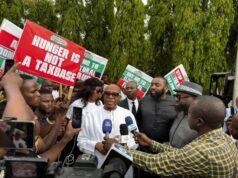
Timothy Osadolor of the PDP accused the government of misleading the public, adding, “We don’t need the World Bank to tell us people are hungry.”
Bola Abdullahi of the ADC dismissed the government’s growth claims as meaningless to the average citizen.
Chris Onyeka of the Nigeria Labour Congress (NLC) said, “Poverty is not a statistic, it is a lived experience,” lamenting that a ₦70,000 wage barely covers a bag of rice.
Economists acknowledged that reforms are necessary but stress the need for short-term relief measures to ease the impact on citizens.
Muda Yusuf (CPPE) noted that the transition phase of economic recovery has worsened poverty due to inflation.
Prof. Akpan Ekpo called for double-digit, sustained growth and heavy investments in human capital.
Okechukwu Unegbu, a former bank chief, warned against overreliance on World Bank data but admitted that poverty is widespread.
Teslim Shitta-Bey of Proshare said the key challenge is ensuring reform gains benefit ordinary people, calling for more digital and energy infrastructure.