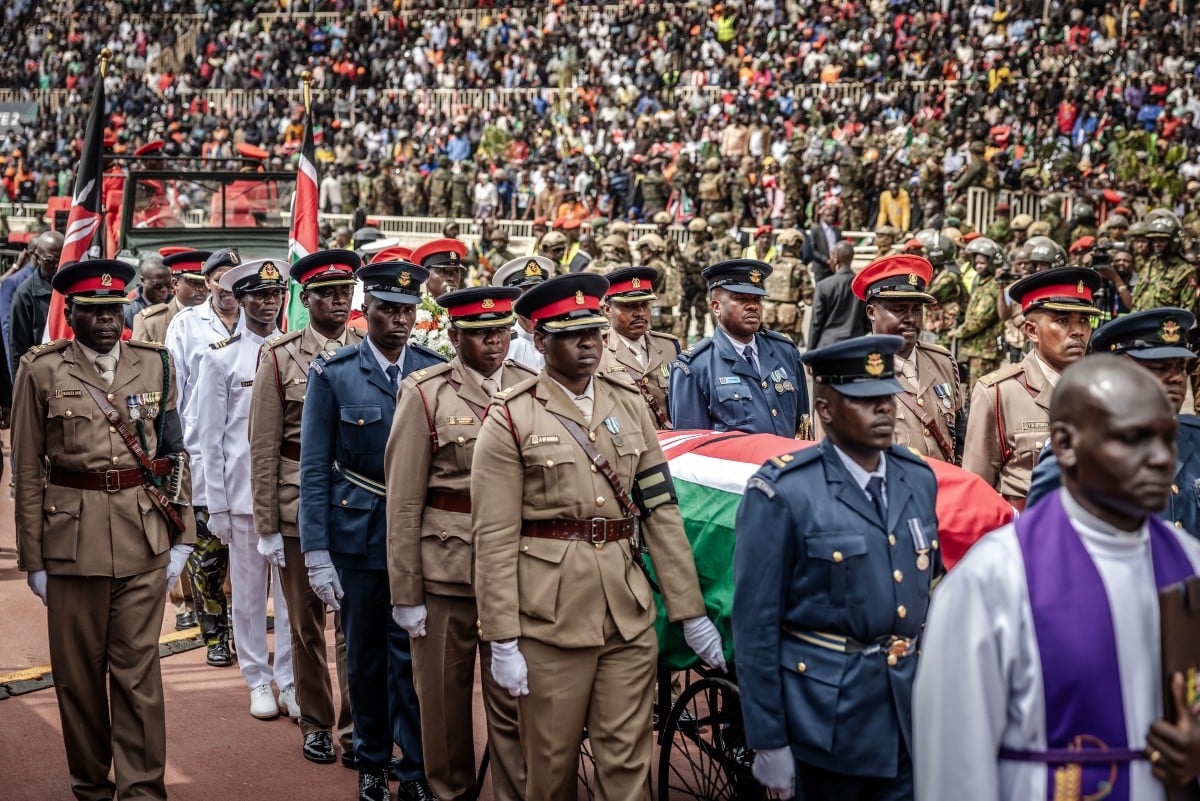

At least four people lost their lives on Thursday in Nairobi as massive crowds gathered to pay final respects to Kenya’s former Prime Minister and opposition icon, Raila Odinga, whose body had just been flown in from India.
Odinga, 80, died on Wednesday while receiving medical treatment abroad, prompting a seven-day national mourning period declared by President William Ruto.
The tragic incident occurred at a stadium in the capital where Odinga’s body was lying in state.
Thousands of mourners, many having arrived from across the country, surged toward the gates, overwhelming security barriers.
As the crowd breached the main entrance, soldiers fired into the air in a desperate bid to control the situation.
Police later fired teargas to disperse the gathering, causing further chaos and injuries.
According to Reuters, two people were confirmed shot dead on site.
However, local media houses KTN News and Citizen TV later reported that the death toll had risen to four, with dozens injured and the stadium left largely deserted.
Earlier that day, thousands of Odinga’s supporters stormed Nairobi’s Jomo Kenyatta International Airport, disrupting a scheduled state reception for the late leader’s body.
President Ruto and military officials were forced to halt the official handover ceremony as mourning crowds overwhelmed the tarmac, forcing airport authorities to suspend operations for over two hours.
The unrest spread into central Nairobi, with mourners occupying major roads and attempting to access the Parliament building, where a public viewing was originally planned.
Despite his role as a long-time opposition figure, Odinga once served as Prime Minister (2008–2013) and maintained a powerful influence in Kenyan politics.
In 2022, he controversially formed a political alliance with President Ruto, the latest move in a career marked by complex realignments.
Odinga was especially revered in western Kenya, home to his Luo ethnic group, many of whom believe he was repeatedly denied the presidency due to electoral manipulation.
“He fought tirelessly for multi-party democracy, and we are enjoying those freedoms today because of his struggle,” Felix Ambani Uneck, University Student, speaking to Reuters.
Odinga’s political journey began in the early 1990s as a vocal champion for democratic reforms during Kenya’s single-party era.
He was detained multiple times for his activism and was instrumental in the creation of the 2010 Constitution, which introduced sweeping reforms.
His confrontational style earned him both admiration and criticism, but he remained a towering figure whose influence shaped generations of Kenyan politics.
As the country prepares for his burial in his hometown this weekend, many are left mourning not only a leader but also the uncertain future of the opposition in his absence.