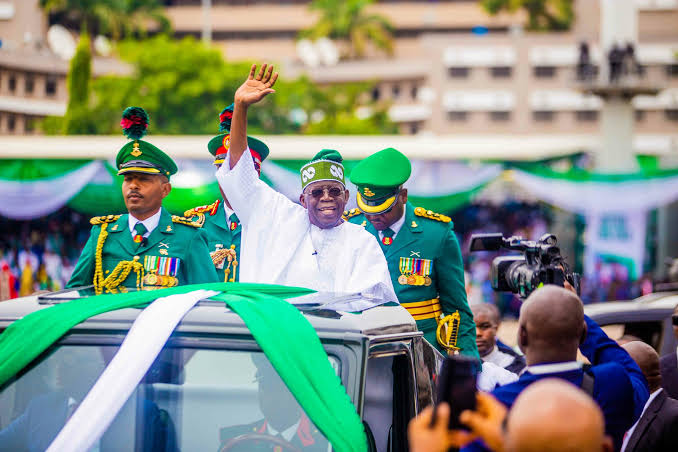

President Bola Tinubu has carried out a major shake-up of Nigeria’s military hierarchy, appointing new Service Chiefs in what officials describe as a move to strengthen national security and reinforce discipline within the Armed Forces.
The announcement, made on Friday through Sunday Dare, Special Adviser to the President on Media and Public Communication, follows weeks of mounting speculation about unrest within the military and persistent coup rumours that have stirred unease nationwide.
Under the reshuffle, General Olufemi Oluyede becomes the new Chief of Defence Staff (CDS), replacing General Christopher Musa.
Major-General W. Shaibu takes over as Chief of Army Staff, Air Vice Marshal S.K. Aneke assumes the position of Chief of Air Staff, and Rear Admiral I. Abbas becomes the Chief of Naval Staff.
The Chief of Defence Intelligence, Major-General E.A.P. Undiendeye, retains his position.
According to the statement, all appointments take immediate effect.
President Tinubu praised the outgoing Service Chiefs for their “patriotic service and steadfast leadership,” while urging the new appointees to “uphold professionalism, vigilance, and unity in defending Nigeria’s democracy.”
Although changes in military command are routine, the timing of this overhaul is significant.
It comes amid renewed “coup scare” reports that have dominated public discourse in recent months.
Rumours about possible unrest in the Armed Forces resurfaced earlier in February 2024, when reports alleged that the Guards Brigade, which protects the Presidency, had been placed on alert over a suspected coup plot.
The Defence Headquarters (DHQ) swiftly dismissed the claims as “baseless,” describing them as malicious attempts to sow panic.
More recently, in October 2025, unverified reports claimed that 16 senior officers were detained for allegedly plotting to overthrow the government.
The DHQ again refuted the story, explaining that the incident involved internal disciplinary matters unrelated to any coup attempt.
Security experts say the repeated coup rumours reveal deeper social and political tensions rather than genuine threats of military takeover.
“The real issue is not that soldiers are plotting, but that citizens are losing confidence in governance and institutions,” a retired military officer told The Guardian.
Nigeria’s economic struggles, widespread insecurity, and growing distrust of public institutions have created a fertile ground for speculation, analysts note.
Nigeria’s situation is further complicated by its proximity to West African nations recently hit by coups, including Mali, Niger, and Burkina Faso. While Nigeria’s military has repeatedly affirmed its loyalty to democratic rule, observers caution that the “coup contagion” in the region has added pressure on Abuja to maintain internal cohesion.
In a statement earlier this year, the DHQ reaffirmed its loyalty to the Constitution, saying:
“The Armed Forces of Nigeria remain committed to defending the country’s unity and democratic order.”
Officials blame social media for amplifying false claims and fuelling panic. Many coup reports begin as anonymous posts online before going viral.
Minister of Information Mohammed Idris warned in February that:
“Fake reports of coups are as dangerous as coups themselves. They spread fear, weaken trust, and distract from the real work of governance.”
Civil society groups, however, argue that government officials should address the frustrations fuelling such narratives instead of dismissing every report as fake news.
The African Democratic Congress (ADC) recently cautioned that “national security must not be used as a pretext to silence dissent.”
For President Tinubu, the reshuffle is not merely administrative but symbolic, a demonstration of authority, loyalty, and recalibration at a time of growing national uncertainty.
“The real coup Nigeria must guard against is one of public despair,” another retired officer said.
“When citizens lose faith in leadership, even rumours can shake the foundations of democracy.”