
Suspended Deputy Commissioner of Police Abba Kyari has told the Federal High Court in Abuja that he fully declared all personal and spousal assets in accordance with the law, insisting that some properties cited by the National Drug Law Enforcement Agency (NDLEA) belonged to his late father.
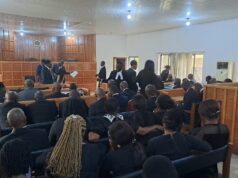
Kyari made the claim on Wednesday while testifying before Justice James Omotosho during the continuation of his trial on alleged non-disclosure and concealment of assets.
The NDLEA is prosecuting Kyari, along with Mohammed Kyari and Ali Kyari, on a 23-count charge bordering on failure to declare assets, money laundering, and unlawful conversion of funds.
According to the agency, the defendants allegedly disguised ownership of several multi-million-naira properties and converted proceeds contrary to the NDLEA Act and the Money Laundering (Prohibition) Act, 2011.
The prosecution had earlier called 10 witnesses and tendered about 20 exhibits to support its case before closing its evidence.
The defendants subsequently filed a no-case submission, which the court dismissed on October 28, ruling that a prima facie case had been established, and ordering them to open their defence.
Justice Omotosho clarified that the ruling did not amount to a conviction, stressing that the accused persons remain presumed innocent until proven guilty beyond reasonable doubt.
While being cross-examined by NDLEA counsel Sunday Joseph, Kyari said some of the assets listed by the prosecution were inherited family properties in Maiduguri, Borno State, which belonged to his deceased father.
“My late father owned over 20 houses, which he left to his 30 children. Some of those properties were later sold to fund his medical treatment before his death,” Kyari told the court.
“I couldn’t declare my father’s properties as personal assets because they belong to the entire family. Only when my share is allocated can I include it in my declaration.”
He added that the NDLEA failed to produce certified title documents to prove ownership, citing Section 128 of the Evidence Act, which he said requires certified true copies of state land documents for such proof.
Kyari also explained that the large sums found in his bank accounts were official operational funds received during his time as head of the Intelligence Response Team (IRT) and earlier as commander of the Special Anti-Robbery Squad (SARS).
He said the money came from the police and several state governments for approved operations.
According to him, some transfers made to his relatives were loan repayments.
“We often used our own funds to execute urgent operations because police funding was delayed by bureaucracy. So, when funds were later released, I reimbursed family members who had lent me money,” he stated.
Kyari admitted that he initially refused to fill the NDLEA asset declaration form until his lawyers were present.
“Yes, I said I would not make a statement without my lawyers. One of the officers later warned me it was an offence not to fill the form,” he added.
Justice Omotosho said the court would address the legal issue of whether family-owned property can be included in an individual’s asset declaration during final submissions.
Following the session, the NDLEA counsel requested time to obtain additional bank records for further cross-examination.
The court adjourned the matter until November 12, 2025, for continuation of trial.