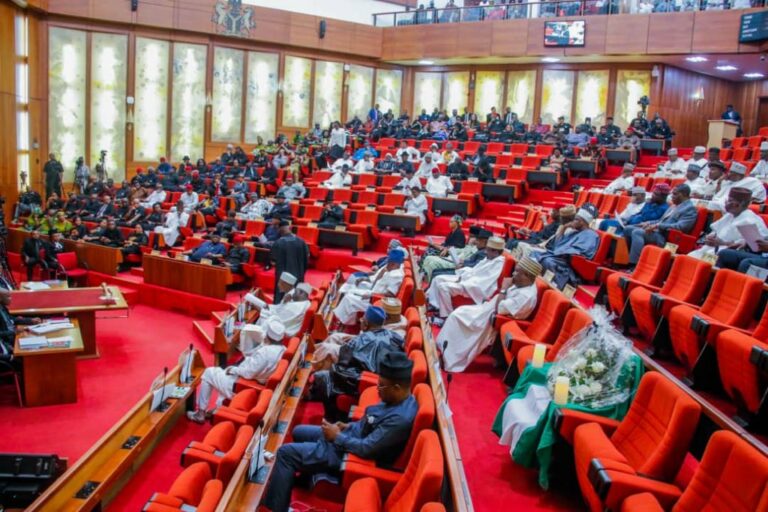

Nigeria may have lost more than $300 billion in crude oil revenue over the years to theft, leakages, and entrenched corruption, according to an interim report of the Senate Ad-Hoc Committee on Oil Theft in the Niger Delta.
The report, presented on Wednesday by Senator Ned Nwoko (Delta North), exposed massive irregularities in the nation’s oil and gas industry, including poor oversight, weak measurement systems, and unrecorded crude exports that have cost the country hundreds of billions of dollars.
“The findings so far expose systemic irregularities and inefficiencies that have robbed the country of enormous wealth,” Nwoko told lawmakers while submitting the 40-page report.
According to the committee, consultant data revealed revenue shortfalls of $81 billion between 2016 and 2017, and over $200 billion in unremitted or untracked oil proceeds since 2015.
Lawmakers described the revelations as “disturbing” and “eye-opening,” though debate ensued over the committee’s recommendation to “track, trace, and recover” stolen crude oil and its proceeds.
While commending the committee’s work, Senator Abdul Ningi (Bauchi Central) cautioned against the Senate exceeding its constitutional boundaries.
“We can track and trace, but recovery is beyond the powers of the Senate. That function belongs to the EFCC or ICPC,” he said.
Senator Solomon Adeola (Ogun West), Chairman of Appropriations, agreed, saying the legislature’s role should focus on oversight and documentation.
“The committee should provide names, figures, and locations, but recovery is an executive responsibility,” he maintained.
Similarly, Senator Ibrahim Dankwambo (Gombe North), former Accountant-General of the Federation, called for a comprehensive forensic audit, well-by-well and rig-by-rig, to uncover the full scale of complicity among oil firms, individuals, and operators of illegal refineries.
“This is not a simple theft problem; it is a complex network of collusion and concealment,” he said.
To stem the losses, the committee proposed several urgent measures, including:
- Full enforcement of international crude measurement standards by the Nigerian Upstream Petroleum Regulatory Commission (NUPRC);
- Deployment of unmanned aerial vehicles (UAVs) and advanced surveillance technologies to monitor pipelines and coastal facilities;
- Establishment of a Maritime Trust Fund to enhance maritime security;
- Creation of special courts for swift prosecution of oil theft cases; and
- Enforcement of the Host Communities Development Trust Fund under the Petroleum Industry Act (PIA).
It also urged that abandoned oil wells be reassigned to the NUPRC for proper utilisation to prevent further losses.
Presiding over the session, Senate President Godswill Akpabio praised Senator Nwoko and his committee for what he described as a “thorough and courageous investigation.”
However, Akpabio supported the call for legislative restraint, emphasizing that recovery of stolen assets lies with the executive.
“Our duty is to track and trace. Recovery lies with government agencies. Nonetheless, this $300 billion revelation is staggering and demands urgent reform,” Akpabio said.
The Senate subsequently adopted the interim report and directed the ad-hoc committee to continue its investigation and submit a comprehensive final report with actionable steps to end crude oil theft and close revenue leakages.