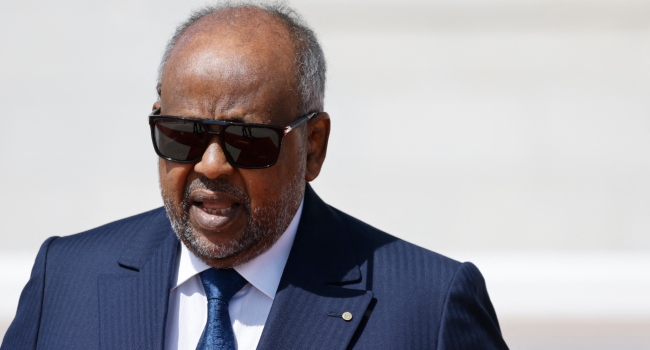

Djibouti’s long-serving president, Ismail Omar Guelleh, will contest for a sixth term in next year’s presidential election, political sources have confirmed to AFP.
The decision follows a constitutional amendment removing an age cap that previously barred him from running again.
Guelleh, 77, has ruled the small but strategically vital Horn of Africa nation since 1999, making him one of Africa’s longest-serving leaders.
His candidacy was confirmed by National Assembly President Dileita Mohamed Dileita after a congress of the ruling People’s Rally for Progress (RPP) party in Djibouti City.
“He has agreed to be a candidate in next year’s presidential election; everything went smoothly,” Dileita told AFP.
Another participant at the congress also confirmed the decision anonymously, though the presidency has yet to make an official announcement.
Guelleh’s re-election, analysts say, appears virtually certain.
He won the 2021 poll with 97 percent of the vote, while his coalition, the Union for the Presidential Majority, dominates parliament.
The move comes less than a week after Djibouti’s parliament abolished the 75-year age limit for presidential candidates, the latest in a series of constitutional changes that have extended Guelleh’s hold on power.
In 2010, lawmakers scrapped the two-term limit, effectively allowing him to remain president indefinitely.
Human rights groups, however, have repeatedly criticised Djibouti’s political climate.
The International Federation for Human Rights (FIDH) has described previous elections as “not free”, while Reporters Without Borders (RSF) ranks the country 168th out of 180 in its 2025 World Press Freedom Index, citing near-total state control of the media.
Djibouti, home to fewer than one million people, sits on the Bab el-Mandeb Strait, a crucial trade route linking the Red Sea to the Indian Ocean.
Despite its small size, it hosts military bases from the United States, France, China, Japan, and Italy, making it a key player in regional geopolitics.
Guelleh’s announcement is not entirely unexpected. In a May interview with The Africa Report, he hinted at his willingness to continue in office.
“All I can tell you is that I love my country too much to embark on an irresponsible adventure and be the cause of divisions,” he said when asked about his plans.
He also downplayed ongoing speculation about his health, joking that he “probably” needed to “lose a few pounds,” before adding, “Otherwise, everything is perfect.”
Guelleh succeeded Hassan Gouled Aptidon, the founding president and leader of Djibouti’s independence movement, after serving as his chief of staff for 22 years.
With the constitutional roadblocks now cleared, Guelleh joins a growing list of ageing African leaders, including Cameroon’s 92-year-old Paul Biya and Ivory Coast’s 83-year-old Alassane Ouattara, who have sought to extend their rule through legal and political maneuvering.