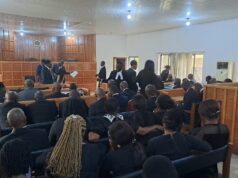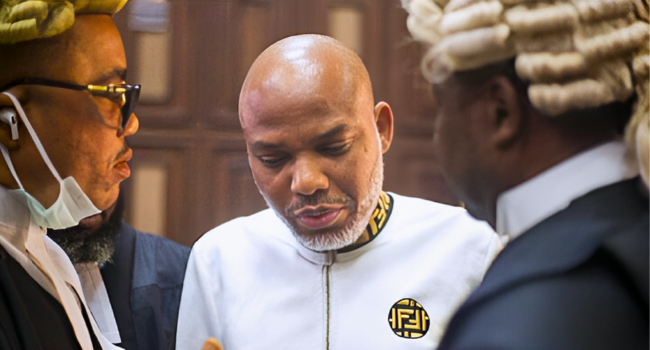

The Federal High Court in Abuja will today deliver a crucial ruling in the long-running legal battle between the Indigenous People of Biafra (IPOB) leader, Nnamdi Kanu, and the Federal Government.
Justice James Omotosho is expected to rule on multiple applications filed by both sides, including Kanu’s challenge to the validity of the terrorism charges against him and his request to be released on grounds of alleged unlawful detention and breach of fundamental rights.
Kanu has been held by the Department of State Services since June 2021 following his controversial return from Kenya, an episode his legal team insists amounted to “extraordinary rendition.”
He is currently facing seven terrorism-related counts, which include allegations of incitement, operating an unlawful organisation, and threatening national security. Kanu denies all accusations.
Justice Omotosho fixed today’s date on November 7 after Kanu failed to open his defence within the six days allocated to him.
Although the prosecution closed its case on June 19, 2025, having called five witnesses and tendered numerous exhibits, Kanu did not proceed with his defence, instead filing new motions contesting the legality of the proceedings.
He argues that the terrorism law under which he is being tried has been repealed, rendering the charges invalid.
Kanu also asked the court to strike out the plea of “not guilty” earlier recorded on his behalf, alleging it was entered under misleading circumstances and contrary to a Supreme Court decision.
He wants all subsequent court proceedings nullified.
However, Justice Omotosho ruled that Kanu was given ample opportunity to defend himself.
The judge noted that the matter, originally filed in 2015, had suffered many delays, mostly at the defendant’s request, before being transferred to his court for an accelerated hearing.
He emphasised that while the court cannot compel a defendant to present a defence, a refusal to do so amounts to waiving that right.
Having abandoned his defence, the court concluded that it would proceed to judgment.
Kanu’s legal odyssey has been marked by numerous adjournments and appeals.
In 2022, the Court of Appeal discharged him and ordered his release, declaring that his rendition from Kenya violated international law.
The Federal Government appealed, and the Supreme Court later reversed the ruling, sending the case back to the Federal High Court for trial.
The IPOB leader’s continued detention has remained deeply contentious, sparking regional, national, and international calls for his release.
Many groups in the South-East argue that freeing him would help ease rising security tensions, but the Federal Government insists he must face trial.
As anticipation builds, security agencies have increased surveillance and patrols across the South-East.
In Abia, Kanu’s home state, Police spokesperson ASP Maureen Chinaka said the Commissioner of Police, Danladi Isa, has deployed officers statewide to prevent any breakdown of law and order.
She stressed that the police, working with other security agencies, are prepared “24/7” to maintain peace regardless of the judgment’s outcome.
Despite the heightened vigilance, there was no noticeable security presence around Kanu’s hometown of Afaraukwu as of the time of reporting.
In Enugu, police spokesman Daniel Ndukwe declined to speculate, asking, “Have you seen the judgment that he is going to be convicted?”
At the national level, the Force Public Relations Officer, Benjamin Hundeyin, did not respond to inquiries.
In a related development, Kanu has submitted a criminal complaint to an Abuja Chief Magistrate’s Court accusing two DSS witnesses, known in court as TAA (PW1) and BBB (PW2), of giving false evidence during his trial.
In the complaint dated November 13, Kanu alleges that both witnesses committed perjury between May and July 2025 during proceedings concerning the admissibility of statements he made in 2015 and 2021.
He cites several laws, including sections of the Penal Code, the Administration of Criminal Justice Act, and constitutional provisions.
Kanu claims that TAA lied when he said he did not know Mr Brown Ekwoaba, a senior DSS investigator who Kanu says oversaw his detention and interviews in 2015.
He supports this with affidavits from his brother and another defendant, as well as public records showing Ekwoaba’s role at the time.
He also accuses BBB of contradicting himself, claiming in court that he had never met Kanu except during trial, despite having earlier testified that he conducted Kanu’s video interview at the DSS Headquarters in July 2021.
Kanu argues that the alleged falsehoods were used to conceal the true chain of custody behind his statements, which are central to the prosecution’s case.