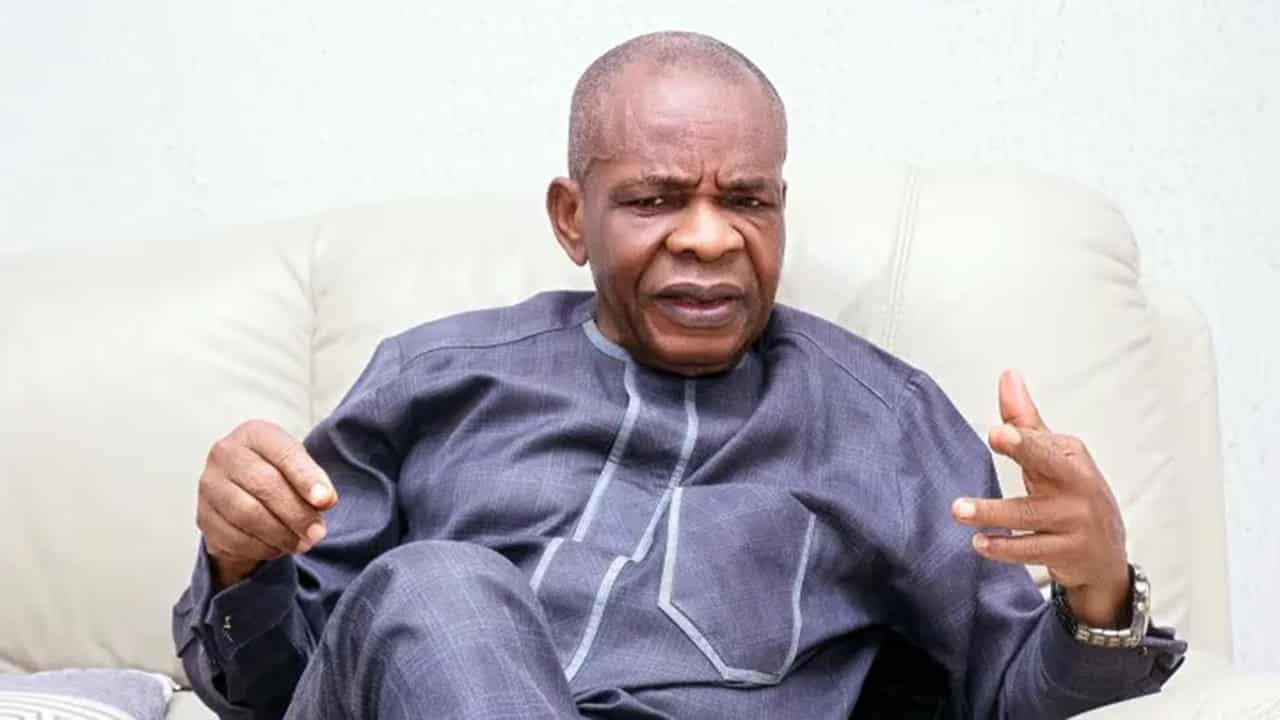

Former Minister of Lands, Housing and Urban Development, Chief Nduese Essien, has sounded a strong warning about Nigeria’s rapidly worsening insecurity, saying the country is “dangerously close to normalising terror.”
In a statement, Essien described the surge in killings, kidnappings, and terrorist attacks as a full-blown national emergency that requires urgent, firm leadership.
He urged President Bola Tinubu to take bold and immediate action to halt the decline.
Essien highlighted a series of violent incidents recorded in recent days:
– the abduction and killing of Brigadier General Musa Uba and three soldiers in Borno,
– the kidnapping of over 64 people in Tsafe, Zamfara,
– the abduction of 25 female students and school officials in Kebbi,
– the murder of a police officer in Yobe,
– attacks on Christian worshippers in Kwara,
– and the mass kidnapping of more than 300 Catholic school students in Niger State.
“These incidents are no longer isolated,” he stressed. “They have become daily realities in many parts of the country, showing a disturbing level of coordination and cruelty.”
According to the elder statesman, communities are increasingly shutting down, farmers are abandoning their farmlands, and places of worship are losing their sense of safety.
Essien accused the Federal Government of failing to respond with the urgency the crisis demands.
He recalled that President Tinubu was once one of the most vocal critics of security lapses under former President Jonathan, yet the insecurity Tinubu condemned has worsened under his administration.
The leadership Nigerians were promised during the campaigns, he said, “has simply not emerged.”
He also expressed concern about the quality of individuals appointed to critical security roles, arguing that the defence sector must be led by professionals, not political appointees.
Terrorist groups, he said, evolve too quickly to be confronted by leaders who lack deep expertise.
“Defence is not a political reward; it is the backbone of national survival,” he insisted.
Essien criticised suggestions that some figures within government may have ties to terrorist organisations or sympathise with them.
No country, he argued, can win the war on terror if parts of its security apparatus are compromised.
He called for an overhauled national security strategy centred on intelligence-driven operations, stronger community-based security networks, a better-equipped military, and stricter accountability.
Those who fund, protect, or assist terrorists, he said, must be exposed and prosecuted regardless of status.
Turning to the root causes of extremism, Essien lamented the growing number of underage, uneducated children wandering the streets—children who often become easy recruits for bandits and extremist groups.
He urged the government to invest in policies that offer hope, opportunity, and dignity to vulnerable populations.
On corruption, Essien, formerly Chair of the House Committee on Anti-Corruption, National Ethics, and Values, said graft remains a “cancer” weakening the nation’s security framework.
He blamed persistent financial leakages, diversion of public funds, and the government’s refusal to act on investigative findings for starving the security sector of the resources it badly needs.
“The politicisation of security is becoming more dangerous than the terrorists themselves,” he warned. If nothing changes, he added, Nigeria risks losing public trust, facing mass displacement, and descending further into ethnic and religious division.
“Propaganda and political manoeuvring must not overshadow the urgent need for decisive security reforms.”