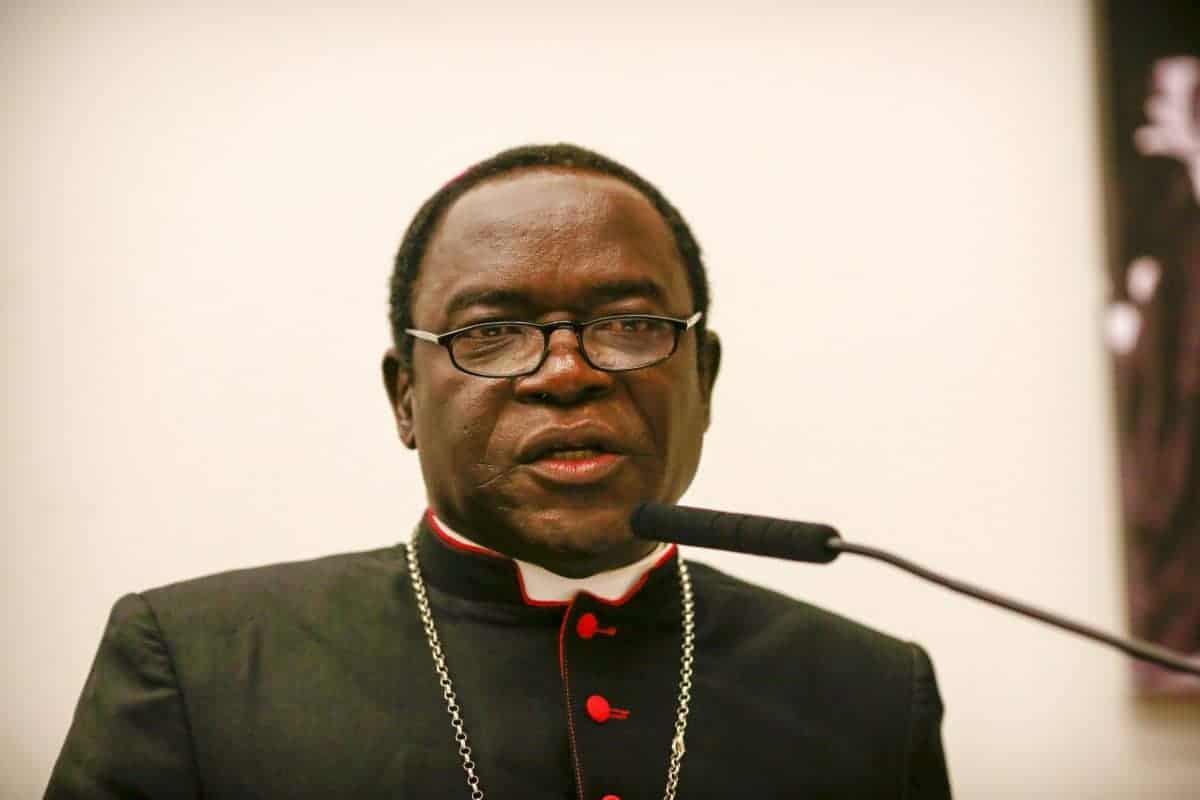

Most Rev. Matthew Kukah, Catholic Bishop of the Sokoto Diocese and Convener of the National Peace Committee, has again dismissed claims that Nigeria is witnessing a Christian genocide.
Speaking at the 46th Supreme Convention of the Knights of St. Mulumba in Kaduna, Kukah argued that the statistics often circulated about alleged mass killings of Christians are unverified and do not meet the internationally accepted definition of genocide.
He said his stance aligns with that of the Vatican Secretary of State, the President of the Catholic Bishops’ Conference of Nigeria, and all Catholic bishops across the country.
Kukah questioned the credibility of the figures being promoted in some reports.
“They claim 1,200 churches are burnt every year in Nigeria. In which Nigeria? No one has reached out to the Catholic Church to confirm such numbers,” he said.
“Those spreading these claims avoid consulting the Catholic Church because they know we do not deal in hearsay.”
He stressed that genocide is defined by intent, not by the number of deaths.
“Genocide is not about how many people are killed. You can kill 10 million people and it still won’t qualify as genocide if the intent is not to eliminate a specific group,” he said.
“So, numbers do not determine genocide, intention does.”
Kukah also pushed back against assertions that Christians are being systematically persecuted in Nigeria.
“If you say Christians in Nigeria are persecuted, how? At least 80% of educated Nigerians are Christians, and Christians control about 85% of the Nigerian economy. With such figures, is it accurate to claim persecution?” he asked.
According to the bishop, many of the concerns within Christian communities stem from internal divisions rather than an organised campaign against believers.
“The biggest problem is that Christians allow themselves to be intimidated. The day we stand together with the belief that an injury to one is an injury to all, things will change,” he said.
He also cautioned against loosely labeling victims of violence as martyrs.
“Being killed inside a church does not automatically make someone a martyr. If someone dies while stealing yam or is attacked by bandits, does that qualify as martyrdom? These are issues we must reflect on more deeply,” he said.
Responding to earlier reports suggesting he opposed designating Nigeria as a “country of particular concern,” Kukah said such labels could worsen tensions and create opportunities for criminal groups to exploit divisions.
He explained that his position is based on extensive research, noting that he recently presented a 1,270-page study on genocide in Nigeria and elsewhere at the Vatican.
“My argument remains that claims of genocide or martyrdom in Nigeria are not accurate,” he said.