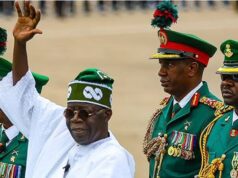

Former First Lady, Aisha Buhari, has warned President Bola Tinubu against repeating what she described as a major shortcoming of the Muhammadu Buhari administration: the failure to remove underperforming officials in good time.
Her views are contained in a new book, From Soldier to Statesman: The Legacy of Muhammadu Buhari, written by Dr Charles Omole and presented at the Presidential Villa, Abuja.
In the book, Aisha Buhari offers a candid assessment of her late husband’s leadership style, identifying emotional restraint and fear of public backlash as key factors that limited decisive action against non-performing appointees.
According to her, President Buhari often hesitated to dismiss officials who failed to deliver because of sympathy linked to age and declining capacity, as well as concern about being labelled authoritarian.
She recalls him saying that removing certain appointees would revive accusations of dictatorship, a fear she believes gradually enabled mediocrity within government.
Aisha Buhari argues that the popular notion of “the devil you know” became an excuse for retaining ineffective officials even when governance suffered.
She said her own standard was straightforward: if an official benefitted personally from office but delivered at least half of expected results, tolerance was possible; but where there was neither performance nor value, removal was necessary.
She noted that within the family, there was a shared understanding that Buhari’s reluctance to sack non-performers became a structural weakness of his administration.
This, she said, was compounded by close aides and relatives who used emotional appeals, flattery and delay tactics to shield loyalists from accountability.
The former First Lady also recounted a tense episode involving security agencies, who allegedly suggested she temporarily relocate from Abuja to allow investigations into some associates to proceed unhindered.
She said she rejected the proposal, after which Buhari became noticeably withdrawn.
Even after leaving office, she claimed Buhari privately appealed to President Tinubu not to probe certain relatives, citing personal dependence on them.
For Aisha Buhari, the episode illustrated the danger of emotional dependence at the highest level of power.
She also revisited Buhari’s widely criticised Berlin remark about her “belonging to the kitchen and the other room,” describing it as misplaced barracks humour that failed on the global stage.
She maintained that the issue was not the joke itself, but its delivery in a formal international setting alongside then German Chancellor Angela Merkel.
Aisha Buhari dismissed rumours of remarriage, saying she has no intention of marrying again.
Her current focus, she said, is philanthropy, particularly the cardiac and metabolic centre in Kano, which she noted has carried out over 200 procedures as part of efforts to reduce Nigeria’s dependence on medical tourism.
She framed her reflections as lessons for President Tinubu and future leaders, urging them to set firm boundaries early, separate family interests from state affairs, confront incompetence promptly and resist governing by fear of public opinion.
To underscore her point, she recalled an incident shortly after Buhari’s victory in 2015, when part of her security convoy was reassigned to a powerful relative.
She said she demanded an immediate reversal, which was carried out within minutes.
Aisha Buhari stressed that her comments were not driven by bitterness or blame but by a desire for Nigeria’s leadership to learn from past errors.
She warned that unchecked loyalty, emotional restraint and prolonged silence could weaken governance.
Her message to President Tinubu, she said, is simple: decisiveness is not dictatorship, and delay in confronting failure carries a national price.