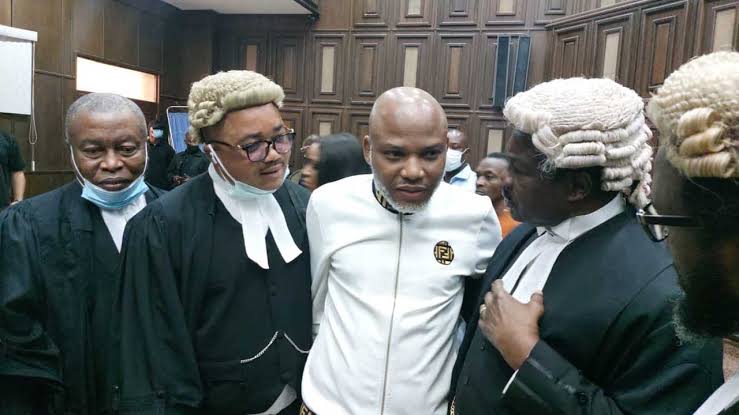

The Legal Aid Council has withdrawn from representing the leader of the Indigenous People of Biafra (IPOB), Nnamdi Kanu, accusing him of attempting to dictate how his case should be conducted.
The development occurred on Tuesday at the Federal High Court in Abuja, where Justice James Omotosho subsequently struck out an ex parte motion filed by Kanu seeking his transfer from the Sokoto Correctional Centre to a custodial facility closer to the Federal Capital Territory.
Counsel from the Legal Aid Council, Demdoo Asan, informed the court that irreconcilable differences had arisen between him and the defendant, making it impossible to continue legal representation.
Asan told the court that efforts to involve Kanu’s relatives in supporting the transfer application were unsuccessful, as none appeared to depose to the motion despite repeated communication and assurances.
He further alleged that Kanu sought to control the conduct of the case by dictating what counsel should say in court, a situation he said was unacceptable for an officer of the court.
According to him, after consultations with his superiors at the Legal Aid Council, a unanimous decision was taken to withdraw from the matter, stressing that a detained client could not direct legal proceedings.
Following the application, Justice Omotosho granted the request for withdrawal, commending the lawyer for upholding the dignity of the court.
On the transfer request, the judge held that the application was incompetent and struck it out, noting that there was no proof of service on the relevant parties since it was filed on December 8, 2025.
Kanu was convicted on November 20, 2025, on terrorism-related charges and sentenced to life imprisonment, a verdict his family has vowed to challenge on appeal.
After the conviction, he was moved from the Kuje Custodial Centre in Abuja to the Sokoto Correctional Centre on security grounds.
The IPOB leader had previously dismissed his legal team led by former Attorney General of the Federation, Kanu Agabi (SAN), opting at one point to defend himself in court, a decision that resulted in repeated confrontations with the trial judge.