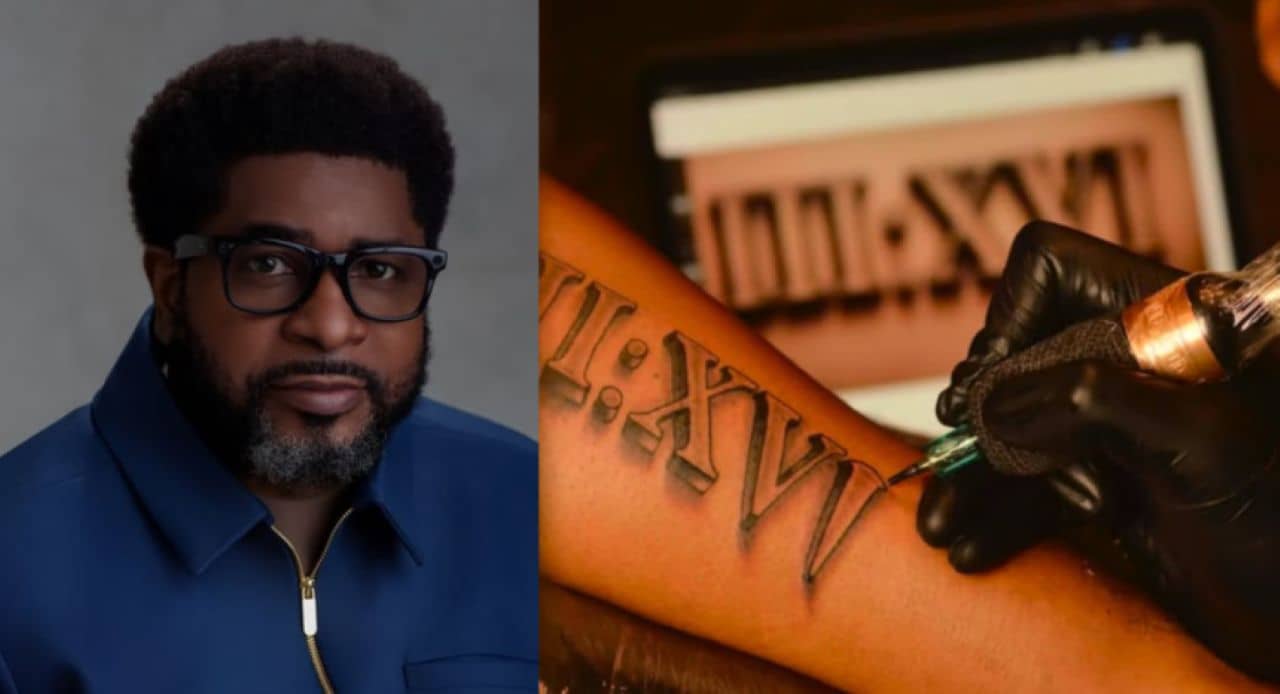

Founder of the David Christian Centre and relationship coach, Pastor Kingsley Okonkwo, has defended his decision to get a tattoo, insisting that there is no scriptural basis forbidding Christians from having tattoos.
The cleric recently sparked debate on social media after unveiling a tattoo on his arm bearing the Roman numeral “3:16,” a reference to John 3:16 of the Bible.
Critics faulted the action, citing Leviticus 19:28, which warns against marking the body.
Responding to the backlash, Okonkwo dismissed the criticisms as rooted in personal preferences and outdated religious traditions rather than clear biblical instruction.
He argued that nowhere in the New Testament is there an explicit prohibition against tattoos for Christians.
“There is no scripture that says a child of God cannot have a tattoo,” he said.
“People are projecting their personal convictions, church culture, or what they believe the Holy Spirit told them onto others. That is not how faith works.”
The pastor challenged his critics to provide either scriptural or scientific evidence showing that tattoos negatively affect a person’s character or spirituality.
“Someone must explain how ink on the skin suddenly makes a person immoral or ungodly. There must be proof, not assumptions,” he added.
Okonkwo also questioned the selective moral outrage surrounding tattoos, noting that practices once condemned in churches, such as wearing makeup, earrings, jeans, or human hair, are now widely accepted.
In a TikTok video addressing critics, he argued that eyebrow tattoos and microblading, commonly practised by many Christians, fall within the same category of body markings.
“People criticising tattoos are doing eyebrow tattoos and wearing human hair to church. If painting eyebrows is acceptable, then tattoos should not suddenly be treated as evil,” he said.
He further likened the stigma around tattoos to the church’s historical aversion to politics, arguing that shunning certain spaces only leaves them to those perceived as immoral.
Okonkwo acknowledged that tattoos are sometimes associated with negative stereotypes but maintained that character, not appearance, defines a person’s values.
According to him, many responsible and morally upright individuals have tattoos.