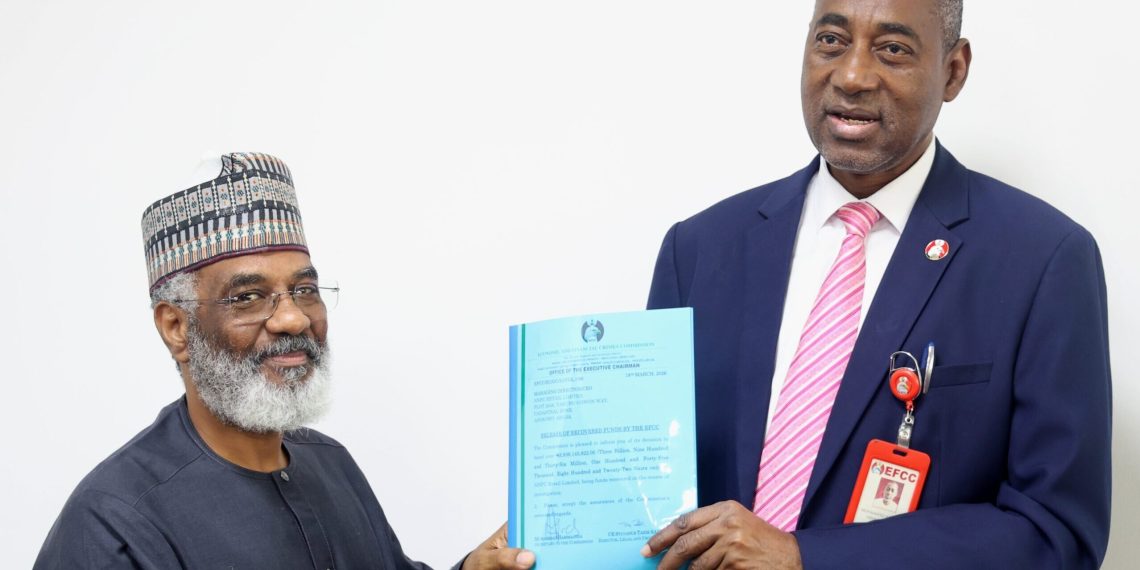

Nigeria’s anti-graft agency, the Economic and Financial Crimes Commission (EFCC), has returned over ₦3.9 billion in recovered funds to the Nigerian National Petroleum Company Limited, marking a significant step in ongoing efforts to tackle corruption in the oil sector.
The handover took place at the EFCC headquarters in Abuja, where the commission’s Secretary, Mohammed Hammajoda, presented the funds on behalf of Chairman Ola Olukoyede.
He said the recovery followed detailed investigations into financial irregularities involving officials within NNPC Ltd.
Hammajoda reaffirmed the commission’s commitment to accountability, noting that the EFCC would continue to pursue stolen public funds despite the risks involved.
Receiving the funds on behalf of NNPC Ltd, Executive Vice President (Downstream), Mumuni Dagazau, commended the EFCC for its diligence.
He described the recovery as a reflection of growing institutional collaboration and a push toward greater transparency within the national oil company.
While the EFCC did not disclose specific details about how the funds were stolen or who was responsible, the development comes amid a series of high-profile corruption investigations linked to NNPC operations.
Among those previously probed is former NNPC Managing Director Mele Kyari, who faced allegations ranging from abuse of office to money laundering.
He has consistently denied any wrongdoing.
The EFCC has also investigated other senior officials, including former Chief Financial Officer Umar Ajiya Isa, in connection with alleged multi-billion-dollar fraud tied to refinery rehabilitation projects.
However, no convictions have been publicly confirmed in relation to the recovered funds.
The latest recovery adds to a growing list of restitutions by the EFCC.
In recent months, the agency has returned hundreds of millions of naira to state governments, including Jigawa and Enugu, following separate investigations into misappropriated public funds.
Officials say these actions underscore the commission’s resolve to trace stolen assets, recover illicit proceeds, and return them to public institutions—while ongoing investigations and prosecutions continue.
Despite these efforts, concerns persist over transparency within NNPC, with critics pointing to years of opaque financial practices and limited public accountability in the sector.