
By Dr. Johnpaul Anih, Ph.D
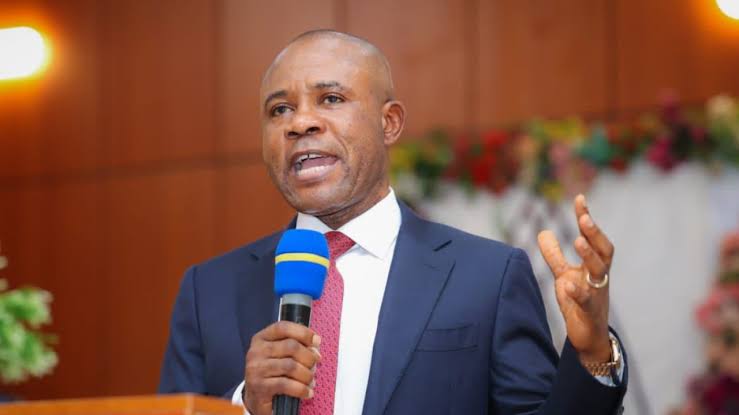
Politics they say, is a game of numbers, but leadership is a test of impact. And in Enugu today, the conversation is gradually shifting from empty promises to visible progress. At the centre of that shift stands Barr. Peter Mbah, a man whose style of governance has stirred both conversation and more importantly, results.
There is something about momentum, it is hard to start, but once it builds, it becomes dangerous to interrupt. That is exactly where Enugu finds itself today.
As any seasoned traveler knows, you don’t jump off a moving vehicle simply because you’re curious about another ride.
For Governor Mbah, no noise, no grandstanding, no long speeches. He chose laying foundations quietly but deliberately.
Take a walk, or better still, a drive across parts of Enugu metropolis today, you will notice something different. Roads that once tested the patience of even the calmest drivers are being reworked. Public infrastructure is gradually shedding the tired look of neglect. There is a sense, subtle but undeniable, that governance is no longer asleep at the wheel.
But beyond the physical changes lies something deeper, “a shift in attitude”.
Leadership at its core is about setting a tone. When the man at the top treats governance like serious business, the ripple effect travels down the ladder.
Civil service begins to wake up. Institutions start to respond. The entire system, slowly but surely, begins to realign.
Of course, no administration is without its critics and rightly so. Democracy thrives on scrutiny. But even the harshest critic would agree that what Enugu needs at this stage is not abrupt disruption, but consolidation.
Development is not a sprint, it is a relay. And it makes little sense to change runners just when the baton is being carried steadily.
There’s a familiar saying “you don’t abandon a well you’ve just started drawing clean water from.”
Enugu under Governor Mbah has begun to yield signs of that clean water, progress that may not yet be perfect, but is clearly promising.
The real question is whether the state has the patience to see the process through.
A second term is often where intentions mature into legacy. The first term lays the groundwork, the second builds the structure.
If Mbah’s current trajectory is anything to go by, then continuity may be the missing ingredient needed to turn incremental gains into lasting transformation.
It is also worth noting that leadership is not just about what is done, but how it is done. There is a growing sense that Mbah understands the urgency of time, that governance is not eternal and that every day wasted is a disservice to the people.
That awareness reflects in the pace and direction of his policies.
Enugu stands at a crossroads, as it often does in moments like this. One path leads to continuity, staying the course, refining the process and deepening the gains already made.
The other leads back to uncertainty, to starting over, to rewriting plans that have only just begun to take shape.
In moments like this, history tends to favour patience over impulse.
No one is suggesting perfection.
No leader achieves that. But governance is not about perfection, it is about progress.
And by that measure, there is a case, a strong one, that Peter Mbah has earned the opportunity to finish what he started.
Because at the end of the day, Ndi Enugu are not just choosing a leader, they are choosing a direction. And most times, the wisest decision is not to change course, but to stay on it.